Trenton Tomato Pie

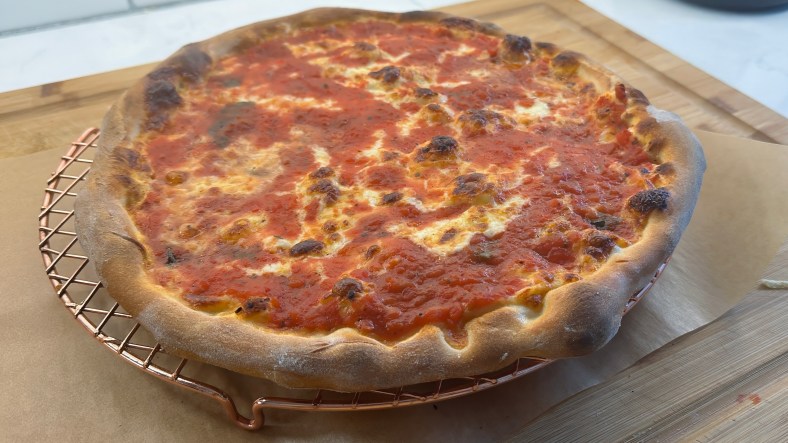
f you think all pizza is just a variation of the same thing, Trenton Tomato Pie is here to prove you wrong. This New Jersey-born specialty isn’t just a pizza—it’s a philosophy. A distant cousin of the classic New York slice and the coal-fired legends of New Haven, Trenton Tomato Pie flips the script on what most people expect from a pizza by doing one simple, yet game-changing thing: the sauce goes on top.

Trenton Tomato Pie traces its roots back to the early 1900s, when Italian immigrants, particularly those from Naples, were bringing their pizza-making skills to the U.S. While New York and New Haven developed their own famous styles, Trenton (now officially called Hamilton Township, though locals still cling to the old name) was busy crafting something uniquely its own. The earliest and most legendary name in the game is Joe’s Tomato Pie, opened in 1910, but it was De Lorenzo’s Tomato Pies, established in 1936, that cemented the style’s reputation. These family-run pizzerias helped define what Trenton-style pizza was all about: a crisp, thin, yet sturdy crust, a restrained amount of cheese, and the signature move—ladling the tomato sauce over the cheese before baking.

Now, let’s talk about what makes Trenton Tomato Pie different from your average slice. The dough is stretched thin but remains firm enough to hold up under the weight of its toppings without going soggy. Unlike the airier Sicilian-style or the charred chew of a Neapolitan pie, this crust has just the right amount of crunch without being cracker-like. It’s baked in a deck oven—usually gas-fired, though some places use coal—resulting in an evenly cooked base with a golden brown, slightly blistered edge.

The cheese, typically low-moisture mozzarella, is applied sparingly, creating a more balanced bite where no single ingredient overwhelms the others. Then comes the defining feature: the tomato sauce. Unlike many pizzas where the sauce is buried beneath a blanket of cheese, Trenton Tomato Pie does it in reverse. The sauce is spooned over the cheese in dollops or a swirling pattern, allowing it to shine as the dominant flavor. This isn’t a basic, thin tomato sauce either—it’s chunky, vibrant, and slightly sweet, often made from hand-crushed San Marzano or Jersey tomatoes, simmered down just enough to concentrate the natural sweetness without losing that fresh, tangy punch.

Toppings on a Trenton Tomato Pie are kept relatively simple. Pepperoni, sausage, mushrooms, and anchovies are all common, but purists argue that the best way to experience this style is with just the essentials—dough, cheese, and sauce. That way, you can fully appreciate the interplay of textures and flavors without any distractions. One standout variation, though, is clam tomato pie, a nod to New Haven-style apizza, which adds briny, garlicky clams to the mix for a coastal twist.

Despite being overshadowed by its big-city neighbors, Trenton Tomato Pie has a fiercely loyal following. Institutions like De Lorenzo’s and Papa’s Tomato Pies (which claims to be the oldest continuously operating pizzeria in the U.S.) keep the tradition alive, serving up these old-school pies to both nostalgic locals and pizza pilgrims who’ve come to see what all the fuss is about.

In a world where pizza is often loaded with excessive toppings, heavy cheese, and thick layers of sauce, Trenton Tomato Pie stands as a testament to restraint and balance. It’s a pizza for those who appreciate the art of simplicity—where each ingredient gets its moment to shine. If you ever find yourself in New Jersey, seeking out an authentic Trenton Tomato Pie should be at the top of your food bucket list. One bite, and you’ll understand why this under-the-radar classic deserves a spot in the pantheon of America’s greatest pizzas.


Nirvana – Nevermind

I was 18 when Nevermind came out, and if you weren’t there, you’ll never fully understand what it felt like. It was like a meteor hit music. One day, it was all hair metal, neon spandex, and drum machines, and the next, it was flannel, distortion, and an existential crisis you could actually dance to. Nirvana didn’t just release an album; they ripped a hole in the fabric of pop culture and let all the disaffected, pissed-off, and misunderstood kids climb through.

And let’s be clear: Nevermind wasn’t supposed to be this big. This was just three scrappy guys from Seattle making an album they thought might sell a few thousand copies, maybe let them quit their day jobs. But then “Smells Like Teen Spirit” happened, and suddenly, everything changed. That opening riff? It’s the sound of the entire ‘80s collapsing in on itself. The second it hit, you knew things weren’t going back to normal. Kurt Cobain’s voice was raw, desperate, and completely unhinged in a way that made you feel like he was singing your own confusion back at you. And that chorus—loud, quiet, louder—wasn’t just a musical trick, it was a tidal wave. It didn’t matter if you were a misfit skater kid or some suburban burnout, this was your anthem.

But Nevermind isn’t just “Smells Like Teen Spirit.” Every song is its own sucker punch. “In Bloom” mocks the very people who bought the album, which makes it even funnier that frat bros cranked it at keggers. “Come As You Are” is sludgy and hypnotic, a song that practically begs you to sink into the couch and let your brain melt. “Lithium” is a singalong for people teetering on the edge, and “Polly” is so stripped-down and haunting that you don’t even realize how horrifying the lyrics are until halfway through.

Then there’s “Drain You,” which might be Nirvana’s most underrated song, full of bizarre, cryptic lyrics about dependency that somehow feel more universal than anything else on the album. “Territorial Pissings” is pure chaos, an explosion of punk energy that makes you want to kick over a table, and by the time you hit “Something in the Way,” you feel like you’ve been through a full psychological breakdown.

And that’s the thing—Nevermind isn’t just music. It’s a mood, a whole generation’s nervous breakdown wrapped in fuzz pedals and Cobain’s gut-wrenching wails. It felt dangerous and vulnerable at the same time, like you weren’t just listening to songs, you were overhearing someone’s diary being set on fire. It turned grunge from a regional subculture into the defining sound of the decade and made rock feel dangerous again after years of corporate gloss.

The cultural impact? Unmatched. Before Nevermind, alternative music was exactly that—alternative. After Nevermind, it was mainstream. This album didn’t just kill hair metal; it burned it to the ground and salted the earth. Suddenly, everyone was wearing ripped jeans, every record label was scrambling to sign the next Nirvana, and every teenager with a cheap guitar was convinced they could start a band. And maybe they could—because Nevermind proved you didn’t need million-dollar production or virtuoso musicianship. You just needed something real, something that mattered.

And that’s why Nevermind is a top-five album of all time. Because it wasn’t just music—it was a revolution. It was the sound of an entire generation realizing they weren’t alone in their discontent. And for those of us who lived through it, it wasn’t just an album we listened to. It was an album that changed us.

Memento

Memento: A Mystery Told Backwards, Sideways, and Inside Out

Christopher Nolan’s Memento (2000) is the cinematic equivalent of trying to put together IKEA furniture with the instructions written in a foreign language—only to realize halfway through that you’ve been reading them upside down. This mind-bending thriller is a masterpiece in nonlinear storytelling, an intricate puzzle box where every new piece changes the picture you thought you were assembling. It’s a film that demands your full attention and, let’s be honest, at least a second viewing to fully grasp just how bamboozled you’ve been.

The Plot: A Mystery in Reverse (Literally)

Leonard Shelby (Guy Pearce) has a problem, and not just the kind that gets solved with a good night’s sleep. He suffers from anterograde amnesia, meaning he can’t form new memories. Every few minutes, his mind resets, leaving him in a constant state of confusion about where he is, what he’s doing, and who just handed him a cup of coffee. His mission? To hunt down the man who attacked him and murdered his wife. His biggest challenge? He won’t remember what he’s learned five minutes later.

To compensate, Leonard tattoos vital information all over his body, jots down cryptic Polaroid notes, and generally looks like a walking conspiracy theorist’s dream board. The film itself is structured in two distinct timelines: a color sequence that plays in reverse order, revealing events from end to beginning, and a black-and-white sequence that moves forward. These two timelines eventually converge in a moment that makes you question everything you thought you knew—about the film, about memory, and possibly about your own life choices.

The Characters: Trust No One (Not Even Yourself)

Leonard, our protagonist, is the world’s most unreliable narrator, but it’s not his fault—his brain is basically running on a reboot loop. Guy Pearce delivers a brilliantly tormented performance, making us sympathize with a man whose entire reality is stitched together by fleeting moments of clarity and sticky notes.

Then we have Teddy (Joe Pantoliano), a grinning, fast-talking mystery wrapped in a Hawaiian shirt. He claims to be Leonard’s friend, but this is Memento, so that probably means he’s a lying, manipulative scumbag. Natalie (Carrie-Anne Moss) is a bartender who may or may not be helping Leonard out of kindness—or possibly just using him as an amnesiac attack dog for her own agenda. Basically, everyone in this film is about as trustworthy as a used car salesman offering you a “once-in-a-lifetime deal.”

The Genius of Nolan’s Storytelling

Memento is the film that put Christopher Nolan on the map, and for good reason. The structure is more than just a gimmick—it immerses us into Leonard’s fractured reality. By experiencing events in reverse, we feel the same disorientation and paranoia that he does. It’s like playing a game where the rules change every five minutes and nobody tells you what they are.

The film forces you to piece together the story just as Leonard does, with each scene recontextualizing the ones before it. One moment you think you have a handle on things, and the next, Nolan pulls the rug out from under you and leaves you flailing in an existential crisis.

The Big Twist (Because Of Course There’s a Twist)

What’s a good psychological thriller without a jaw-dropping twist? In Memento, it’s not just one big revelation—it’s a series of gut punches that make you question everything Leonard believes. Without giving away too much (but also, if you haven’t seen it by now, what are you waiting for?), let’s just say that Leonard’s search for justice is more complicated than it seems, and the “truth” is as slippery as a wet bar of soap.

By the time the credits roll, you’re left with a sinking feeling that the whole cycle is doomed to repeat itself. It’s a film that doesn’t just end—it lingers in your mind, making you rethink the entire movie on the drive home and possibly making you question your own memory in the process.

Final Thoughts: A Film That Messes With Your Brain (In the Best Way Possible)

Memento isn’t just a film—it’s an experience. It’s the kind of movie that rewards close attention and multiple viewings, each one revealing new layers of deception, manipulation, and tragic irony. It’s also a film that makes you want to start keeping better notes, just in case you wake up one day and forget where you put your car keys.

Christopher Nolan took what could have been a simple revenge story and turned it into one of the most innovative thrillers of all time. It’s a film that doesn’t just entertain—it challenges, frustrates, and ultimately blows your mind.

So if you haven’t seen it yet, grab a notepad, turn off your phone, and prepare to have your brain thoroughly scrambled. Just don’t forget to write down that you watched it.

The Beatles – Abbey Road

here are great albums, and then there is Abbey Road, which doesn’t just sit at the top of the mountain—it built the mountain, paved the road up it, and then casually walked across a zebra crossing on its way out. Released in 1969 as the Beatles’ last recorded album (yes, Let It Be technically came later, but let’s all agree to pretend that never happened in this timeline), Abbey Road is the sound of four geniuses who barely tolerate each other making some of the best music of their lives. It’s both a swan song and a defiant middle finger to anyone who thought they’d lost their touch, and if it weren’t for Sgt. Pepper’s Lonely Hearts Club Band hogging all the nostalgic glory, this would be the definitive Beatles album. Scratch that—maybe it is.

From the opening bass line of “Come Together,” where Paul McCartney’s groove is so thick you could spread it on toast, to the farewell whisper of “The End,” Abbey Road is a masterclass in reinvention. “Come Together” itself is a bluesy, slinky number that sounds like it was born in a smoky bar in a dream. It makes no lyrical sense whatsoever, but it’s so cool you don’t care. Then there’s “Something,” where George Harrison decides he’s had enough of being the quiet one and writes the greatest love song in the Beatles’ catalog, making Sinatra gush about how it was the best love song ever written (which is hilarious, considering he also thought it was a Lennon/McCartney tune).

McCartney, never one to be outshined, serves up “Oh! Darling,” a song where he howls like he’s been time-traveling with Little Richard, and “Maxwell’s Silver Hammer,” a whimsical little murder ditty that sounds like a children’s song if that child were a sociopath. Then there’s “Octopus’s Garden,” which is probably the only time anyone has ever been grateful for Ringo singing lead. It’s charming, it’s goofy, and somehow, it works—mostly because George Martin’s production is so pristine it could make an actual octopus cry tears of joy.

But let’s be honest, Abbey Road is really about that Side B medley, where McCartney, Lennon, and George decide to stop writing full songs and instead create a sprawling, perfectly stitched-together rock opera in miniature. “You Never Give Me Your Money” starts as a gentle lament before it becomes a carnival of rock and roll, “She Came In Through the Bathroom Window” is a cryptic fever dream that sounds way cooler than its story actually is, and by the time we hit “Golden Slumbers,” McCartney is singing like a man who knows this is the end of something historic. And then there’s “The End” itself, where Ringo finally gets his drum solo (a tasteful one, no less), and the three guitarists engage in an unprecedented six-string duel, before the Beatles bow out with the immortal words: “And in the end, the love you take is equal to the love you make.” It’s almost unbearably poetic.

If Abbey Road were just a collection of songs, that would be one thing, but its cultural impact is immeasurable. That album cover alone—four men casually crossing the street—has been parodied, imitated, and worshiped to the point where tourists still risk getting flattened by London traffic just to recreate it. Sonically, it was groundbreaking, from its pioneering use of the Moog synthesizer to its meticulous production that set the gold standard for album recordings moving forward. Every major rock band in the ‘70s took notes from Abbey Road—Queen, Pink Floyd, even Zeppelin leaned into the idea that a rock album could be a fully realized piece of art rather than just a collection of singles.

So why is Abbey Road a top-five album of all time? Because it’s not just an album—it’s a myth. It’s the sound of the greatest band ever finding one last spark of unity before the inevitable implosion, of four men who changed the world choosing to go out not with a whimper, but with a masterpiece. It’s proof that music doesn’t just reflect culture—it creates it. And if we’re being honest, Abbey Road is so damn good, it almost makes you forget about Let It Be. Almost.

Worldwide Food Tour – England

A Culinary Symbol of Cornwall

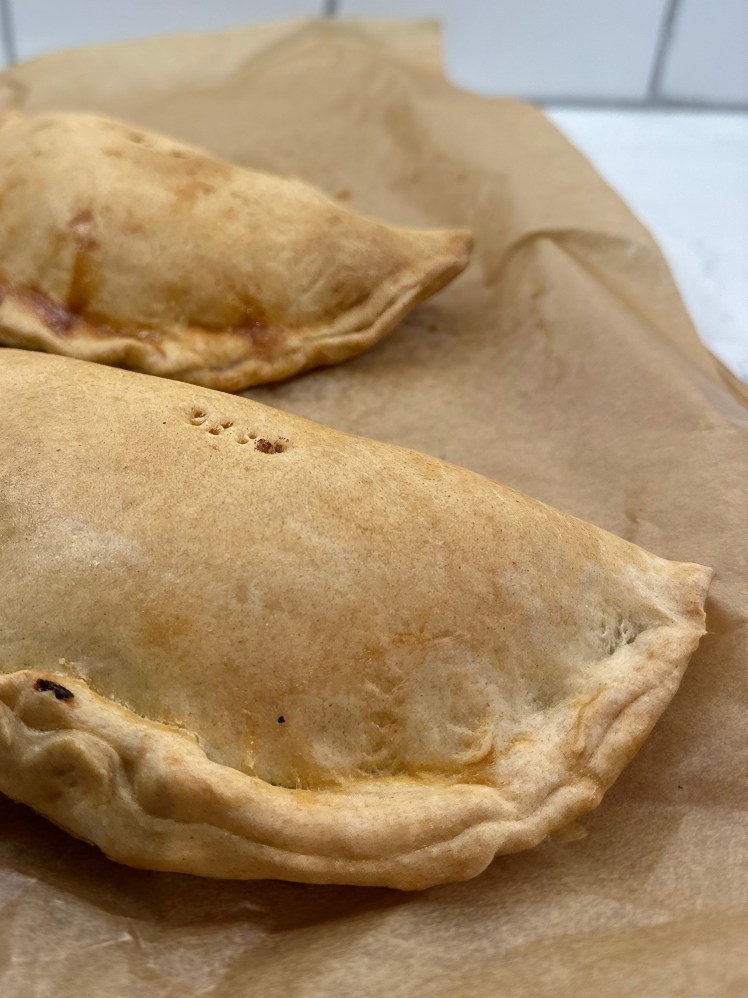
Few dishes are as intrinsically linked to a place as the Cornish pasty is to Cornwall, England. This golden, crescent-shaped pastry has been a staple of Cornish life for centuries, woven into the cultural fabric of the region as both a practical meal and a symbol of local identity. While pasties exist in various forms around the world, the Cornish pasty is protected by Protected Geographical Indication (PGI) status, ensuring that only pasties made in Cornwall using traditional methods can bear the official name.

From the tin mines of the 18th and 19th centuries to modern-day bakeries and family kitchens, the Cornish pasty remains a beloved, hearty dish that represents the resourcefulness and culinary heritage of England’s rugged southwest.


The History: A Miner’s Best Friend

The Cornish pasty’s origins can be traced back to the 13th century, when similar pastry-wrapped dishes were eaten in England. However, it was during the 18th and 19th centuries that the pasty became synonymous with Cornwall, particularly among tin miners. These men worked long hours underground in dark, dangerous conditions, and they needed a meal that was both portable and sustaining.

The pasty was the perfect solution. Its thick, crimped edge served as a built-in handle, allowing miners to hold and eat the pasty without touching their food with dirty, arsenic-laden hands. Some pasties even had a savory filling on one side and a sweet filling on the other, providing both a main course and dessert in a single package.

Over time, the pasty became deeply embedded in Cornish culture, with generations passing down family recipes. Today, it remains an essential part of local food traditions, often celebrated at events like the World Pasty Championships held annually in Cornwall.


What is a Cornish Pasty?

A traditional Cornish pasty consists of a shortcrust or rough puff pastry encasing a filling of beef, potato, onion, and swede (rutabaga), all seasoned simply with salt and pepper. Unlike other meat pies, the filling is uncooked before baking, allowing the ingredients to steam inside the pastry, creating a distinctively rich and succulent flavor.

Key characteristics of an authentic Cornish pasty:

  • Shape: Always D-shaped with a crimped edge along one side
  • Filling: Beef, potato, onion, and swede—never pre-cooked
  • Seasoning: Only salt and pepper; no additional herbs or gravy
  • Pastry: A sturdy yet flaky crust designed to hold its shape

Once assembled, the pasty is baked until golden brown, developing a crispy, slightly blistered crust that locks in the filling’s juices.


Tasting Notes: A Hearty, Comforting Bite

A warm Cornish pasty delivers an immediate sense of comfort. The crust is crisp and slightly crumbly, giving way to a tender, buttery texture that contrasts beautifully with the steaming filling inside.

The beef is juicy and rich, enhanced by the natural sweetness of swede and onion. The potatoes add a soft, starchy element that binds the flavors together. Seasoned with just salt and pepper, the pasty allows the natural savoriness of the ingredients to shine without overpowering the dish.

A well-made Cornish pasty is deeply satisfying, offering a perfect balance of textures and flavors in every bite. It’s substantial but not heavy, making it an ideal meal on the go or a nostalgic taste of Cornwall’s working-class history.


Beyond Cornwall: A Global Favorite

Though firmly rooted in Cornwall, the pasty has traveled far beyond England’s borders. In the 19th century, Cornish miners emigrated to places like Michigan (USA), Australia, and Mexico, taking their beloved pasty with them. Today, pasties remain a staple in Michigan’s Upper Peninsula, where they are often served with gravy or ketchup—a regional twist.

Despite these adaptations, the Cornish pasty remains one of England’s most iconic dishes, a timeless comfort food that continues to tell the story of Cornwall’s history, resilience, and culinary tradition.

New Haven Apizza

If you think you know pizza but haven’t tried New Haven apizza, prepare for a revelation. This Connecticut-born classic isn’t just a regional variation—it’s an institution. Locals (and pizza purists) will tell you it’s not just pizza; it’s apizza (pronounced ah-beetz, thanks to its Neapolitan dialect roots). And if you’re expecting something soft, foldable, and loaded with cheese, think again. New Haven-style apizza is a blistered, charred, chewy masterpiece that’s as much about texture as it is about flavor.

New Haven’s pizza legacy started with Italian immigrants in the early 20th century, particularly Frank Pepe, the man who put this style on the map. In 1925, Pepe opened Frank Pepe Pizzeria Napoletana, serving up coal-fired pies with his now-famous white clam pizza. Not long after, rival pizzerias like Sally’s Apizza and Modern Apizza emerged, each perfecting their own take on this iconic style. Unlike the more famous New York-style pizza, which leans on a balanced crust-to-topping ratio and a slight crispiness, New Haven apizza is all about the crust—thin, crisp on the bottom, airy inside, and charred to perfection in a coal-fired oven.

Let’s talk about that char. New Haven apizza is intentionally cooked at blistering hot temperatures (sometimes over 600°F), which gives it a signature blackened, crispy exterior. Don’t be alarmed by those dark spots—it’s not burnt; it’s perfectly charred, adding a smoky depth of flavor that’s completely unique. The dough itself is made with high-protein flour, fermented longer than usual to develop complex flavors, and stretched into an irregular, oblong shape—so don’t expect a perfectly round pie.

Then there’s the sauce-to-cheese ratio, which in New Haven is refreshingly sparse. A traditional “plain” apizza (tomato pie) features little more than a thin layer of tangy tomato sauce, oregano, garlic, and a drizzle of olive oil—no cheese unless you ask for it (mootz, short for mozzarella). That’s right, cheese is optional here. Order a plain pie without specifying “mootz,” and you’ll get a saucy, crispy, dairy-free experience that lets the ingredients shine in their purest form. If you do opt for mozzarella, it’s typically applied in moderation rather than covering the entire pizza.

Of course, we can’t talk about New Haven apizza without mentioning its most famous creation: the white clam pie. This local legend, first made at Frank Pepe’s, is an absolute must-try. Imagine a garlicky, olive oil-based pizza topped with freshly shucked littleneck clams, grated pecorino Romano, and a sprinkle of oregano—it’s briny, rich, and utterly addictive. No red sauce, no mozzarella, just pure seafood-meets-charred-dough magic. It might sound unusual, but one bite, and you’ll understand why people drive for hours just to get their hands on it.

Beyond clams, other classic New Haven toppings include hot cherry peppers, sausage, and fresh tomato (which is typically added post-bake for a bright, juicy contrast). But no matter what toppings you choose, the beauty of apizza lies in its balance—crispy, chewy crust, minimalist toppings, and that unmistakable coal-fired flavor.

Despite its deep roots in New Haven, apizza has started making waves beyond Connecticut. Devoted fans and former Yale students have helped spread the gospel of charred pies to other cities, with New Haven-style pizzerias popping up in places like New York, Boston, and even Los Angeles. But for the truest experience, nothing beats the original. Whether you’re biting into a classic tomato pie at Sally’s, indulging in a white clam pie at Pepe’s, or grabbing a crispy, cheesy slice at Modern, one thing is for sure—New Haven apizza is one of America’s greatest contributions to the pizza universe.

So, if you ever find yourself in the Elm City, do yourself a favor: order a large pie, embrace the char, and remember to call it apizza.

The Departed

The Departed: A Symphony of Swearing, Rats, and Deception

Few films manage to be both a masterclass in tension and a glorious showcase of creative profanity quite like Martin Scorsese’s The Departed (2006). This is the movie that finally netted Scorsese his long-overdue Oscar for Best Director, and boy, did he earn it. Packed to the brim with double-crosses, brutal executions, and enough Boston accents to make Ben Affleck cry tears of joy, The Departed is a pulse-pounding, white-knuckle thrill ride wrapped in a crime drama.

The Plot: Two Rats in a Maze (With Guns)

At its core, The Departed is a game of cat and mouse—except both the cat and the mouse are undercover, armed, and swearing so much that even Samuel L. Jackson might ask them to take it down a notch. Set in the crime-ridden underbelly of Boston, the film pits two men against each other: Billy Costigan (Leonardo DiCaprio), an undercover cop infiltrating the Irish mob, and Colin Sullivan (Matt Damon), a mole embedded within the Massachusetts State Police, feeding intel to the very criminals they’re trying to catch.

Both men are playing the long con, leading double lives so intensely stressful that you can practically hear their therapists drafting resignation letters. Their target (and, in Sullivan’s case, employer) is the delightfully unhinged mob boss Frank Costello, played by Jack Nicholson, who delivers one of the most gloriously unhinged performances of his career. Costello is a crude, ruthless, scenery-chewing villain who operates with a complete disregard for rules, human life, and good table manners.

As the film progresses, both Costigan and Sullivan are tasked with unmasking each other while simultaneously keeping their own covers intact. It’s like a chess game where all the pieces are armed and have serious anger management issues. The tension tightens like a noose as their respective worlds start to crumble, culminating in a series of shocking, rapid-fire deaths that leave audiences slack-jawed and questioning their faith in happy endings.

The Characters: Boston’s Most Stressed-Out Residents

Leonardo DiCaprio’s Billy Costigan is a man perpetually teetering on the edge of a full-blown breakdown. Posing as a thug to earn the trust of Costello’s crew, Billy is wracked with anxiety and desperation, which DiCaprio plays with a level of intensity that makes you want to hand him a stress ball and a warm cup of tea. His polar opposite is Matt Damon’s Colin Sullivan, the smug and self-assured golden boy whose ability to lie straight to everyone’s face would make him a great politician if he weren’t already a criminal.

And then there’s Mark Wahlberg as Sergeant Dignam, a walking, talking Boston stereotype who has exactly one mode: insult. Wahlberg steals every scene he’s in, hurling relentless barbs with the precision of a seasoned stand-up comedian. If sarcasm were an Olympic sport, Dignam would have more gold medals than Michael Phelps.

Jack Nicholson’s Costello, meanwhile, is a pure force of chaos. Whether he’s executing rivals, smearing blood on someone’s face, or casually tossing racial slurs like candy, he is absolutely unhinged in a way that only Nicholson can pull off. His over-the-top performance is perfectly counterbalanced by Martin Sheen’s weary, noble Captain Queenan, the one moral compass in a sea of corruption. And we can’t forget Vera Farmiga as Madolyn, the psychiatrist caught between the two men, whose romantic entanglements only add more fuel to this already blazing dumpster fire of deceit.

The Departed’s Greatest Strength: Relentless Tension (and Swearing)

What makes The Departed so damn good is its ability to maintain tension so tight it could snap at any moment. Scorsese expertly juggles multiple storylines, ensuring that every scene propels the plot forward, whether through heart-pounding action or razor-sharp dialogue. Every character is living on borrowed time, and the audience can feel it.

The cinematography captures Boston’s gritty underworld beautifully, and the soundtrack is pure gold, from The Rolling Stones’ “Gimme Shelter” (because it’s not a Scorsese film without it) to the ever-present, bagpipe-infused “I’m Shipping Up to Boston” by the Dropkick Murphys, which somehow makes even the simplest walking scene feel like an impending bar fight.

The Twist (Or: Everyone Dies, and Then Everyone Dies Again)

By the film’s third act, the tension reaches unbearable levels. After Queenan meets an unfortunate end via a multi-story drop, Costigan’s cover is hanging by a thread, and Sullivan’s secret is on the verge of exposure. What follows is one of the most jaw-dropping, kill-‘em-all sequences in recent cinematic history. In a matter of minutes, nearly every major character is executed in rapid succession. It’s brutal, it’s shocking, and it’s an audaciously bold move that leaves audiences gasping for air.

And just when you think the carnage is over, Wahlberg’s Dignam (having vanished for a suspiciously long stretch) waltzes back in for the final act of vengeance, executing Sullivan in his own apartment. It’s the cherry on top of this blood-soaked sundae, leaving the audience with a darkly satisfying sense of justice.

Final Thoughts: A Crime Epic for the Ages (and the Foul-Mouthed)

The Departed isn’t just a great crime film; it’s a masterclass in storytelling, tension, and, let’s be honest, creative swearing. It’s got all the hallmarks of a Scorsese classic—moral ambiguity, intense performances, stunning cinematography, and a whole lot of “f***s.”

It’s no wonder the Academy finally handed Scorsese that golden statue—he took a Hong Kong crime thriller (Infernal Affairs) and transformed it into an American classic that stands shoulder to shoulder with the greats. It’s a movie that doesn’t just keep you on the edge of your seat; it kicks the seat out from under you and leaves you lying on the floor, wondering what the hell just happened.

A masterpiece of deception, betrayal, and poetic justice, The Departed is the crime thriller that never lets up—and neither does its body count.

Goal Met: Make 50 Different Pizzas

This will be a cakewalk, I said to myself, I make pizza all the time how hard can it be to make 50 different pizzas? Let me tell you dear readers – it was very hard. The first few were easy as I busted out crowd favorites like Neapolitan, Pepperoni, and even a meat lovers. It was about 10 pizzas in when I started to wonder if just coming up with new toppings was a good way to accomplish this.

I did some research into topping combos and came up with a few that looked interesting but as part of my research I started seeing more regional pizzas pop up and it got me interested in how pizza can change as it travels across the world or even across the state. So I did a deep dive and became a pizzaologist. Tracking pizza as it went through all its different iterative changes.

These regional pizzas were still dough, sauce, and cheese but the way they went about it changed and I used my handy research assistant (ChatGPT) to do a deep dive into how Pizza was introduced to these regions and what the history of the style was (you can find these in the individual pizza posts) and it was some fascinating stuff.

Now there are some that argue for one style of pizza as being ‘real pizza’ and I get it. For me it’s a two way tie between a classic NY/NJ slice and true Neapolitan pizza. I get the appeal of Chicago deep dish and the buttery crust of a real good pan pizza and to be honest, I love them all. I’m not an elitist in that way (No, don’t take my NY Pizza card!) but I always come back to the classics when I’m in the mood for a good pizza that scratches that itch.

It was an educational journey and introduced a few new pies into my rotation (such as Apizza or pizza fritte) and there were a few that were just not great such as the steamed pizza. It’s like.. A bao bun with sauce and cheese. The texture was just not what I want from a pizza. The flavor was alright, but man I like steam buns and pizza but not this unholy fusion.

I’m glad I did this and I feel like I can talk about regional / international pizzas with a much more informed opinion having made and tried a lot of them.  The only drawback was I always felt like I needed to be making a new pizza even if I wanted a classic pie. Now that it’s over I expect classic margheritas are on tap for a few weeks to make things simple!

Worldwide Food Tour – England

A Dish Born from Frugality and Tradition

Few dishes in British cuisine are as cherished and steeped in tradition as Yorkshire pudding. Though humble in its ingredients, this golden, airy delight is an essential component of a traditional Sunday roast dinner in England. Originally devised as a way to make the most of a meager pantry, Yorkshire pudding has become a symbol of British culinary ingenuity, transforming simple batter into a crispy-yet-pillowy accompaniment.

Hailing from Yorkshire in northern England, this dish has been enjoyed for centuries, evolving from a frugal side dish to a nationally beloved comfort food. Whether served with roast beef and gravy, as part of a full meal, or even as a dessert with jam, Yorkshire pudding is a testament to the versatility of British cooking.


The History: A Clever Way to Stretch a Meal

Yorkshire pudding has its roots in the 18th century, when it was first recorded as “dripping pudding.” Before ovens had regulated temperatures, large joints of meat were roasted on spits over an open fire, with fat and juices dripping down into a pan placed below. Cooks in Yorkshire realized that if they poured a simple batter of flour, eggs, and milk into that pan, it would puff up and become a satisfying, crispy, and slightly chewy dish—perfect for filling up hungry diners before the costly meat was served.

The earliest known recipe appeared in Hannah Glasse’s 1747 cookbook, “The Art of Cookery Made Plain and Easy,” where it was officially named Yorkshire Pudding. Over time, the dish became a staple across England, particularly as a companion to roast beef in a traditional Sunday roast.

The importance of Yorkshire pudding in British culture is so profound that in 2008, the Royal Society of Chemistry even declared that a proper Yorkshire pudding must rise at least four inches to be considered authentic!


What is Yorkshire Pudding?

Despite its name, Yorkshire pudding is not a dessert like an American pudding but rather a savory baked dish made from a thin, pancake-like batter. It is light and airy on the inside while crispy and golden on the outside.

A classic Yorkshire pudding is made from four key ingredients:

  • Flour – Provides structure and crispness
  • Eggs – Help create a light, fluffy texture
  • Milk – Adds richness and forms a smooth batter
  • Beef Drippings or Oil – Essential for achieving a crisp, golden exterior

The secret to a successful Yorkshire pudding lies in extremely hot fat and a very hot oven. The batter is poured into preheated, smoking-hot muffin tins or a roasting pan with beef drippings, causing an instant sizzle that helps create the classic dramatic rise and hollow center.

It can be made in individual portions (muffin-sized) or as a large, pan-baked pudding that is sliced and served.


Tasting Notes: A Delicate Balance of Crisp and Airy

A well-made Yorkshire pudding delivers a satisfying contrast in textures:

  • The exterior is crisp and golden-brown, with a delicate crunch that shatters slightly as you bite in.
  • The interior is soft, eggy, and airy, almost like a popover or a soufflé, but with a bit more chew.
  • The flavor is rich and slightly savory, enhanced by the depth of the beef drippings if used. However, it remains neutral enough to soak up gravy, meat juices, or even sweet toppings like jam when served in different contexts.

Yorkshire pudding is best enjoyed fresh from the oven, when its textures are at their peak.


How Yorkshire Pudding is Served

1. The Classic: With Roast Beef and Gravy

The most traditional way to enjoy Yorkshire pudding is alongside roast beef, gravy, and vegetables in a Sunday roast dinner. The pudding is perfect for sopping up the rich, meaty juices, adding both texture and flavor to the meal.

2. As a Starter (Old Tradition)

Historically, Yorkshire pudding was served before the main meal, drizzled with gravy. This was a way to fill diners up cheaply before the more expensive meat was served.

3. Toad in the Hole

Another British classic, Toad in the Hole, takes the Yorkshire pudding batter and bakes sausages inside it, creating a heartier, more substantial dish.

4. As a Dessert

In some parts of England, Yorkshire pudding is even served as a sweet dish, topped with golden syrup, jam, or even cream—a testament to its versatility.


Beyond Yorkshire: A Dish Loved Around the World

While Yorkshire pudding is most famous in England, similar dishes exist in various forms across the world. The American popover is nearly identical, and the Dutch baby pancake shares many similarities but leans more toward the sweet side.

Today, Yorkshire pudding is a staple in British households and pub menus, and its reputation continues to spread globally. Whether paired with a roast, sausages, or even something sweet, Yorkshire pudding remains a timeless, comforting delight that embodies the heart and soul of English cuisine.

St. Louis Style Pizza

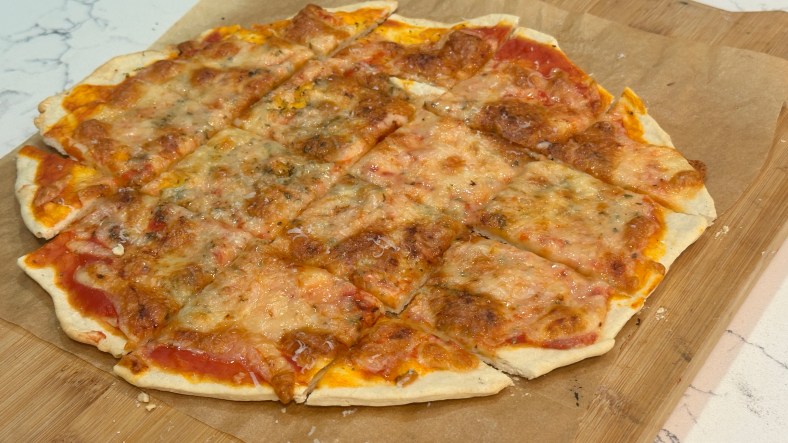
If you’ve never had St. Louis-style pizza, get ready for something totally unexpected. This Missouri-born creation defies every traditional pizza rule in the best way possible—starting with the fact that it’s cut into squares, not slices. That’s right, in St. Louis, pizza isn’t served in the familiar triangle shape but instead in a grid of bite-sized squares, thanks to what’s known as the “party cut” or “tavern cut.” But the unique slicing method is just the beginning of what sets this style apart.

First and foremost, the crust is unlike any other. Instead of a chewy, airy dough, St. Louis-style pizza has an ultra-thin, cracker-like crust that snaps rather than bends. There’s no yeast involved, which means the dough stays flat and crispy, giving each bite a satisfying crunch. This makes it one of the few pizzas that you definitely cannot fold—and honestly, you wouldn’t want to. The crisp texture is the backbone of the entire experience.

Then there’s the cheese—and this is where things get really St. Louis. Unlike most pizzas that use mozzarella, St. Louis-style pizza is topped with Provel cheese, a hyper-local blend of cheddar, Swiss, and provolone. Provel is an acquired taste—it’s ultra-melty, creamy, and has a slight smoky, buttery flavor. While some people love its gooey texture, others find it almost too processed. But for St. Louisans, Provel is non-negotiable. You’ll even find it in toasted ravioli, another local specialty. If you order a St. Louis-style pizza outside of Missouri, chances are they’ll swap in mozzarella, but if you want the real deal, it’s gotta be Provel.

As for the sauce, St. Louis keeps things sweet and tangy. Unlike the bright, acidic sauces of Neapolitan or New York-style pizza, St. Louis pizza sauce often has a touch of sugar, creating a slight sweetness that balances the saltiness of the Provel cheese. It’s usually spread in a thin layer, so the sauce never overwhelms the crispy crust.

And finally, we have the toppings. Since the crust is thin and crispy, St. Louis-style pizza can handle a lot of toppings without getting soggy. Popular choices include Italian sausage, pepperoni, mushrooms, onions, and green peppers, though some places get more creative. One classic St. Louis topping combo is bacon and onion, a salty-sweet mix that plays well with the Provel.

While the “who invented St. Louis pizza?” debate continues, one name always comes up: Imo’s Pizza. Founded in 1964 by Ed and Margie Imo, this family-owned business turned the local style into a full-blown institution. Today, Imo’s is to St. Louis what Domino’s is to the rest of America—a citywide staple with dozens of locations serving up thin, crispy, Provel-smothered pies.

Outside of Missouri, St. Louis-style pizza remains a bit of a cult favorite. Some people can’t get enough of the crispy crust and melty Provel, while others struggle to embrace its unconventional approach. But love it or hate it, St. Louis-style pizza is one of the most distinct and proudly regional pizzas in the U.S. It’s not trying to be New York, Neapolitan, or Chicago deep-dish—it’s doing its own thing, unapologetically.

So, if you ever find yourself in St. Louis, forget the debate over whether Provel is real cheese, embrace the party cut, and dive into a crispy, cheesy, square-shaped bite of Missouri’s finest. Just don’t ask for a slice.