Memento

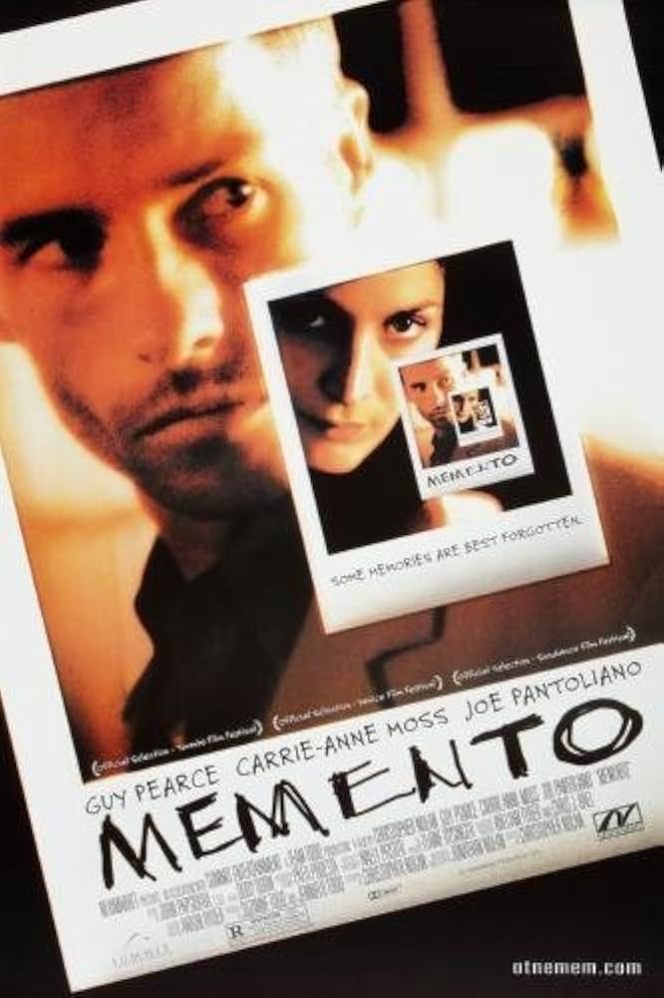
Memento: A Mystery Told Backwards, Sideways, and Inside Out

Christopher Nolan’s Memento (2000) is the cinematic equivalent of trying to put together IKEA furniture with the instructions written in a foreign language—only to realize halfway through that you’ve been reading them upside down. This mind-bending thriller is a masterpiece in nonlinear storytelling, an intricate puzzle box where every new piece changes the picture you thought you were assembling. It’s a film that demands your full attention and, let’s be honest, at least a second viewing to fully grasp just how bamboozled you’ve been.

The Plot: A Mystery in Reverse (Literally)

Leonard Shelby (Guy Pearce) has a problem, and not just the kind that gets solved with a good night’s sleep. He suffers from anterograde amnesia, meaning he can’t form new memories. Every few minutes, his mind resets, leaving him in a constant state of confusion about where he is, what he’s doing, and who just handed him a cup of coffee. His mission? To hunt down the man who attacked him and murdered his wife. His biggest challenge? He won’t remember what he’s learned five minutes later.

To compensate, Leonard tattoos vital information all over his body, jots down cryptic Polaroid notes, and generally looks like a walking conspiracy theorist’s dream board. The film itself is structured in two distinct timelines: a color sequence that plays in reverse order, revealing events from end to beginning, and a black-and-white sequence that moves forward. These two timelines eventually converge in a moment that makes you question everything you thought you knew—about the film, about memory, and possibly about your own life choices.

The Characters: Trust No One (Not Even Yourself)

Leonard, our protagonist, is the world’s most unreliable narrator, but it’s not his fault—his brain is basically running on a reboot loop. Guy Pearce delivers a brilliantly tormented performance, making us sympathize with a man whose entire reality is stitched together by fleeting moments of clarity and sticky notes.

Then we have Teddy (Joe Pantoliano), a grinning, fast-talking mystery wrapped in a Hawaiian shirt. He claims to be Leonard’s friend, but this is Memento, so that probably means he’s a lying, manipulative scumbag. Natalie (Carrie-Anne Moss) is a bartender who may or may not be helping Leonard out of kindness—or possibly just using him as an amnesiac attack dog for her own agenda. Basically, everyone in this film is about as trustworthy as a used car salesman offering you a “once-in-a-lifetime deal.”

The Genius of Nolan’s Storytelling

Memento is the film that put Christopher Nolan on the map, and for good reason. The structure is more than just a gimmick—it immerses us into Leonard’s fractured reality. By experiencing events in reverse, we feel the same disorientation and paranoia that he does. It’s like playing a game where the rules change every five minutes and nobody tells you what they are.

The film forces you to piece together the story just as Leonard does, with each scene recontextualizing the ones before it. One moment you think you have a handle on things, and the next, Nolan pulls the rug out from under you and leaves you flailing in an existential crisis.

The Big Twist (Because Of Course There’s a Twist)

What’s a good psychological thriller without a jaw-dropping twist? In Memento, it’s not just one big revelation—it’s a series of gut punches that make you question everything Leonard believes. Without giving away too much (but also, if you haven’t seen it by now, what are you waiting for?), let’s just say that Leonard’s search for justice is more complicated than it seems, and the “truth” is as slippery as a wet bar of soap.

By the time the credits roll, you’re left with a sinking feeling that the whole cycle is doomed to repeat itself. It’s a film that doesn’t just end—it lingers in your mind, making you rethink the entire movie on the drive home and possibly making you question your own memory in the process.

Final Thoughts: A Film That Messes With Your Brain (In the Best Way Possible)

Memento isn’t just a film—it’s an experience. It’s the kind of movie that rewards close attention and multiple viewings, each one revealing new layers of deception, manipulation, and tragic irony. It’s also a film that makes you want to start keeping better notes, just in case you wake up one day and forget where you put your car keys.

Christopher Nolan took what could have been a simple revenge story and turned it into one of the most innovative thrillers of all time. It’s a film that doesn’t just entertain—it challenges, frustrates, and ultimately blows your mind.

So if you haven’t seen it yet, grab a notepad, turn off your phone, and prepare to have your brain thoroughly scrambled. Just don’t forget to write down that you watched it.

The Departed

The Departed: A Symphony of Swearing, Rats, and Deception

Few films manage to be both a masterclass in tension and a glorious showcase of creative profanity quite like Martin Scorsese’s The Departed (2006). This is the movie that finally netted Scorsese his long-overdue Oscar for Best Director, and boy, did he earn it. Packed to the brim with double-crosses, brutal executions, and enough Boston accents to make Ben Affleck cry tears of joy, The Departed is a pulse-pounding, white-knuckle thrill ride wrapped in a crime drama.

The Plot: Two Rats in a Maze (With Guns)

At its core, The Departed is a game of cat and mouse—except both the cat and the mouse are undercover, armed, and swearing so much that even Samuel L. Jackson might ask them to take it down a notch. Set in the crime-ridden underbelly of Boston, the film pits two men against each other: Billy Costigan (Leonardo DiCaprio), an undercover cop infiltrating the Irish mob, and Colin Sullivan (Matt Damon), a mole embedded within the Massachusetts State Police, feeding intel to the very criminals they’re trying to catch.

Both men are playing the long con, leading double lives so intensely stressful that you can practically hear their therapists drafting resignation letters. Their target (and, in Sullivan’s case, employer) is the delightfully unhinged mob boss Frank Costello, played by Jack Nicholson, who delivers one of the most gloriously unhinged performances of his career. Costello is a crude, ruthless, scenery-chewing villain who operates with a complete disregard for rules, human life, and good table manners.

As the film progresses, both Costigan and Sullivan are tasked with unmasking each other while simultaneously keeping their own covers intact. It’s like a chess game where all the pieces are armed and have serious anger management issues. The tension tightens like a noose as their respective worlds start to crumble, culminating in a series of shocking, rapid-fire deaths that leave audiences slack-jawed and questioning their faith in happy endings.

The Characters: Boston’s Most Stressed-Out Residents

Leonardo DiCaprio’s Billy Costigan is a man perpetually teetering on the edge of a full-blown breakdown. Posing as a thug to earn the trust of Costello’s crew, Billy is wracked with anxiety and desperation, which DiCaprio plays with a level of intensity that makes you want to hand him a stress ball and a warm cup of tea. His polar opposite is Matt Damon’s Colin Sullivan, the smug and self-assured golden boy whose ability to lie straight to everyone’s face would make him a great politician if he weren’t already a criminal.

And then there’s Mark Wahlberg as Sergeant Dignam, a walking, talking Boston stereotype who has exactly one mode: insult. Wahlberg steals every scene he’s in, hurling relentless barbs with the precision of a seasoned stand-up comedian. If sarcasm were an Olympic sport, Dignam would have more gold medals than Michael Phelps.

Jack Nicholson’s Costello, meanwhile, is a pure force of chaos. Whether he’s executing rivals, smearing blood on someone’s face, or casually tossing racial slurs like candy, he is absolutely unhinged in a way that only Nicholson can pull off. His over-the-top performance is perfectly counterbalanced by Martin Sheen’s weary, noble Captain Queenan, the one moral compass in a sea of corruption. And we can’t forget Vera Farmiga as Madolyn, the psychiatrist caught between the two men, whose romantic entanglements only add more fuel to this already blazing dumpster fire of deceit.

The Departed’s Greatest Strength: Relentless Tension (and Swearing)

What makes The Departed so damn good is its ability to maintain tension so tight it could snap at any moment. Scorsese expertly juggles multiple storylines, ensuring that every scene propels the plot forward, whether through heart-pounding action or razor-sharp dialogue. Every character is living on borrowed time, and the audience can feel it.

The cinematography captures Boston’s gritty underworld beautifully, and the soundtrack is pure gold, from The Rolling Stones’ “Gimme Shelter” (because it’s not a Scorsese film without it) to the ever-present, bagpipe-infused “I’m Shipping Up to Boston” by the Dropkick Murphys, which somehow makes even the simplest walking scene feel like an impending bar fight.

The Twist (Or: Everyone Dies, and Then Everyone Dies Again)

By the film’s third act, the tension reaches unbearable levels. After Queenan meets an unfortunate end via a multi-story drop, Costigan’s cover is hanging by a thread, and Sullivan’s secret is on the verge of exposure. What follows is one of the most jaw-dropping, kill-‘em-all sequences in recent cinematic history. In a matter of minutes, nearly every major character is executed in rapid succession. It’s brutal, it’s shocking, and it’s an audaciously bold move that leaves audiences gasping for air.

And just when you think the carnage is over, Wahlberg’s Dignam (having vanished for a suspiciously long stretch) waltzes back in for the final act of vengeance, executing Sullivan in his own apartment. It’s the cherry on top of this blood-soaked sundae, leaving the audience with a darkly satisfying sense of justice.

Final Thoughts: A Crime Epic for the Ages (and the Foul-Mouthed)

The Departed isn’t just a great crime film; it’s a masterclass in storytelling, tension, and, let’s be honest, creative swearing. It’s got all the hallmarks of a Scorsese classic—moral ambiguity, intense performances, stunning cinematography, and a whole lot of “f***s.”

It’s no wonder the Academy finally handed Scorsese that golden statue—he took a Hong Kong crime thriller (Infernal Affairs) and transformed it into an American classic that stands shoulder to shoulder with the greats. It’s a movie that doesn’t just keep you on the edge of your seat; it kicks the seat out from under you and leaves you lying on the floor, wondering what the hell just happened.

A masterpiece of deception, betrayal, and poetic justice, The Departed is the crime thriller that never lets up—and neither does its body count.

Heat

Imagine if somebody made a crime thriller that’s actually two movies in perfect balance: a cop movie and a heist movie doing an intricate dance around each other until they collide in an explosion of gunfire and existential crisis. That’s Michael Mann’s “Heat,” a film that treats both sides of the law with such careful attention that you’ll find yourself rooting for everyone and no one at the same time.

Al Pacino plays Lt. Vincent Hanna, a detective who’s married to his job (and also his third wife, but the job is definitely his true love). Robert De Niro is Neil McCauley, a professional thief who lives by the motto “Don’t let yourself get attached to anything you are not willing to walk out on in 30 seconds flat if you feel the heat around the corner.” Spoiler alert: both of these life choices are going to prove problematic.

The film opens with a precision-engineered armored car heist that establishes McCauley’s crew as the Ocean’s Eleven of armed robbery, if Ocean’s Eleven were directed by a perfectionist with a fetish for metallic blue color grading. This brings them to the attention of Hanna’s department, setting up a cat-and-mouse game between two men who might actually be the same cat, just wearing different uniforms.

At its heart, “Heat” is a movie about work-life balance, if your work happens to involve either robbing banks or stopping bank robbers. Both leads are essentially workaholics who happen to be on opposite sides of the law. Their infamous coffee shop scene (the first time Pacino and De Niro ever shared the screen together) plays like the world’s most intense job interview, if job interviews involved discussing your philosophy on murder.

What Makes It Sizzle:

  • The downtown L.A. shootout that redefined what a movie gunfight could sound like (so realistic that the military uses it for training)
  • Michael Mann’s signature style turning Los Angeles into a chrome and steel urban jungle
  • A supporting cast so deep it makes other movies’ supporting casts look like amateur hour
  • Character development that gives everyone, even minor players, clear motivations and stakes
  • The most intense coffee shop conversation in cinema history
  • Dante Spinotti’s cinematography making Los Angeles look like a noir painting come to life

What Makes It Simmer:

  • At nearly three hours, it demands a serious time commitment
  • Some viewers might find the pacing deliberately methodical
  • The domestic drama subplots occasionally feel less engaging than the main story
  • If you’re expecting non-stop action, you might be surprised by how much time is spent on character development

The Verdict:
“Heat” is what happens when you take a crime thriller and treat it with the gravity of a Shakespeare play. It’s a meditation on duality, professionalism, and the cost of dedication wrapped in the clothes of a cops-and-robbers movie. Mann crafts a Los Angeles that feels both real and mythic, where every street corner could be the setting for either a philosophical discussion or a firefight.

The film’s greatest achievement is making you understand and empathize with both sides while never letting you forget that this can only end one way. It’s like watching two grandmasters play chess, if chess pieces were armed with automatic weapons and had complicated home lives.

Rating: 5 out of 5 precision-timed heists

Hard Boiled

If you’ve ever watched an action movie and thought “This needs more… everything,” then John Woo’s “Hard Boiled” is your cinematic all-you-can-eat buffet. This is what happens when you take Hong Kong action cinema, crank it up to 11, break off the dial, and keep cranking anyway.

Chow Yun-fat stars as Tequila (yes, that’s his name, and it’s probably the most normal thing about this movie), a clarinet-playing supercop who apparently attended the “Shoot First, Shoot Again, Maybe Ask Questions While Shooting” School of Law Enforcement. When his partner gets killed in a spectacularly violent teahouse shootout (because in this world, even teahouses aren’t safe), Tequila embarks on a revenge mission that makes Rambo look like a pacifist.

Enter Tony Leung as Alan, an undercover cop so deep in the criminal underworld he probably has to remind himself which side he’s on every morning. Together, they form the kind of buddy-cop duo that doesn’t so much bend the rules as shoot them full of holes while diving sideways in slow motion.

The plot? Well, there’s gun smuggling, triads, and corrupt cops, but let’s be honest – the plot is basically “How many amazing action sequences can we string together before the audience passes out from excitement?” The answer, it turns out, is “a lot.” The finale alone, set in a hospital (because nothing says “careful consideration for public safety” like a extended gunfight in a hospital), is a 40-minute symphony of choreographed chaos that makes you wonder if the film’s budget was just “all the bullets in Hong Kong.”

What Makes It Shoot Straight:

  • Action sequences that redefine what’s possible in action cinema
  • Chow Yun-fat’s ability to make dual-wielding pistols while sliding down stairs look like the most natural thing in the world
  • Tony Leung bringing actual dramatic depth to his role between the explosions
  • John Woo’s masterful direction that turns violence into ballet
  • The hospital sequence that somehow keeps topping itself for a full 40 minutes
  • More slow motion doves than a bird sanctuary having an existential crisis

What Makes It Misfire:

  • The plot can be harder to follow than a bullet trajectory in a mirror maze
  • Some of the dubbing in international versions is… let’s say “enthusiastic”
  • If you’re looking for subtle character development, you might have to look between the explosions
  • The physics are more “poetic” than “actual”

The Verdict:
“Hard Boiled” is what happens when you let action cinema off its leash and feed it nothing but adrenaline and gun powder. It’s excessive, melodramatic, and absolutely glorious. This is a movie where people don’t just dive through windows – they dive through windows while shooting two guns at two different targets while a dove flies past in slow motion… and that’s one of the more restrained scenes.

Is it over the top? Of course it is. The top is a distant memory to this film. “Hard Boiled” looked at the top, scoffed, and then shot it while jumping through the air in slow motion. But that’s exactly why it works. This isn’t just action cinema – it’s action cinema pushed to its logical (and sometimes illogical) extreme.

Rating: 5 out of 5 strategically placed doves

P.S. Try counting the number of bullets fired in this movie. Actually, don’t – you’ll run out of numbers. Also, pay special attention to the matchstick Tequila keeps in his mouth. It’s probably the only thing in the movie that doesn’t explode at some point.

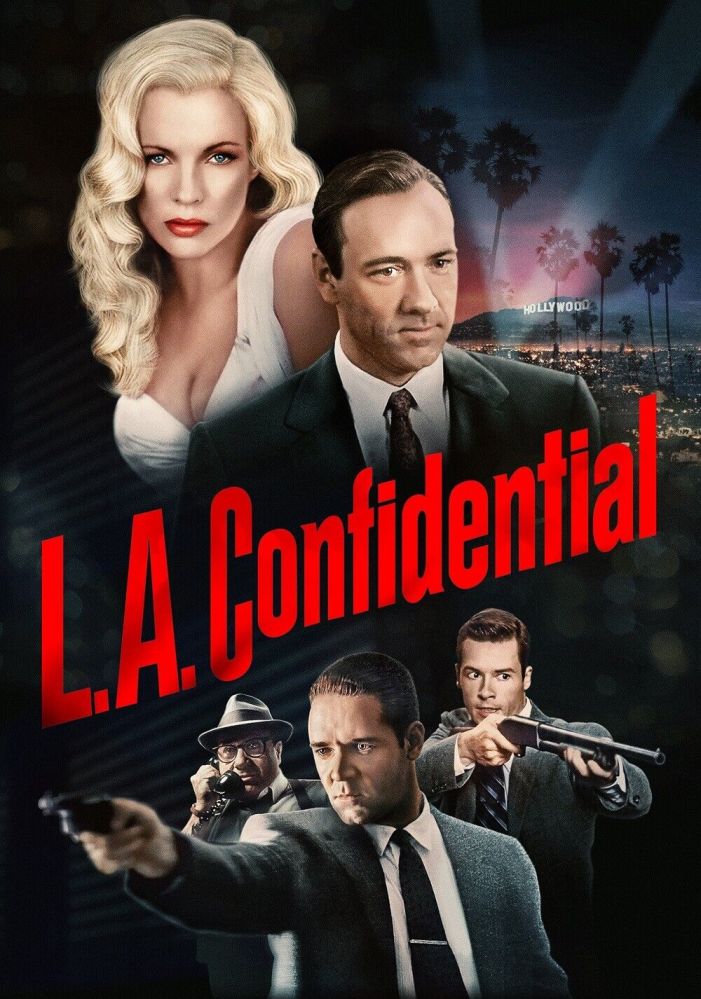
LA Confidential

Welcome to 1950s Los Angeles, where the men are crooked, the women are dangerous, and everyone’s eyebrows are perfectly sculpted. Curtis Hanson’s “L.A. Confidential” is what happens when you take film noir, inject it with Hollywood steroids, and tell it to solve a murder case that’s more twisted than a pretzel in a tornado.

Our trio of troubled cops includes Guy Pearce as Ed Exley, the kind of straight-arrow officer who probably wrote detention slips in kindergarten; Russell Crowe as Bud White, whose anger management technique is to manage to get angry at absolutely everyone; and Kevin Spacey as Jack Vincennes, a cop so slick he makes his own hair gel out of pure swagger. Together, they form the world’s most dysfunctional crime-solving team since somebody thought it was a good idea to give Sherlock Holmes a cocaine habit.

The plot kicks off with the Nite Owl Massacre, a multiple homicide that’s about as straightforward as quantum physics explained by a drunk physicist. What starts as a simple coffee shop shooting spirals into a labyrinth of corruption that involves dirty cops, Hollywood prostitutes (who look like movie stars), movie stars (who act like prostitutes), and enough double-crosses to make a geometry teacher dizzy.

Enter Kim Basinger as Lynn Bracken, a Veronica Lake lookalike who’s caught in the middle of all this mess. She’s the kind of dame that makes smart men stupid and stupid men even stupider – which in 1950s L.A. is really saying something. Her presence in the story adds layers of complexity to both the plot and the already complicated relationships between our three cops, who apparently never got the memo about bros before… well, you know.

The film weaves together so many subplots it should come with a road map and GPS. We’ve got tabloid journalism (Danny DeVito as Sid Hudgens, who never met a scandal he couldn’t make juicier), police corruption (James Cromwell as Captain Dudley Smith, whose Irish brogue could charm the scales off a snake), and a prostitution ring that gives new meaning to the term “plastic surgery.” All of this somehow ties together in a way that makes perfect sense, assuming you’ve been taking detailed notes and perhaps consulted a private detective.

What Makes It Shine Brighter Than a Hollywood Premiere:

  • Dialogue sharp enough to shave with
  • A plot more intricate than a Rube Goldberg machine, but twice as satisfying when it all comes together
  • Period detail so precise you can practically smell the cigarette smoke and casual misogyny
  • Career-defining performances from the entire cast, especially the then-unknown Aussie duo of Pearce and Crowe
  • Brian Helgeland’s screenplay, which somehow makes following three protagonists feel as natural as falling down stairs

What Makes It Shadier Than a Palm Tree at Midnight:

  • You might need to watch it twice to catch all the plot threads (though that’s hardly a punishment)
  • The first hour requires more concentration than defusing a bomb
  • Some viewers might need a flowchart to keep track of who’s betraying whom
  • The authentic period attitudes toward women and minorities might make modern viewers cringe

The Final Verdict:
“L.A. Confidential” is what happens when you take every film noir cliché in the book, feed them through a meat grinder of excellent writing, phenomenal acting, and pitch-perfect direction, and serve them up on a plate garnished with Hollywood corruption and garnished with murder. It’s a movie so good it makes you wish all police procedurals involved corrupt cops, glamorous prostitutes, and Danny DeVito running a scandal magazine.

This is the kind of film that reminds you why people fell in love with movies in the first place. It’s complex without being confusing, stylish without being shallow, and nostalgic without being naive. It’s like Raymond Chandler and James Ellroy had a baby, and that baby grew up to be the coolest kid in film school.

Rating: 5 out of 5 slightly tarnished badges

P.S. Keep an eye out for the scene where Exley interrogates a suspect while pretending to be way more hardboiled than he actually is. It’s like watching a Boy Scout try to impersonate Dirty Harry, and it’s absolutely perfect. Also, count how many times someone lights a cigarette – you could turn it into a drinking game, but you’d be unconscious before the second act.

Malcolm X

Spike Lee’s “Malcolm X” isn’t just a movie – it’s a movement captured on film, a three-hour-plus journey through one of the most complex and transformative figures in American history. And let me tell you, if you think you know Malcolm X’s story from your history books, this film will make you think again.

The film follows Malcolm Little’s evolution from a small-time hustler (played with explosive charisma by Denzel Washington in what should have won him the Oscar) to the powerful, controversial, and ultimately transformative figure known as Malcolm X. It’s a journey that takes us from the streets of Boston and Harlem to the holy cities of the Middle East, and from militant black nationalism to a more universal, though no less revolutionary, vision of human rights.

Lee structures the film like a religious conversion narrative – which, in many ways, it is. We begin with Malcolm as a “red” conk-wearing hustler, running numbers and pulling scams with his buddy Shorty (played by Spike Lee himself). This section plays almost like a gangster film, with its zoot suits, lindy hop dancing, and jazz soundtrack. But beneath the flash, we see the systematic racism that shaped Malcolm’s early worldview.

The prison sequence marks the first transformation, as Malcolm encounters the teachings of the Nation of Islam through fellow inmate Brother Baines. Washington brilliantly portrays Malcolm’s awakening, showing us a man literally remaking himself through education and religious conviction. His famous scene practicing writing on prison paper – starting with “A” and filling every inch of space – is a masterclass in showing intellectual awakening on screen.

As Malcolm X, the Nation of Islam minister, Washington captures both the fire and intelligence that made Malcolm such a magnetic speaker. The film doesn’t shy away from his more controversial statements but contextualizes them within the reality of 1960s America. When Malcolm speaks, whether to small groups or massive crowds, you understand why people listened.

The final act deals with Malcolm’s break from the Nation of Islam, his pilgrimage to Mecca, and his evolution toward a more inclusive worldview – while never abandoning his commitment to black empowerment and human rights. It’s here that the film reaches its tragic but transcendent conclusion, with Lee skillfully weaving documentary footage into the narrative.

What Soars:

  • Denzel Washington’s performance is a tour de force that captures Malcolm’s intelligence, charisma, and evolution
  • Ernest Dickerson’s cinematography shifts with each phase of Malcolm’s life, from the vibrant colors of his hustler days to the stark clarity of his later years
  • The supporting cast, particularly Angela Bassett as Betty Shabazz, brings depth to every scene
  • Spike Lee’s direction balances intimate personal moments with sweeping historical drama
  • The use of actual footage and photographs grounds the film in historical reality

What Struggles:

  • At 3 hours and 22 minutes, the film demands significant viewer commitment
  • Some of the early period sequences can feel slightly stylized
  • The complexity of Malcolm’s political and religious ideas sometimes gets simplified
  • The film’s structure occasionally makes it feel like multiple movies in one

The Verdict:
“Malcolm X” is more than a biopic – it’s an American epic that forces us to confront our nation’s painful history while celebrating the possibility of personal transformation. It’s a film that understands its subject was not just a historical figure but a living, breathing, evolving human being who contained multitudes.

Lee and Washington don’t give us a sanitized hero or a simple villain, but rather a man who constantly questioned, grew, and fought for what he believed was right, even as those beliefs changed. It’s a film that reminds us that the past isn’t past, that the questions Malcolm X grappled with – about justice, identity, resistance, and human dignity – remain urgently relevant.

Rating: 5 out of 5 raised fists

P.S. Pay attention to the film’s opening credits sequence, which intercuts the American flag with footage of the Rodney King beating – a reminder that Malcolm’s story isn’t just history, but a continuing conversation about race and justice in America. Also, the fact that Spike Lee had to reach out to prominent African American artists and athletes to help fund the film’s completion adds another layer to its significance as a piece of cultural history.

Fargo

Fargo (1996): You Betcha It’s a Masterpiece

Oh jeez, where do we start with “Fargo”? Ya know, the Coen Brothers could’ve just made a straightforward crime thriller about a kidnapping scheme gone wrong in Minnesota. Instead, they gave us a quirky masterpiece that’s basically what would happen if you dropped film noir into a wood chipper and reassembled it in the Land of 10,000 Lakes.

The story begins with Jerry Lundegaard (William H. Macy, perfecting the art of desperate flop sweat), a car salesman whose financial schemes have landed him in deeper trouble than a moose in quicksand. His solution? Hire two thugs to kidnap his wife so his wealthy father-in-law will pay the ransom. Because what could possibly go wrong with that plan? Everything. Everything could go wrong.

Enter our heroes and villains: Carl Showalter (Steve Buscemi, described memorably as “kinda funny lookin'”) and Gaear Grimsrud (Peter Stormare, who elevates silence to an art form) are the hired kidnappers who turn out to be about as reliable as a chocolate teapot. But the real star is Frances McDormand as Marge Gunderson, the very pregnant police chief who investigates the inevitably botched crime with the kind of cheerful persistence that makes Minnesota Nice seem downright terrifying.

The plot unfolds like a dark comedy of errors written by an evil genius who’s really into regional accents. Bodies pile up, wood chippers get involved (yah, that scene), and through it all, Marge methodically follows the trail of breadcrumbs while stopping occasionally for all-you-can-eat buffets. It’s like watching Lady Macbeth performed at a church potluck, only with more fake blood and “you betchas.”

The Coens craft a world that’s simultaneously absurd and authentic. The Minnesota accents might seem exaggerated until you actually visit Minnesota. The polite small talk in the middle of tense situations isn’t parody – it’s documentary. And the way violence erupts suddenly into this mannered world makes it all the more shocking.

What Works Like a Hot Dish at a Church Supper:

  • Frances McDormand’s Oscar-winning performance as Marge, creating one of cinema’s most unique and compelling detectives
  • The perfect balance of humor and horror that makes the dark moments darker and the funny moments funnier
  • Roger Deakins’ cinematography that turns the white Minnesota landscape into both beautiful backdrop and metaphorical blank canvas for bloodshed
  • The supporting cast of character actors who make every small role memorable
  • Dialogue that’s quotable without being cutesy (“And I guess that was your accomplice in the wood chipper?”)

What’s Shakier Than a Jello Salad:

  • The Mike Yanagita scene still puzzles some viewers (though it actually serves a subtle purpose in the plot)
  • The “based on a true story” claim is about as genuine as Jerry’s loan applications
  • Some viewers might find the accents and mannerisms too heightened
  • The pacing in the middle section requires some patience

The Final Verdict:
“Fargo” is what happens when exceptional filmmakers take genre conventions, regional specificity, and moral commentary and blend them into something wholly unique. It’s a crime story that’s less interested in the mechanics of crime than in the peculiar characters who commit them and the decent folks who clean up afterward.

The film works on multiple levels: as a straight crime thriller, as a dark comedy, as a morality tale about the dangers of greed, and as a celebration/satire of Midwestern values. It’s like a layer cake made of violence, desperation, and Minnesota nice, all frosted with snow and blood.

Rating: 5 out of 5 white Oldsmobile Ciera sedans

P.S. Keep an eye out for the scene where Carl tries to function in a world of excessive Minnesota politeness. His increasing frustration with people who just want to make pleasant conversation while he’s trying to be a hardened criminal is comedy gold. Also, remember: if someone offers you coffee in Minnesota, just say “yah” and save everyone some time.

Platoon

If you’ve ever wondered what the opposite of a feel-good war movie looks like, Oliver Stone’s “Platoon” is your answer. This isn’t your grandfather’s World War II glory story – this is Vietnam in all its mud-soaked, morally ambiguous, soul-crushing reality.

Our guide through this green inferno is Chris Taylor (Charlie Sheen, back when that name meant “serious actor”), a college dropout who volunteered for Vietnam out of a naive sense of patriotic duty. Remember those idealistic college essays you wrote about making the world a better place? Yeah, this is like that, except with more leeches, less sleep, and the constant threat of stepping on a land mine.

Taylor finds himself caught between two father figures: Sergeant Elias (Willem Dafoe), the compassionate warrior who hasn’t quite lost his humanity, and Sergeant Barnes (Tom Berenger, sporting a face full of scars and a soul full of darkness), who embodies the war’s dehumanizing effects. If Elias is the platoon’s conscience, Barnes is its survival instinct gone rabid.

The film doesn’t so much unfold as it descends – into madness, into moral corruption, into the heart of darkness (and yes, that Conrad reference is entirely intentional). We watch as Taylor’s idealism crumbles faster than a cookie in a monsoon. The platoon faces not just external enemies but internal ones: fear, paranoia, and the growing realization that maybe the real war isn’t between Americans and Vietnamese, but between different visions of what America should be.

Stone, drawing from his own Vietnam experiences, crafts scenes that feel less like Hollywood set pieces and more like fever dreams. The night ambushes, where muzzle flashes briefly illuminate terrified faces. The village raid that spirals into an atrocity. The cannabis-hazed moments in the “underworld” bunker where soldiers escape through rock music and chemical recreation. It all feels horrifyingly authentic.

The film’s most iconic moment – Elias running from the NVA with his arms raised (spoiler alert: it doesn’t end well) – becomes a sort of crucifixion image, the death of whatever moral high ground America thought it had in this conflict. When Samuel Barber’s Adagio for Strings swells over scenes of destruction, it feels less like a soundtrack and more like a requiem for lost innocence.

What Makes It Hit:

  • The raw authenticity that only comes from a director who’s actually been there
  • Willem Dafoe and Tom Berenger delivering career-defining performances as the angel and devil on Taylor’s shoulders
  • Cinematography that makes you feel the suffocating heat and paranoia of the jungle
  • A supporting cast (including a young Forest Whitaker and Johnny Depp) that brings the diverse reality of Vietnam-era America to life
  • The gradual build-up of tension that makes the explosive moments all the more impactful

What Makes It Miss:

  • Some of the symbolism (good sergeant vs. evil sergeant) can feel a bit heavy-handed
  • Charlie Sheen’s performance, while solid, occasionally feels overwhelmed by his more experienced co-stars
  • The voiceover narration sometimes states themes that the visual storytelling already conveys
  • The pacing in the middle section can drag for viewers expecting constant action

The Final Word:
“Platoon” isn’t just a war movie – it’s an exorcism of America’s Vietnam demons caught on film. It’s brutal, uncompromising, and absolutely essential viewing. While “Apocalypse Now” gave us Vietnam as surreal nightmare and “Full Metal Jacket” gave us Vietnam as dark satire, “Platoon” gives us Vietnam as it was: a meat grinder that took young men’s bodies and souls.

This isn’t a movie you enjoy – it’s a movie you survive, much like the war itself. It’s also one of the most important war films ever made, precisely because it strips away all the glory and pageantry to show war’s true face. When the credits roll, you’ll feel like you’ve been through something significant, even if you’re not quite sure you want to go through it again.

Rating: 5 out of 5 shattered illusions

P.S. Watch for the scene where King (Keith David) explains the reality of who’s fighting this war: “You got your white-bread, college boys like you out here, fighting this war, alongside your poor, black, Spanish, and redneck boys who’d be the first to die.” It’s a moment of clarity that cuts through all the fog of war.

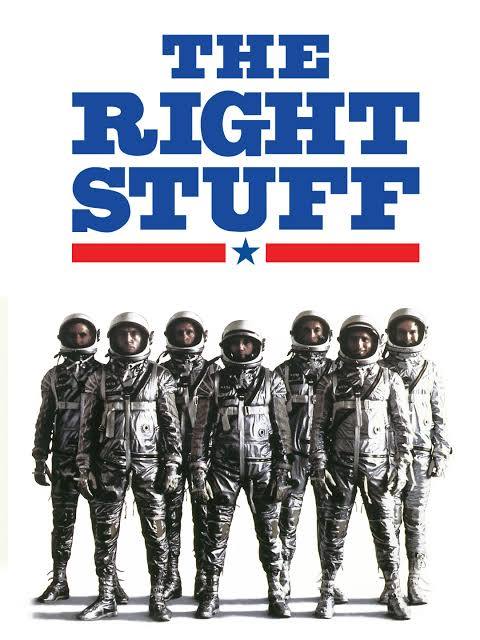
The Right Stuff

Ever wonder what happens when you take a bunch of cocky test pilots, stuff them into experimental aircraft, and tell them to push the limits of human possibility? Well, “The Right Stuff” has your answer, and spoiler alert: it involves a lot of sonic booms and even more swagger.

Based on Tom Wolfe’s bestselling book, this epic chronicles the birth of America’s space program, starting with the sound barrier-breaking exploits of test pilots at Edwards Air Force Base and culminating in the Mercury space program. At its heart is Chuck Yeager (Sam Shepard), the quintessential test pilot who treats breaking the sound barrier like it’s just another day at the office (which, for him, it kind of was).

Enter the Mercury Seven astronauts, led by John Glenn (Ed Harris, sporting a smile that could power a spacecraft) and Gordon Cooper (Dennis Quaid, whose cocky grin should have its own credit). These guys go from being hotshot pilots to America’s first astronauts, though the transition isn’t exactly smooth. Think of it as going from being cowboys of the sky to being spam in a can, as some of them put it.

The film brilliantly captures the absurdity of early spaceflight preparation. Want to be an astronaut? Great! Just let us stick every possible medical instrument into every possible orifice, spin you around until you’re ready to redecorate the centrifuge, and then parade you in front of the press like circus animals. All while your wives (including a stellar Pamela Reed as Trudy Cooper) maintain perfect hair and picture-perfect smiles for the cameras.

Director Philip Kaufman weaves together multiple storylines with the skill of a master storyteller. We bounce between Yeager’s continuing adventures pushing the envelope at Edwards, the Mercury astronauts’ training and missions, and the political circus surrounding the space race. The film manages to be both intimately personal and grandly historical, showing us both the men behind the headlines and the massive governmental machine that turned them into American icons.

What really sets “The Right Stuff” apart is its sense of humor about the whole enterprise. Yes, these men were heroes, but they were also gloriously human. The film captures their competitiveness, their fears, their family struggles, and their occasional bouts of what Tom Wolfe called “maintaining the zipper-down reputation.” It’s three hours and thirteen minutes of American history that never feels like a history lesson.

The Review Stuff:

What Works:

  • The cast is phenomenal across the board, with Sam Shepard’s laconic Yeager and Ed Harris’s earnest Glenn being particular standouts
  • The visual effects, despite being pre-CGI, are still impressive and give a visceral sense of what early test flights and space missions felt like
  • The script balances humor, drama, and historical accuracy with remarkable skill
  • Caleb Deschanel’s cinematography makes both the desert and space look equally magnificent
  • Bill Conti’s score soars as high as the aircraft it accompanies

What Doesn’t:

  • At over three hours, the film can feel a bit long-winded in places
  • Some of the supporting characters get lost in the shuffle
  • The political context of the space race with the Soviets feels somewhat underdeveloped
  • A few of the effects sequences haven’t aged as well as others

The Verdict:
“The Right Stuff” is that rare historical epic that manages to be both informative and entertaining, reverential and irreverent. It’s a testament to both human achievement and human folly, showing us heroes who were all too human and humans who became heroes. While it might be a bit too long for some viewers, it’s a journey worth taking, especially for anyone interested in aviation, space exploration, or just damn good filmmaking.

Rating: 4.5 out of 5 sonic booms

P.S. Keep an eye out for the running gag about the mysterious test pilot deaths being explained away as “crashes into the side of a mountain.” It’s both darkly funny and historically accurate – the government’s go-to explanation for classified mishaps during the Cold War era.

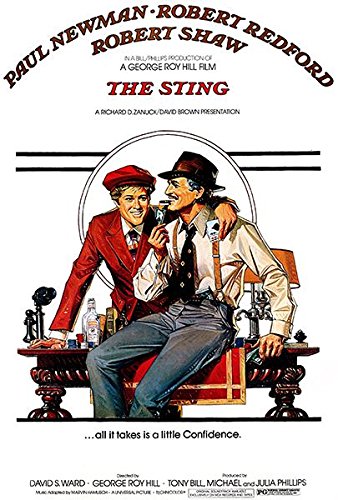
The Sting

When Revenge is Best Served with Style

Need to get revenge on a murderous crime boss? Try elaborate confidence games and ragtime music! At least that’s the approach Johnny Hooker (Robert Redford) takes after his partner gets killed by enforcer Loretta Numbers for scamming a numbers runner connected to crime boss Doyle Lonnegan (Robert Shaw).

Hooker seeks out Henry Gondorff (Paul Newman), a master con artist who’s “retired” in the same way that Michael Jordan was “retired” – which is to say, not really. Gondorff, despite nursing the kind of hangover that would kill a lesser man, agrees to help set up the ultimate con: a fake betting parlor designed to separate Lonnegan from his money and his smugness simultaneously.

What follows is a masterclass in the long con, featuring more moving parts than a Swiss watch factory. Gondorff infiltrates Lonnegan’s high-stakes poker game on a train, winning big with cheating that’s so obvious it would make a Vegas casino blush. This gets Lonnegan’s attention and, more importantly, his anger – something Gondorff and Hooker plan to leverage like a financial advisor with inside information.

The duo assembles a team of con artists who make Ocean’s Eleven look like amateur hour. They create an entirely fake off-track betting parlor, complete with a cast of characters that would make Broadway jealous. There’s Kid Twist (Harold Gould) posing as a Western Union clerk, giving out “sure thing” horse racing tips that are actually delayed results. The Erickson (Eileen Brennan) provides the female touch, while Eddie Niles (John Heffernan) plays the part of a disgruntled betting parlor employee willing to help Lonnegan “cheat” the house.

Meanwhile, FBI Agent Polk (Dana Elcar) is pursuing Hooker for killing a pursuer who was actually offed by someone else (it’s complicated), and corrupt cop Lieutenant Snyder (Charles Durning) is trying to get his cut of whatever action Hooker’s running. It’s like a chess game where half the pieces are actually checkers in disguise.

The con builds to a magnificent crescendo involving a fake shooting, a betting parlor raid that’s actually staged, and Lonnegan losing half a million dollars (in 1936 money!) to a horse that already lost. The beauty of the con is that Lonnegan can’t even go to the police because everything he tried to do was illegal anyway.

The Verdict

What I Love:

  • Newman and Redford’s chemistry that makes other screen partnerships look like blind dates
  • David S. Ward’s script that’s more intricately plotted than most retirement plans
  • Marvin Hamlisch’s adaptation of Scott Joplin’s ragtime music that makes white-collar crime seem downright jaunty
  • Period details so perfect you’ll check your calendar to make sure it’s not 1936
  • A plot twist ending that M. Night Shyamalan probably studies like religious text

What Could’ve Been Better:

  • Might make you overly suspicious of any gambling establishment
  • Will definitely affect your ability to play poker with a straight face
  • Could make you question why your revenge plans aren’t this stylish

“The Sting” pulls off the ultimate con: making audiences root for criminals while tapping their feet to ragtime music. It won seven Academy Awards, proving that sometimes crime does pay, as long as it’s fictional and features really good-looking people.

Rating: 5 out of 5 marked cards

P.S. – If someone named Kid Twist offers you horse racing tips, maybe check the timestamps first.