The Third Man

Our story begins with the arrival of Holly Martins, a writer of dime-store cowboy novels, who’s come to Vienna at the invitation of his childhood chum, Harry Lime. But hold on to your hats, because things are about to take a dark turn. No sooner does Holly set foot in the city than he learns that Harry has been killed in a traffic accident. Cue the dramatic music!

Not one to take things at face value, Holly starts digging deeper. He attends Harry’s funeral and meets a colorful cast of characters, including the lovely Anna Schmidt (Harry’s girlfriend), the jovial Baron Kurtz, and the cynical British officer, Major Calloway. But here’s the kicker: each of these people seems to have a different version of how Harry died. Inconsistencies abound, and Holly’s spidey senses are tingling.

Major Calloway drops a bombshell on Holly: Harry was actually a notorious black marketer, responsible for stealing penicillin from hospitals, diluting it, and selling it on the streets. This caused the deaths of many innocent people, including children. Talk about a plot twist! Holly, ever the loyal friend, refuses to believe it and sets out to clear Harry’s name.

As Holly plays amateur detective, things start to get dangerous. Witnesses clam up or wind up dead. A mysterious “third man” is spotted at the scene of Harry’s accident. Holly realizes he might be in over his head, but he’s in too deep to back out now.

Just when you think things can’t get any crazier, Holly spots none other than Harry Lime himself, lurking in a shadowy doorway. Plot twist number two: Harry’s been alive this whole time! Turns out, he faked his death to escape the heat from the police and his double-crossed partners in crime.

Harry arranges a clandestine meeting with Holly on the famous Wiener Riesenrad, the Giant Ferris Wheel. In a scene dripping with tension and moral ambiguity, Harry delivers a chilling monologue, justifying his evil deeds with a twisted philosophy. He even compares the insignificant dots of people below to mere dots on a page, ripe for the taking. Sociopathic much, Harry?

The climax of the film is a heart-pumping chase through the sewers of Vienna. Harry tries to escape, but Holly and the police are hot on his trail. In a moment of poetic justice, Holly has the chance to shoot Harry but hesitates, torn between his loyalty and his conscience. Calloway steps in and finishes the job, putting an end to Harry’s reign of terror.

The final scene is a masterclass in understated emotion. Anna, Harry’s girl, walks right past Holly at Harry’s second funeral, ignoring his affections. Calloway delivers the film’s iconic final line, “Death’s at the bottom of everything, Martins. Leave death to the professionals.” Mic drop.

So there you have it, a story of friendship, betrayal, and the depths of human depravity, all wrapped up in a stylish film noir package. The Third Man is a cinematic masterpiece that keeps you guessing until the very end.

(plot summary AI assisted)

This one is an easy 4/5 stars. I like Orson Welles and film noir so this is right up my alley. I came in clean to this having heard very little about it so the plot twist caught me by surprise or perhaps I couldn’t think straight due to god damn zither music. Very enjoyable movie that was well acted and the use of shadow and lighting was incredible – the lighting was a fourth star in this movie the long shadows distorting reality and making you second guess what you’re seeing were disorienting at times.

The Great Dictator

In what might be history’s most audacious case of “dress for the job you want, not the job you have,” Charlie Chaplin plays both a mild-mannered Jewish barber and his exact doppelganger, Adenoid Hynkel, the power-hungry dictator of Tomania (subtle, Charlie, real subtle). Our story begins in the trenches of World War I, where our unnamed barber heroically bumbles his way through a series of military mishaps, including accidentally piloting a plane upside down while carrying an important officer. Because apparently that’s how you survive war – with slapstick.

Fast forward to the barber waking up in 1939, after spending twenty years in the hospital with convenient plot-device amnesia. He returns to his barbershop in the Jewish ghetto, completely oblivious to the fact that his hometown has become the center stage for Hynkel’s anti-Semitic regime. Talk about missing a few newsletters during your hospital stay.

The ghetto sequences showcase some of Chaplin’s finest moments of resistance-through-comedy. Our barber befriends Hannah (Paulette Goddard), who’s made it her personal mission to bonk storm troopers with frying pans. He also gains the protection of Schultz, a high-ranking officer who recognizes him as the soldier who saved his life during the war (in that upside-down plane, no less – funny how these things come full circle).

Meanwhile, in a palace that looks like what would happen if you let a megalomaniac loose in IKEA, Dictator Hynkel is busy being a walking parody of Hitler. He practices speeches in mock German (which is really just gibberish peppered with occasional words like “wiener schnitzel” and “sauerkraut”), dances with an inflatable world globe in a scene that somehow manages to be both hilarious and terrifying, and throws temper tantrums that would make a toddler say “maybe dial it back a bit.”

The political satire kicks into high gear when Benzino Napaloni (Jack Oakie), the dictator of Bacteria, comes to visit. Their relationship is a masterclass in fragile masculinity, with both dictators trying to out-dictator each other. They compete over chair heights during a barbershop scene (yes, really), engage in a food fight at a formal dinner, and generally behave like schoolyard bullies who’ve been given countries to run. Their mustache-to-power ratio is off the charts.

Things take a turn when Schultz objects to Hynkel’s increasingly aggressive policies and ends up fleeing to the ghetto with a death sentence on his head. He and the barber organize a resistance movement, which goes about as well as you’d expect from a group led by an amnesiac barber and a defected officer with questionable planning skills. They end up in a concentration camp, but manage to escape wearing soldier uniforms (because apparently security protocols in Tomania were somewhat lax).

Through a series of coincidences that would make Charles Dickens say “that’s a bit much,” Hynkel goes duck hunting, falls into a lake, and gets arrested by his own troops who mistake him for the barber. Meanwhile, the barber, in stolen military gear, is mistaken for Hynkel just as the dictator is about to give a victory speech about invading Austria. Instead of doing the sensible thing and running for the hills, our barber-turned-accidental-dictator decides to give an impassioned speech about democracy, peace, and human dignity.

The film ends with Hannah listening to the speech on the radio in her new home in recently-invaded Austria. She’s inspired by the message of hope, though one might question the long-term viability of a resistance plan that involves accidentally replacing a dictator with his look-alike and hoping nobody notices the sudden personality change and complete reversal of all policies. But hey, in for a penny, in for a pound.

Chaplin’s film manages to be simultaneously slapstick comedy, pointed political satire, and earnest humanitarian plea. Released in 1940, when America was still officially neutral in World War II, the film was either an act of incredible courage or spectacular madness – or perhaps the special kind of genius that comes from being both. While some of the plot turns might require Olympic-level suspension of disbelief, the film’s core message about the absurdity of hatred and the power of human dignity remains as relevant as ever. Plus, where else are you going to see Hitler and Mussolini caricatures having a food fight?

(caption AI assisted)

I’d give this 4/5 stars. Mostly because it’s an audacious film and relevant to modern times. I can just imagine Trump and Putin having the chair size fight and it makes me giggle (which helps keep the night terrors away) Chaplin still has comedic chops especially with his physical comedy and although the plot contrivances are hard to believe they do land pretty well. After watching most of Chaplin’s silent movies during this project it was neat to see him speaking and he really does a great job. I’m a bit sad to not have any more of his films on my viewing schedule this year but I might loop back when this over and fill in the gaps.

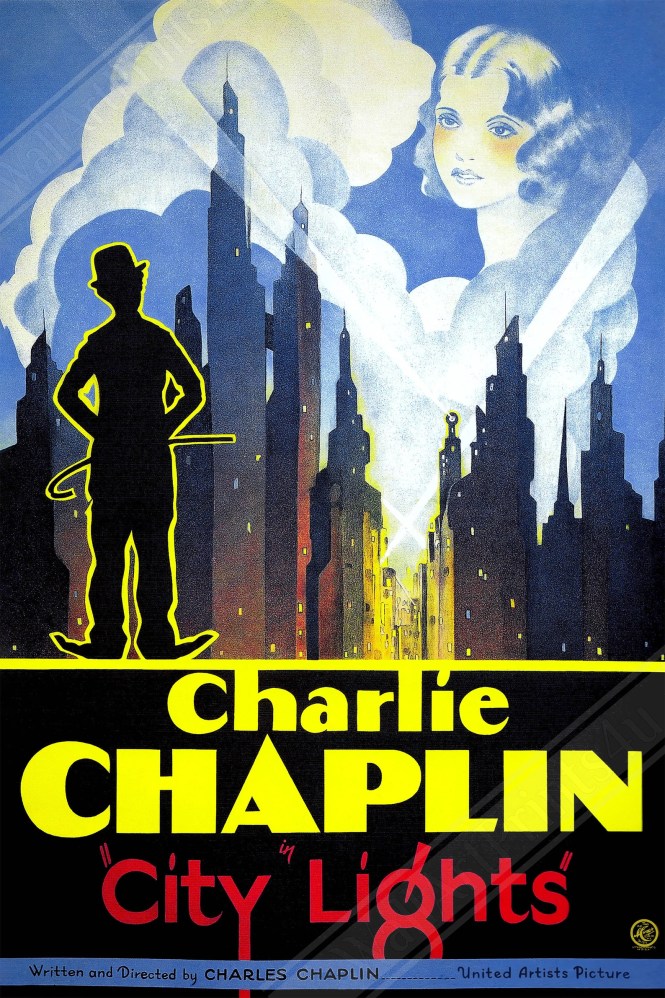
City Lights

Category: Silent Film, Comedy

Starring: Charlie Chaplin

Another Chaplin movie (a lot of his seem to make most ‘best movie’ lists and I can start to see why.  In this particular one he reprise the role of the tramp and the movie opens with him taking a nap under a tarp that is later revealed to be a statue that is having a big unveiling.  The usual slapstick shenanigans happen and he eventually escapes the authorities. He then meets a flower girl who is selling flowers and is instantly smitten.

As he’s leaving the flower girl hears a fancy car with a chauffeur and thinks it’s the tramp. Later that night the tramp is down by the water and he sees someone trying to kill themselves. He saves them from the attempt and it turns out the guy’s a millionaire and he takes the tramp back to his house to keep the party going. The guy’s a complete lush and when the tramp asks him for money to buy more flowers from the flower girl he peels off a few from a fat stack and sends him on the way telling him to take his car – a very nice Rolls Royce.

The thing is – the millionaire only really remembers the tramp when he’s hammered – once he’s sober he is a cruel and abrupt stereotype of a 1920’s tycoon.  It’s something that is repeated a few times with the millionaire who always seems to find the tramp when he’s sauced out of his mind.

Meanwhile the tramp keeps visiting his blind girl and one day she isn’t at her usual street corner. He eventually tracks her down and finds out that she is ill, so he keeps her company by reading her a newspaper. One of the articles is about a doctor who has a procedure to restore sight – the girl smiles and said it’d be wonderful because then she can see him. The tramp knowing he’s pretending to be rich and is aware of his looks isn’t enthused with this idea. However, as he’s leaving he finds an eviction notice and realizes her family is getting kicked out of the apartment.   Determined to help her he decides to get the money to pay her back rent.

The problem is he’s visited the blind girl too many times and the foreman fires him. One of his buddies ropes him into a fixed fight to make some cash but the crooked boxer takes off because the police are coming the his replacement is a giant of a man with murder in his eyes.  A comical drawn out boxing match happens which includes the tramp hitting the boxer with a shovel, the boxer punching the police, and general mayhem. However, the boxer eventually beats the tramp and he goes away without the money needed for the girl.

It’s at this time that the millionaire rolls up on the tramp, three sheets to the wind, and invites him to party (again). They have a good time and the tramp asks if he can give him the money for the girl. The rich guy says sure – and all seems to be solved, except that at that moment burglars break into the house and rob it – with the tramp making his getaway by running from the police (something he does quite frequently, to be honest)

Knowing that it’s a matter of time he runs to the girl and gives her the money – telling her that he’ll see her “in a while” shortly after the police find and arrest him. A while later he gets out of prison and goes to her street corner, only to find her gone.  One day as he’s walking down the street he looks in a store window and there she is! She runs a florist shop now and her sight has been restored! He nervously starts to approach but some newsboys who have taken a dislike to him start harassing him and she sees it through the window. She offers him a coin and a flower and when she touches his hand she realizes who he is and they share a smile.

4/5 – At this point the whole tramp gets the girl thing seems to have been done this is just another angle on it. The deranged millionaire was pretty funny and the slapstick bits are pretty consistent and humorous. Chaplin’s ability to express emotion without words is without peer and I can see why he dominated the silent film industry and his fame endures to this day.

Citizen Kane

Category: Drama
Starring: Orson Welles

Widely considered one of the greatest movies of all time it was hard to go into this fresh as the move has entered and somehow stayed in the zeitgeist (Rosebud is a classic example) and I have seen this movie before a very very long time ago, so it wasn’t like I was going into it blind. That being said – Welle’s acting is magnetic and draws you into whatever character he’s playing – and the film, even with it’s 1930’s sensibilities, is eminently watchable.

The movie starts with Kane as an old man on his deathbed in a palatial estate called Xanadu – he’s holding a snow globe and as he shuffles off this mortal coil he mutters a single last word “Rosebud” – setting up the mystery of why this great man would choose that as his last words. It’s such a mystery that a newspaper assigns an investigative reporter to do a story on Kane which sets up the framework of the movie.

The reporter (Thompson) tries to talk to Kane’s ex wife – a bitter alcoholic who refuses to speak to anyone about him. He then investigates Kane’s business manager’s office and reads some old records showing how Kane came into his fortune and how he squandered it.

It starts with Kane as a child. His parents have a mining claim that is producing and they arrange for him to go to a boarding school and have his money managed by the aforementioned business manager. When they went to send him off to boarding school – he hits them with the sled he was happily riding before the family broke apart.

When Kane turned 25 he got access to the money and responsibly and sensibly invested it using sound strategies to grow his portfol.. Ahh who are we kidding he wasted almost the entire fortune with poor decisions on booze, news, and flooze(ies).  He buys a newspaper and immediately goes full Murdoch – building influence and power through the press. He marries the niece of the president and seems like he’s riding high.

He decides to run for political office (well that sounds familiar) and during his run he meets a woman (Susan) and begins a torrid affair. He is discovered and because this isn’t 2024 the affair ruins his political career (and marriage). Kane, determined to prove his choice to have an affair was a good one, pushes poor lounge singer Susan into singing opera.  She.. Doesn’t have the vocal range for opera and even though she tells him this he blithely ignores here and builds an entire opera house for her debut – which was as awful as you imagine it was.  Kane’s best friend Leland who runs the arts column for their paper, writes a scathing review of Susan and the opera and Kane finds the review before print and fires Leland but then for some reason publishes the poor review

The reported manages to convince Susan to speak to him and she tells him that she begged him not to have to continue, but Kane makes her and eventually they have a big enough argument that Kane strikes Susan and she leaves him. He’s finally all alone – having driven away everyone who cared for him.

Thompson speaks to the butler who confirms the incident and say Kane went into a rage and only calmed down when he grabbed a snow globe.. At which point he whispers ‘rosebud’

Then the famous ending – where they’re going through his things and burning some of it (I’m not really sure why) and as the camera pans the pile of detritus you see a sled with the name ‘rosebud’ on it.

5/5 – great movie.. Deserves it’s flowers. Welle’s acting is superb and the story (apparently loosely based on Randolph Hurst) is compelling and keeps you interested. I liked the bittersweet ending where you can’t help but feel that Kane is longing for the time in his life when he was truly happy – riding that sled in the snow before his parents sent him away.

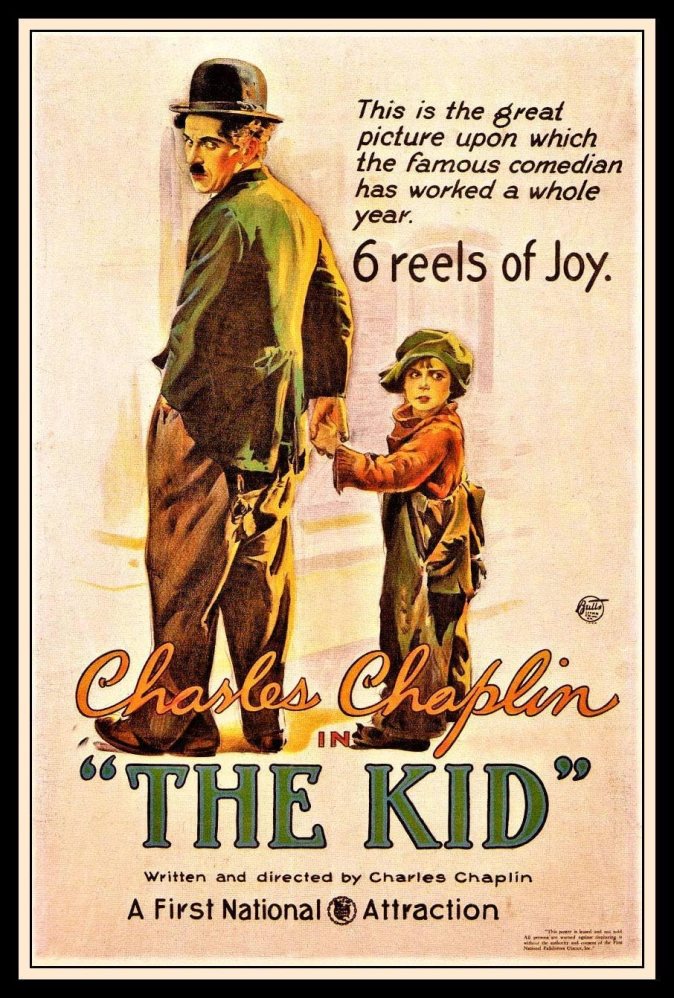
The Kid – 1921

Charlie Chaplin

Silent Movie / Comedy – 1921

3/5 stars

This one starts with an ingénue who has a baby but the father isn’t interested (doesn’t believe it’s his? Who knows with silent movies) so she is desperate to keep her career so she does the unthinkable and abandons the baby in a rich person’s car hoping he can have a better life (leaving a note asking for someone to care for this orphan child).However – the car is promptly stolen by two thugs who race off in the car only to pull over when the baby starts crying – one thug waves the gun at the baby and suggests (via body language) maybe we should you know.. Shoot it? The other thug who isn’t a complete sociopath decides to leave the baby in an alley (arguably an equally poor solution) where Chaplin’s tramp happens to live.

Chaplin stumbles across the baby and tries to leave it but his conscious won’t let him neither will the police officer who patrols the slums. He tries to put the baby in passing mother’s carriage but that backfires as she catches him in the act and Chaplin goes back into his hovel unsure what to do.

5 years pass and they’ve fallen into a  poverty riddled routine where the kids breaks a window with a rock and Chaplin walks around as a window repairman  and they scrape together enough to maybe buy some food (although seeing a coin operated gas meter was illuminating) – all during this time the mother becomes a famous wealthy actress who tries to atone for her guilt by running a charity for children where she unwittingly interacts with her own child – and she gives him a small toy to cheer him up.

The trouble began when a local bully stole the toy and the kid wasn’t taking that shit and threw down like a champion. They got into a proper brawl and the whole hood showed up for the show (not much else going on tbh) – the kid is whopping the bully’s ass but then the bully’s gigantic dad shows up and tells Chaplin if he kid loses he’s going to curb stomp him so Chaplin tries to throw the fight and pronounce the bully the winner but the kid has the heart of a lion and drops the bully with a tyson-esque combo (in reality he looked like Yoda fighting during the clone was) then Gigantor comes for Chaplin but he manages to avoid his punches for a while until he grabs a brick and starts going full mason on the bully’s dad’s forehead.. Eventually goliath falls and they escape back to their hovel.

Shortly afterward the kid gets sick and his mother (still unknowingly) arranges for a doctor to visit – where Chaplin explains that the kid isn’t his and shows the doctor the note. The doctor arranges for an orphanage to kidnap the kid forcefully which honestly is a traumatic scene to watch as a father which sets off a wacky rooftop chase scene where Chaplin rescues the kid and they hide out in a flophouse to figure out what to do. However, during this the mom met with the Dr. who showed her the note Chaplin had and she realizes that the kid is hers! What are the odds! She puts out a 1,000 dollar reward for his return

The owner of the flophouse sees the reward in the paper and grabs the kid to turn him in for the money and when Chaplin wakes up the kid is gone (again, nightmare fuel for dads) and he frantically searches for him before giving up and falling asleep at the door of his hovel which kicks off an LSD fueled fever dream where the people in his neighborhood are devils and angels and he’s flying around doing.. uhh.. I’m not sure. He’s awaken by the police and he thinks he’s going to jail but he’s actually brought to the mansion of the mother who then lets him in (presumably to reunite with the kid)

Fun fact: The actor who played the kid was uncle Fester in the Addams Family TV series!

Not Fun fact: This movie was written shortly after lost a son in childbirth – making is especially poignant.

Really not fun fact: The kid was conceived on a very young actress and Chaplin married her to avoid the scandal and was divorced shortly after – then he did it AGAIN with the girl who played the angel in THIS movie knocking her up at 16. Yikes.

All Quiet on the Western Front

Category: War Film

Starring:

A pretty visceral World War I movie depicting the horrors of trench warfare. Told from the point of view of the German soldiers it depicted a harrowing experience spoke to the futility of war.

It starts out in a classroom in Germany when a teacher is giving an impassioned speech about serving the fatherland in the war and the jingoistic speech gets all the young men fired up and they decide that they should all go enlist together. Filled with enthusiasm they join the army and are sent to train under a wannabe despot Colonel Himmelstoss which quickly removes their enthusiasm as they are treated brutally and made to suffer in their training because Himmelstoss is apparently a sadist (although they do get him eventually in a midnight raid but it’s not too serious)

Once deployed they immediately come under fire and one of their group is killed while the rest scatter. Eventually reaching their muster point they realize there’s no food and that they have to pay a veteran solider (Katz) in order to get access to the pig he stole from a truck earlier in the day.

Eventually they get sent to the front lines and the movie treats you to a visceral experience of what war was like during WWI. People dying all around you, the never-ending bombardment of shells, being forced to go over the top of the trench into machine gun fire in order to advance the line. It’s brutal and unflinching (although edited for 1930’s sensibilities)

In a strange coincidence Himmelstoss arrives at 2nd company and is rejected by the men and the next day he’s forced to over the top of the trench with the rest of them and is almost immediately gunned down. One of the soldiers is running down the lines and is attacked and has to stab a man to protect himself and ends up having to stay in a pit all night with the dying man which is traumatic and he ends up begging for the mans forgiveness. 

Later on Paul (one of the soldiers) is badly wounded in action and taken to a\ hospital where his leg is operated on. He eventually pulls through but is given a medical furlough and he returns home. He’s surprised as how everyone in his hometown is still gung-ho on the war and buying into the patriotic fatherland. When he speaks out about the horrors of war he is derided and called a coward.

Paul returns to the front to a new second company (still run by Katz) and is jaded with the futility of it all. During a search for wild pigs for food there’s a bombing and  Katz takes shrapnel in the shin and Paul carries him to a hospital tent, not realizing other shrapnel has hit Katz and he died on the way. Paul can’t believe his friend is dead and he’s shell shocked an devastated.

Back on the front line Paul is in a trench and waiting during a quite time when he sees a butterfly land near his trench. He’s transfixed by this beautiful thing in such an ugly place that he reached out to touch it…

And is promptly 360 no scope sniped. The end.

3/5 – The movie did a good job showing the horrors of trench warfare in World War I and how the interpersonal relationships formed in such a horrid place can be one of the only things to sustain you.

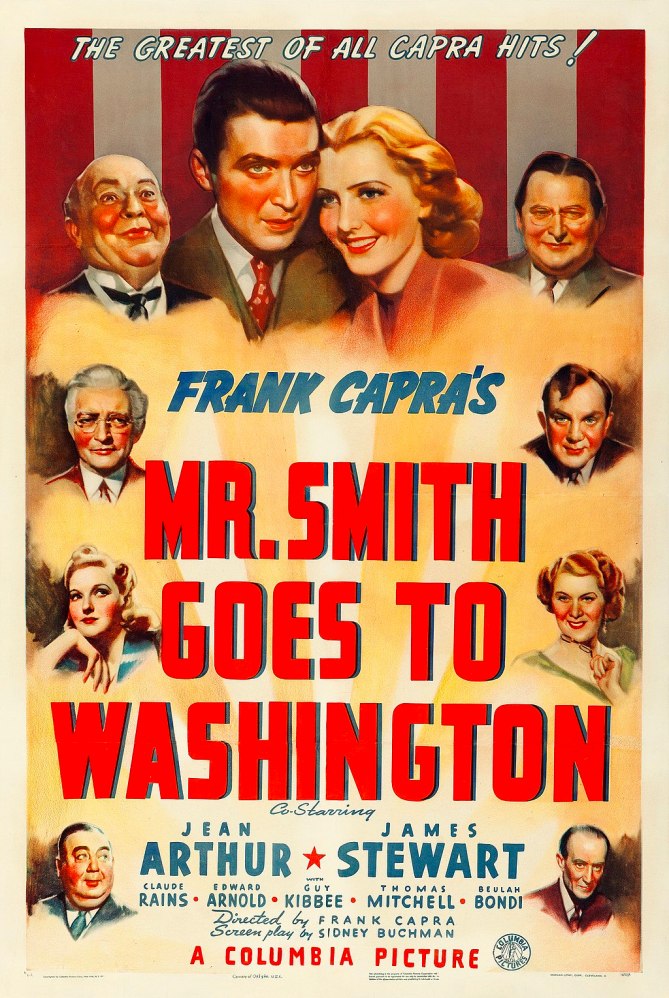
Mr. Smith Goes to Washington

Category: Drama/Comedy
Starring: James Stewart

A sitting senator dies and a governor needs to replace him. Feeling pressure from wealthy lobbyists to appoint one of their guys to the post he is torn because his constituents don’t want him and he’s worried about his career.  He eventually concoct a scheme to appoint a local man, Jefferson Smith, because they seem him as naïve and easy to manipulate. 

Smith is a ‘true patriot’ and when he gets to Washington he immediately walks away from him handlers and does the full tourist experience in DC.. While his handlers go crazy because they have no idea where he went and they have meetings and press lined up for him. Once he eventually gets to his office he meets the secretary of the old senator Clarissa Saunders – who is jaded with politics and is considering leaving.

Smits is mentored by Joseph Paine who was a good friend of Smith’s father. He is part of a group of corrupt senators working with a ‘boss’ Jim Taylor to get rich through senate policy. Paine has a party at his house and invites Smith who becomes  smitten with Paine’s socialite daughter who toys with him like a cat with a mouse due to his naivete. Shortly after the Washington press gets a hold of him unsupervised and it’s a bloodbath – they make him out to be a bumbling fool who doesn’t belong there.

Angered by the press Smith complains he’s not really doing anything in his new job Paine suggests he submit a bill and Paine will bring it to the floor. Smith thinks it over with Clarissa and decides to create a national boys camp with a federal loan that will be paid back by the boys with pennies. The problem with that is the particular parcel of land that he’s trying to buy is part of a graft scheme by Taylor hidden in a much larger appropriations bill. Taylor tells Paine to get Smith to drop it but Smith is too principled and ignores the directive and speaks about the bill in the senate the next day.

Taylor immediately puts his corruption machine to work and the results is an accusation that Smith already owns the land he’s trying to buy with the federal funds and this is all a grifting scheme (they even had a land deed and everything!) Smith overwhelmed by this runs away. Clarissa finds him near the Lincoln Monument and convinces him to stand up for himself and suggest he do a filibuster in order to hold up the senate and get them to see his point of view.

Armed with the policy of procedures Clarissa explained to him the get the Senate president to give him the floor against all of Taylor’s co-conspirators and once he’s given the floor he refuses to relinquish it filibusters late into the night. In order to dissuade him Taylor has all the papers he owns print attack ads and articles calling Smith corrupt. Smith sees these but still perseveres.  Paine shows him fabricated letters from his home state saying they want him to drop his bill and face expulsion from the Senate. None of the other senators will support his bill and he is beginning to despair.

Meanwhile his boy rangers realize what’s going on and start making newspapers with the truth and start delivering them across the area. Taylor’s goon squad sees this and literally drive this kids off the road. Talk about heavy handed – I’m pretty sure in the good handbook attacking kids is a violation of goon ethics.

Back to the Senate where Smith is flagging and all the other senators have walked out  but a smile from the Senate leader renews his determination to go on – until not long after he passes out from exhaustion. Paine upon seeing the dedication Smith had to doing the right thing is overcome with guilt and runs out of the senate and tries to eat a bullet.  The other senators stop him and then in the commotion he runs back an and admits on the floor his guilt, that Taylor was behind it and Smith is innocent.

5/5 – Just a great feel good movie about doing the right thing and sticking with your principles no matter what the cost. Jimmy Stewart shines here as a conflicted man outwardly peaceful but with a simmering rage directed at people who he considers unjust.  The corruption angle and patriotism is a bit heavy but for the time the film was released it makes sense. There comedy parts are laugh out loud funny and the drama is moving even if it seems a bit cliched to modern tastes. Overall a really enjoyable movie with well acted parts!

Modern Times – 1936

Silent Film – 1936
Charlie Chaplin

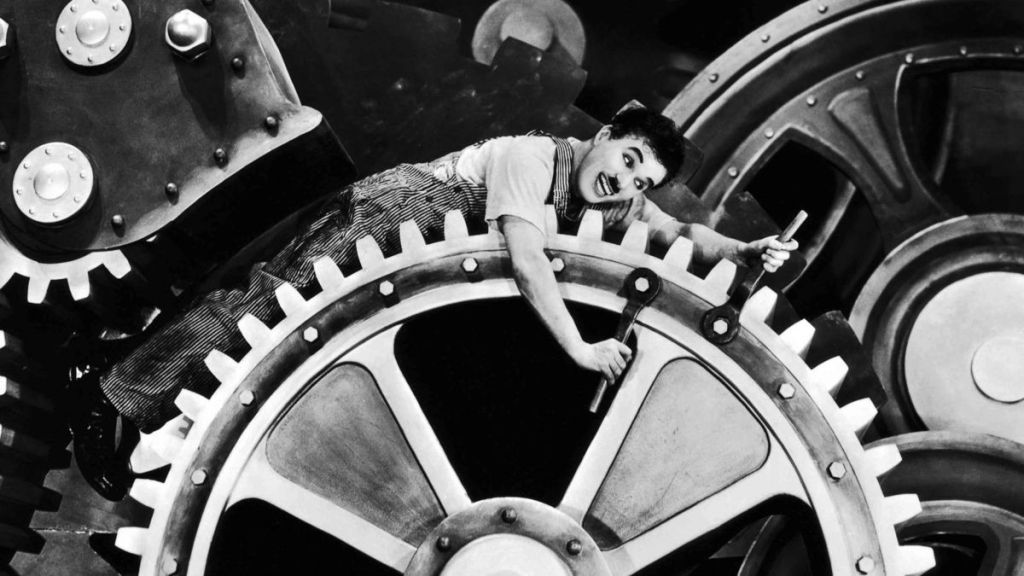
Another visit to Chaplin’s tramp character. This time he’s working in a factory where everything is regimented and watched over (very big brother like) by the boss via television screens. Chaplin’s character is starting to show stress from the repetitive nature of the work and then goes off the rails in a madcap dash around the factory -eventually getting stuck in the gears in a pretty famous scene

He’s committed to a hospital and when he gets out accidentally gets involved in an anti govt protest and ends up in jail. At some point in prison he ingests a bag of cocaine and goes full Tony Montana (only without the guns) and in his rush around the station he stops a breakout attempt without even realizing what he’s doing.  The cops are so thankful they give him a cushy cell with lots of amenities which the tramp seems to really enjoy. However – his time in prison is soon to be over and he unsuccessfully tries to convince the police that he belongs back in prison since he gets three meals a day and a comfortable place to sleep.

One released he struggles to find a job – eventually finding work using a letter of recommendation from the police captain at a shipyard where he’s given a simple job of hammering some piles in – however he didn’t understand the instructions (in true tramp style) and ends up launching a ship that… wasn’t quite ready to be launched. Dejected from his inability to find work he’s walking down the street when he sees a young girl stealing bread and when the cops ask him what happened he said he stole the bread trying to get back to his cushy prison cell.  Witnesses tell the police that he didn’t really do it and he’s freed back onto the streets.

Really determined to go back to jail – he goes to a restaurant and eats a ton of food and then doesn’t pay – tracking down a cop to come arrest him for it.  He’s locked up in a paddy wagon – and lo and behold, the girl from earlier is in the wagon with him! He tries his charm on her and she seems to vibe with him.. When suddenly the paddy wagon crashes and they escape in the chaos.

He tries to go straight for the girl and takes a job as a night watchman at a department store  – he has a great time roller skating around and sharing what the store has to offer with her but then three goons break in and try to rob the place – the tramp realizes they’re fellow factory workers who are just hungry and desperate. He decides not to call the police and falls asleep in a very unfortunate location where he is discovered the next day and promptly fired.

The girl gets a job dancing in a nightclub and convinces the owner that the Tramp is a singer and waiter but he’s terrible at the waiting part and his last chance is the singing performance. He’s really nervous but the girl helps him write the words on his cuffs so he won’t forget them – but he loses the cuffs during the dancing part! What’s he to do? That’s right.. He channels his inner Eminem and goes full five mile on them: Chaplin Modern Times ‘non-sense song’

Things are seeming up for these two lovebirds, but then the police track the girl down from her previous escape and her and the Tramp are forced to flee once again.  The stop at the site of the road and the girl desparis at they have nothing left but the tramp reassures her and they set off down the road into whatever awaits them.

4/5 – Great move and one of Chaplin’s finest performances

I think this is the first time you hear Chaplin’s voice in one of this films and he uses it to sing a nonsense song that somehow conveys an idea without using an actual language (he made it all up). The slapstick comedy was tight and funny and the camera work and direction was engaging.  Some of the ‘special effects’ were really well done practical effects that he sold with his conviction and body control.  Reading into it somewhat it was a commentary on industrialization and the political climate of the time and has eerie echoes into the current day with AI threatening to displace a lot of people’s jobs. It was one of the last silent films of the era and Chaplin’s last performance as the tramp and I’m glad he got to set off into whatever future awaited him with someone by his side.

Scarface – 1932

Mobster Movie  / Black and white

You have to love a film that starts with the moral message that the film is trying to convey instead of using the movie to tell the story and let the audience infer their intent. No, these guys straight up called out the government and the police for letting the mob run wild with little to no law enforcement.  I guess knowing it’s a morality tale helps defray some of the excessive (yet bloodless) violence in the movie.

Basically the movie starts with a mob boss getting whacked by a mysterious whistling hit man causing a power vacuum that coincidentally is filled by mob boss Lovo and his lieutenant Tony. Lovo is a calculating and careful boss who wants to expand in south Chicago only – due to the north being controlled by a pretty powerful mob boss O’hara. Tony, however, is a lunatic who embraces all the lovely Italian immigrant stereotypes and refuses to listen to his boss and starts causing trouble in the north side. Eventually he starts taking over the territory and has O’hara gunned down in his flower shop.. But they didn’t finish the job so they had to storm a hospital to execute him in cold blood (how’s that for a morality tale)

The new boss of the north side tries to gun down Tony while he’s having dinner with Poppy (the boss’ girl!) using newly imported tommy guns but he manages to escape (grabbing a machine gun in the process) and then uses the machine gun to go on a full scale murder rampage (seriously – it’s a murder montage.. Murtage?) in retribution killing most of O’hara’s crew except Gaffney (Boris Karloff in a starring role!)

Tony’s now a rising star. O’hara’s second in command is in hiding and all of sudden Lovo’s girl Poppy starts to respond to Tony’s flirting and invitations to come see his new place.  Bad news for Lovo (still technically the boss). One night in a dance club they’re both sitting a table with Poppy and she pulls out a cigarette.. And Tony and Lovo both offer her a light.. Who will she choose?! You guessed it – Tony. Lovo does NOT look pleased.

Coincidentally that night there’s an assassination attempt on Tony and he believes it was Lovo who hired guns from out of town to do it – he has someone call Lovo’s office while he’s there saying the hit went down and Lovo tried to play it off as wrong number. Well Tony knew then it was Fredo all alo.. I mean Lovo all along. He took care of business (as in he machine gunned Lovo too) and now was the big boss of Chicago.

This is a good spot to talk about Cesca, Tony’s sister. She’s a rebellious 18 year old girl who wants to get involved in the ‘scene’ and refuses to take no for an answer even though Tony is a controlling psychopath who refuses to see her as anything other than a child which only makes her more determined to prove she’s old enough to hang. We also introduce Tony’s right hand man Guino always seen flipping a coin and is fiercely loyal to Tony and operates as his fixer – taking care of problems.. Permanently.

Some of you can see where THIS is going.. Cesca keeps pursuing Guino and he’s just a man and eventually  unwisely gives into the very persistent Cesca. Where’s Tony during all this? Hiding in Florida waiting for the heat from his murder spree to die down.  Tony comes back and hears the Cesca is shacking up ‘with some man’ and goes into a rage and murders his best friend! Cesca is inconsolable and tells Tony they had just gotten married and were planning to surprise him.

A public execution of someone is all the police needed to issue a warrant for his arrest and Tony barricades himself in his mansion filled with machine guns (straight line to the Pacino Scarface ending scene!) and has an extended shootout with the police (with Cesca who at first was going to shoot him in a rage then obviously had a psychotic break and is willing to go all in on the mob life) he’s holding out pretty well until Cesca takes a bullet to the gut and dies. With the house filling up with tear gas, Tony realizes the game is up and tries to escape but then it shot down in a hail of bullets (again, just like Pacino) and dies in a literal gutter.

Morality tale complete – literally EVERYONE who did a crime in the movie ended up dead. People who were involved with the mob died.. Pretty much used a large hammer to beat the message into the audience.

4/5

I really enjoyed this movie – it was dripping in old school mob speak (that Chicago/mob accent that you hear a lot in mobster movies of the time) and even with the heavy handed morality it really was a classic example of a mobster movie (even if a few scenes were pulled from life like the St. Valentine’s day massacre)  and had some great over the top performances and you can really see how Pacino’s Scarface is the spiritual successor to this version of Scarface.

The Thief of Baghdad [1924]

Silent movie

Swashbuckling / Adventure

Starring: Douglas Fairbanks

The entire length of this movie I was thinking to myself – oh, wait this is what Disney’s Aladdin as loosely based on (silly sidekick, princess who needs to be married off, a flying carpet and a dude who falls in love with a woman he’s met for 10 minutes)

Movie starts out with Fairbank’s character being an unrepentant thief (literally he goes into a mosque and tells everyone exactly this) who steals things in the marketplace via his athletic sneakiness and overall charm – ending with him stealing a magic rope that goes in the air by itself (we’ve seen that used frequently in media over the years) – he goes back to his 1 BR studio  condo located in a well behind the market and meets up with his partner – showing him the rope and plotting how they can use it .

The announcement comes out that the princess is to be married off and princely suitors should come to Agraba.. Oh wait.. Baghdad and then Alladd.. Oh wait.. ‘the thief’ thinks the Palace! Ah ha! With the rope we can rob that place blind! So they scout out a good location and then use the rope at night to sneak into the castle where the thief steals some jewels via a slapstick comedy involved sleepy fat eunuchs but during his escape he sees the princess and.. BLAM INSTANT DEEP LOVE FOR BOTH OF THEM.

Anyways.. Someone hears the noise and he has to hide under a rug but as he’s trying to leave one of the princess’ handmaidens sees him and chases him off and he goes back to his pal who asks where the treasure is and he says the corniest line in movie history at the time (while holding up the princesses slipper) this is the real treasure. Her slipper –  which I’m sure is delightful after sweating all day in the Agrabah.. Shit.. Baghdad sun.

So anyway – the thief is besotted but he isn’t a prince – so he watches the real princes walk in – and there are three of them.. The prince of Persia (not who you think) who is a comically obese sleepy prince, the prince of the indies who is an arrogant jerk and the prince of the Mongols who is dripping with stereotypes.  The princess thinks none of them have drip like Alladd.. Dammit.. The thief and  despairs before her man rides on  a stolen horse wearing stolen clothes pretending to be a prince. He was actually there to kidnap his  true love who he met one day ago (Queen Elsa disapproves) but through the Mongol spy in the palace he is revealed to be a common thief!

So the Caliph DQs him and the princess is distraught – so she comes up with a plan to delay them saying give them seven moons to find a gift worthy of her and she will choose – so they go off on an adventure to find these rare treasures. The thief meets up with the priest who he mocked in the beginning asking for help and he showed him a dangerous path to find a great treasure that will surely win this contest but warning him it is a perilous journey.

Prince of Persia takes a nap while his retainers find a magic carpet thanks to a crafty beggar who knew a secret (I see you Walt) and the prince of the Indies finds a lost idol with magic crystal eyes (imagery that is repeated through the years in fantasy elements – and I think it was on the cover of the original D&D players guide) and the Mongol leader finds a hidden magic apple that will heal any injury even dead (which tests on a random fisher man just minding his business)

While this is going on the thief is going through his peril – caves full of flames, giant furry bat attacks, underwater temptations, giant fish/squid monsters,  proto-ents,  flying horses and general peril – and he eventually finds a magic box that will create whatever the user wants (thanks to the advice of a hermit who lived in the caves)  he triumphantly returns to the hermit and.. Promptly rides off on a summoned horse.. Man didn’t even summon up some chicken wings or a lady friend for this lonely hermit. Bruh – not cool.

Anyways, the Mongol’s great idea to win the princess’ favor is to.. Poison her? Presumable to use the apple to heal her.. But its apparent the poison is fact acting and he can’t get there in time (thanks to the crystal ball) so they hitch a ride on the magic carpet and zoom off to save the princess who realizes they all came back with awesome treasures but her true love is still missing..

The Mongol decides he’s tired of her shit and just sneaks in a bunch of warriors to storm the castle, take over the city and imprison the Caliph and the princes. He’s got it made in the shade.. He’s going to marry the princess and rule all of Baghdad.. But wait.. THAT’S THE THIEFS MUSIC!!

He rides in and starts throwing magic dust like a deranged tinker bell summoning up an army 10,000 strong.. The Mongols flee and the prince is about to have his bro execute him when the slave/spy says why not grab the magic carpet and steal the princess? So that’s what he does but the Thief arrives under the cover of his invisibility cloak and rescues her at the last minute!