I Did It.

Wow. That was quite a journey. I’m honestly still processing the fact that I managed to complete everything. Looking back, I’ve spent over two decades setting goals, and the highest I ever reached before was maybe 60% completion—and that was with a modest list of just ten goals. When I first considered taking on this challenge, I almost talked myself out of it, remembering past failures. But turning 50 flipped a switch in me. I figured I might not succeed, but I knew I’d regret it if I didn’t even attempt it. Maybe not the most optimistic mindset to start with, but if this experience has taught me anything, it’s that with discipline and structure, you can fundamentally shift how you approach things.
Coming up with 50 goals was an adventure in itself. The first few were easy—I pulled from old, unfinished goals and added new ones that felt both exciting and challenging. But once I hit the 30-goal mark, I struggled. That’s when I had to shift my perspective. I started thinking about what turning 50 really signified. I reflected on what I had accomplished, what I had always wanted to do but never got around to. And then it hit me: I had spent years assuming there would always be time. But what if there wasn’t? Shouldn’t I seize the moment now, while I still had the energy to truly enjoy it? That realization changed everything. Suddenly, the list filled itself. Visiting my father’s hometown in Italy. Buying my dream guitar. Sipping on really old Scotch. Once I reframed the process, it became much easier to round out the list. I even left a few open slots, which I later filled with “Explore AI” and “Complete a Bob Ross painting tutorial.”


As I got deeper into rounding out the 50, I found myself turning to the internet for inspiration. Seeing what others had on their goal lists helped me refine mine. Some ideas resonated, some didn’t, but the process helped me think outside the box. And ironically, one of my late additions—learning about AI—ended up being a game-changer. AI became an essential tool throughout the year. With a goal of blogging about my experience, I faced an immense workload, closing in on nearly 300 posts. Without AI’s help in researching topics, I would have been buried under the effort. I even used AI to critique my writing, offering an unfiltered, sometimes ego-bruising editorial lens that ultimately improved my work.
To keep myself accountable, I knew I needed rules. Once the 50 goals were set, I committed to not altering them to make things easier. But I’m also pragmatic—life happens. In the early months, I tore something in my shoulder, which derailed my fitness-related goals. So, I built in a contingency: I allowed myself to swap out five goals if necessary. This gave me a degree of flexibility while ensuring I didn’t just swap out challenges for convenience. I ended up using four swaps (documented on my website), and two of them were due to physical limitations rather than avoidance.


So how did I pull this off while managing a full-time job, two small kids, and a marriage? With structure. I built a framework that allowed me to make progress without compromising what truly mattered.
The first rule: priorities first. My family always comes first—no exceptions. I didn’t pursue these goals at the expense of time with my kids or my wife. I still coached my kids’ teams, played with them on weekends, and handled all the usual parenting duties. I made sure my wife and I kept our Friday lunch dates, giving us uninterrupted time together. And work? That stayed a priority too. I enjoy my job and wasn’t about to let this project interfere with my professional commitments. With those priorities locked in, anything else became negotiable.


The second rule: do something every day. Even on chaotic days—work was crazy, the kids had back-to-back activities, and my wife was out of town—I could still do something. Read a few pages of a book. Practice Italian on Babbel for five minutes. Write a quick gratitude journal entry. Even brushing my teeth at night, I could squeeze in a small action. The consistency was the key. After a few months, it became so ingrained that skipping a day felt like a glitch in my system. These small, daily efforts accumulated, creating momentum that accelerated progress over time.


The third rule: find hidden time. It’s there if you look for it. That hour-long commute? Perfect for listening to educational podcasts or checking off an album from my music list. Instead of doom-scrolling my phone during lunch, I’d read, write, or learn something new. Even waiting for my kids to finish practice became an opportunity—reading on my Kindle, researching goals, or sketching ideas. Once I stopped treating time as something to kill and started seeing it as something to use, my productivity skyrocketed.


The final rule: track everything. This was huge. I needed to see my progress at a glance, so I built a spreadsheet with progress bars and a dashboard to keep me motivated. If one goal was lagging, I’d shift focus to bring it up to speed. As the months passed and those bars turned blue, I felt the inertia pulling me forward. That visual reinforcement made a huge difference. I also used OneNote to collect ideas, notes, and drafts, which kept me organized and efficient. These tools gave me a comprehensive view of where I stood at any given moment.


As the year progressed, I started identifying areas of wasted time and replacing them with intentional actions. Little by little, I started to see myself as someone who followed through, rather than someone who set goals only to abandon them. That shift in self-perception was a turning point. Once I hit 75% completion, I could see the finish line. In the last 60 days, I went into overdrive, laser-focused on getting everything to 100%. I don’t think I could have sustained that level of intensity for an entire year, but as I neared the end, it felt like shifting from marathon pace to an all-out sprint.


But of course, there were downsides. Sustaining focus for an entire year was mentally exhausting. Between work, family, and this challenge, there were weeks when I was completely burned out. Fortunately, some of my goals—meditation, hiking, drawing—helped counteract the stress. On particularly rough weeks, I leaned into those activities, taking long hikes with my kids to reset. Still, there were stretches, especially in the summer, where I did nothing, and guilt crept in. Eventually, I realized that guilt was unnecessary. I wasn’t trying to become a productivity guru or a social media influencer—I was just a 50-year-old guy trying to accomplish something meaningful. And as I watched my goals falling one by one, I realized that even with breaks, I was still on track.


Another major downside? Free time took a massive hit. Movies, TV, video games—I barely engaged with any of them. I didn’t play a single hour of video games all year, missed most new film releases, and barely kept up with my sports teams. (Not that the Jets gave me much to miss.) These things might not be “productive,” but they’re enjoyable, and I realized I missed them. Sometimes, you just want to unwind and watch your favorite team blow a late lead.


Ultimately, I learned so much from this experience—not just about discipline and productivity, but about balance, adaptability, and what really matters. There were tough moments, but overall, I’m glad I did it. And now, looking ahead, I’m excited to see where these lessons take me next.


DOUGHS DOUGHS DOUGHS

Throughout this challenge I came across alternate ways of making pizza dough using interesting raitos, methodologies or ingredients. Since I usually just made a cheese pizza with each of them (a nice baseline that lets me judge solely on the crust) I don’t think they need their own post, but I’m going to touch on them here and provide some notes

Rye/Wheat Pizza dough (Nancy Silverton)
This pizza dough was getting a lot of hype online and I was curious what the addition of rye flour would do for a pizza dough. So I tracked down her recipe and gave it a shot. The methodology was simple – it used a sponge (or biga) to preferment and the folding technique. The rest of the steps were easy enough to follow. The resulting pizza was tasty and definitely had an earthier flavor than I was used to which was kinda of nice. I think the issue I has was the recipe I was using was adapted for home ovens, and I cooked them at 900 in my outdoor pizza oven so they dried out a bit. I think I’d like to give this a go again but use the high heat formulas

No knead cast iron pizza
No kneading? No complex formulas to create a delicious pan pizza? Sign me up -I’ve got a cast iron pan and some time so lets go! There’s a bunch of versions of this out there but the most referenced one is here . It really couldn’t be simpler: Mix the ingredients then cover and wait. That’s it. Once the dough has risen put it in the pans, then rise again until they’re puffy. Sauce, cheese and fire on a baking stone or steel. The resulting crust was open and airy and crispy from the oil used and the cheese at the edges got crispy. Overall this was a really good pizza, and super easy.

“72+” Pizza (extreme fermentation)

I’m usually a 24-48 hour pizza fermenting guy – 36 hours is usually the sweet spot where the yeast has put in the work and the flavor and rise is where it needs to be for an amazing pizza. I found a pizza formula for 72 hours and decided to make three dough balls and make them at 72, 96, and 120 hours. It obviously used very little yeast and relied on time to make it happen. The dough at 72 was super easy to open and felt a bit delicate so I was careful to top and bake quickly. The dough definitely had a nice flavor and cooked up crisp. The 96 was a bit more delicate and I had to use a a bit more bench flour to ensure I didn’t rip the dough when opening it and it cooked up a bit flat – I suspect the yeast was starting to give out. The 120 was a problem as it felt like it would tear if I looked at it funny – so I setup the pie on parchment paper and shaped it gently into a square shape as opening it didn’t seem possible. What came out of the oven wasn’t that great it didn’t have a great bite and was almost a flatbread. I suspect if I wanted to ferment that long I’d need to change the yeast ratios to account for it as the original formula was only for 72.

Thin Crust (Bar Pie)
Who doesn’t love a cracker thin crust? Crispy yet tender this bar pie style pizza is super easy to shape as you roll it out with a rolling pin (so much easier with an industrial roller, but all I have is the pin, so..) parbake it to ensure the sauce doesn’t make it soggy then top and throw back in the oven. Charred edges, crispy crust lots of ‘ronis and you’ve got a good Friday night. This goes really good with an ice cold beer which makes sense!

Sourdough Pizza
What to do with all this sourdough discard I was creating in making a sourdough starter? The very first thing that came to mind was making sourdough pizza of course. I did some research and found a few common methodologies and the one that made sense was to use the discard with some fresh yeast to refresh the rising ability a bit. It was also useful in that I could make it in the morning and have pizza at night since the starter delivered most of the flavor elements a long rise in the fridge would give it. The first attempt wasn’t that great, I think the starter was a bit weak so I fed that bad boy a bit more frequently and the next time the dough rose much better and the pizza had a great sourdough flavor note. I suspect I’ll be using this a lot as I go through my sourdough phase.

Tortilla Pizza / Naan Pizza
Is this cheating? Probably but I wanted pizza and didn’t have dough available. What I did have was a bunch of flour tortillas in the pantry. So I looked online and I found a viral video of tortilla pizzas and decided that sure this could work. Dear readers – it did not. If you aren’t a pizza person and just want a hit of sauce and cheese then sure, this could work for you. I suspect that one of the issues can be that I had ‘extra soft and fluffy’ tortillas because that’s what my kids like. If I used standard thin tortillas maybe it would have been a different experience?

Building on this, I also has some garlic naan leftover and said – well what if I throw sauce and cheese on this? The first try was a disaster as naan is designed to absorb liquid and that’s what it did turning into a soggy mess. Try #2 was me putting down a solid layer of cheese first then saucing it and that one was actually pretty good.

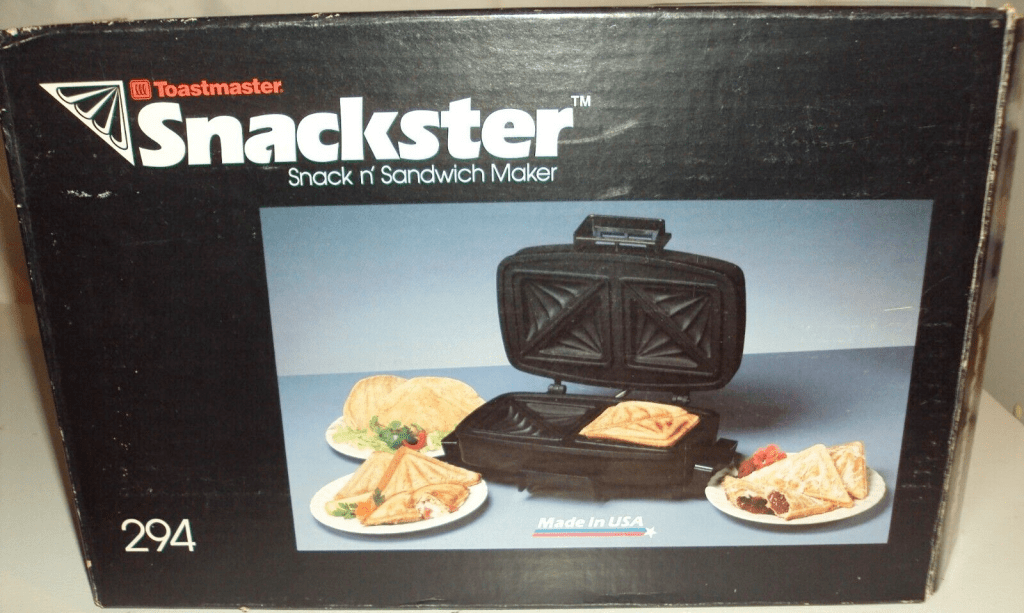
Bear with me here – I know these are pizza hacks. They are no substitute for a real dough that is made with love but if my research showed me anything its that a lot of people are doing this and who am I to judge their pizza happiness? One of my favorite memories as a kid is making hot pockets (back before they actually existed) by buttering two slices of bread and filling it with sauce and cheese and using that old school sandwich press. If doing these hacks makes people want to learn how to make their own pizza, isn’t that a good thing?

That’s what it all comes down to. Pizza is happiness – you make whatever pizza makes you happy. Except pineapple pizza. Stop it.

Steamed Pizza (Pizza Gourmet)

Steamed pizza is one of the most unusual and under-the-radar styles of pizza out there, a method that flips the traditional idea of a crispy, blistered crust on its head in favor of something softer, almost pillowy. While most pizzas are baked in blazing-hot ovens, fried in oil, or even grilled over an open flame, steamed pizza is cooked using steam, resulting in a completely different texture and eating experience. Instead of the charred, crunchy bite you’d expect from a Neapolitan or New York slice, steamed pizza is all about softness, with a light, fluffy dough that feels almost cloud-like, yet still structured enough to hold up to toppings.

The origins of steamed pizza are difficult to pinpoint, as steaming isn’t a common technique in traditional Italian pizza-making. However, it’s not entirely unheard of, particularly in places where steaming is already a popular cooking method. In China and parts of Southeast Asia, for example, steamed buns like baozi and mantou share similarities with steamed pizza dough in terms of texture. Some variations of steamed pizza are also seen in certain regional Chinese street foods, where dough is steamed before being topped with ingredients, creating a unique fusion of pizza and dumpling-like softness.

The most well-known version of steamed pizza in the United States comes from Connecticut, where a small pizzeria called American Steamed Cheeseburgers in Meriden became famous for steaming not just their cheeseburgers but also their pizzas. Using a special steaming oven, the dough is gently cooked with steam instead of direct heat, allowing it to rise and cook evenly without forming a crispy crust. Instead of bubbling, browned mozzarella, the cheese melts into an ultra-creamy, almost fondue-like consistency that blends into the sauce in a way that’s completely different from the gooey pull of a traditional baked pizza.

The process of steaming changes not just the texture but also the overall balance of flavors. Without the caramelization that comes from high-temperature baking, the flavors of the ingredients remain purer, with a slightly more delicate taste. The tomato sauce, for example, stays bright and tangy rather than developing the deeper, jammy flavors that baking produces. The cheese, instead of forming a browned crust, turns into a smooth, velvety layer that melts into the dough rather than sitting on top of it. Toppings, depending on how they are applied, either steam along with the pizza or are added after cooking to maintain their freshness and crunch.

While steamed pizza remains a novelty, it has started to gain attention from food experimenters looking for new ways to reimagine pizza. Some home cooks and chefs have adapted the method using bamboo steamers, stovetop steam ovens, or even pressure cookers, experimenting with different dough hydration levels and steaming times to perfect the texture. Certain styles of Chicago deep-dish and Detroit-style pizza also incorporate an element of steaming, though unintentionally—because of their deep pans and thick layers of sauce and cheese, the dough often partially steams as it bakes, creating a fluffier interior beneath the crispy edges.

Though it may not have the widespread appeal of a crispy, fire-kissed Neapolitan or a classic New York slice, steamed pizza is an intriguing example of how pizza-making can evolve beyond the traditional oven. It offers a softer, almost comforting take on pizza, one where the emphasis is on lightness, tenderness, and melt-in-your-mouth textures rather than crunch. Whether it remains a niche curiosity or catches on as a legitimate pizza trend, one thing is certain—steamed pizza is proof that there’s always room for innovation in the pizza world.

Dessert Pizza (Nutella)

Nutella dessert pizza is the kind of indulgence that feels almost too good to be true, a perfect fusion of crispy, chewy pizza dough and rich, velvety chocolate-hazelnut spread. While it may seem like a modern Instagram-worthy creation, its roots can be traced back to Italy, where simple, dough-based desserts have long been a staple. Italians have always had a knack for transforming pizza into a sweet treat, whether through zeppole, bomboloni, or even fried pizza dusted with sugar. When Nutella entered the scene in the 1960s, it was only a matter of time before it became a natural companion to warm, freshly baked pizza crust. The combination is both effortless and irresistible, taking something already beloved and making it even more decadent.

At its core, Nutella pizza begins just like any other pizza—with a well-made dough. The best versions use a Neapolitan-style crust, light and airy with just the right amount of chew, baked at high temperatures to achieve that signature crispness on the outside while staying soft within. Some variations take inspiration from Roman-style pizza al taglio, using a thicker, more focaccia-like base. The key to a perfect Nutella pizza is achieving a balance between crispness and tenderness, ensuring that the dough can hold up to the weight of the rich chocolate-hazelnut spread without becoming too brittle or too soft. Some recipes call for baking the Nutella directly on the pizza, allowing the heat to melt it into a warm, gooey layer, while others opt for spreading it onto the crust after baking, letting the residual warmth do the work of softening the spread without making it too runny. Either method results in the same outcome: a luscious, chocolatey experience that satisfies any sweet tooth.

While Nutella alone is more than enough to make this dessert shine, the best versions of Nutella pizza incorporate additional toppings that elevate it beyond a simple spread-on-bread combination. Fresh fruit is a popular choice, with bananas adding a creamy, natural sweetness and strawberries or raspberries bringing a tart contrast to the rich chocolate. Blueberries, blackberries, and even thinly sliced pears can be used to enhance the flavor profile, adding a layer of brightness to every bite. For those who crave a bit of crunch, chopped hazelnuts, almonds, or even crushed biscotti provide a delightful contrast in texture, making each slice more dynamic. A dusting of powdered sugar is a classic finishing touch, giving the pizza an elegant, snow-dusted look, while a drizzle of honey or caramel adds an extra level of indulgence. Those looking to take Nutella pizza to the next level often serve it with a scoop of vanilla or hazelnut gelato, allowing the cold creaminess of the ice cream to melt slightly over the warm Nutella, creating a contrast that is nothing short of magical.

Some variations push the decadence even further by stuffing the crust with Nutella, ensuring that every bite is an explosion of melted chocolate. Others experiment with a balance of sweet and salty, adding a pinch of flaky sea salt or even crushed pretzels to enhance the chocolate’s depth. The beauty of Nutella pizza is its versatility—it can be as simple or as extravagant as desired, with endless possibilities for customization. Whether served as a dessert at an Italian trattoria, as a brunch treat at a trendy café, or made at home for a special occasion, it has an undeniable ability to bring joy to any table.

Though Nutella pizza is most commonly associated with Italy, where it appears in pizzerias and bakeries across cities like Naples, Rome, and Milan, it has spread far beyond its origins. It has become a staple in high-end dessert menus, food festivals, and home kitchens worldwide. The appeal is universal—after all, who can resist the combination of warm, fresh-baked dough and rich, chocolate-hazelnut spread? For those looking to recreate it at home, the process is remarkably simple. A basic pizza dough, rolled out and baked until golden, provides the perfect foundation. Once out of the oven, a generous layer of Nutella is spread over the warm crust, melting slightly as it meets the heat. From there, the toppings are limited only by imagination, whether it’s fresh fruit, nuts, powdered sugar, or an extra drizzle of something sweet. The result is a dessert that feels both effortless and luxurious, a perfect way to end a meal or simply indulge in a moment of pure chocolate bliss.

Nutella dessert pizza is more than just a sweet twist on a classic dish—it’s an experience. The contrast between the crispy, slightly chewy crust and the smooth, melted Nutella creates a textural harmony that is instantly satisfying. Whether enjoyed as a shared treat among friends, a romantic dessert for two, or even as a guilty-pleasure snack in the middle of the night, it is the kind of dish that brings instant happiness. It is a reminder that pizza doesn’t always have to be savory, that dough can be a vehicle for something beyond cheese and tomatoes, and that sometimes, the simplest combinations—warm dough and chocolate—can be the most unforgettable.

Goal Update: Visit 10+ Famous Pizza Places

I was at a work conference in Manhattan for a week and decided to seize this opportunity to squeeze in a few more famous pizza places into my year.

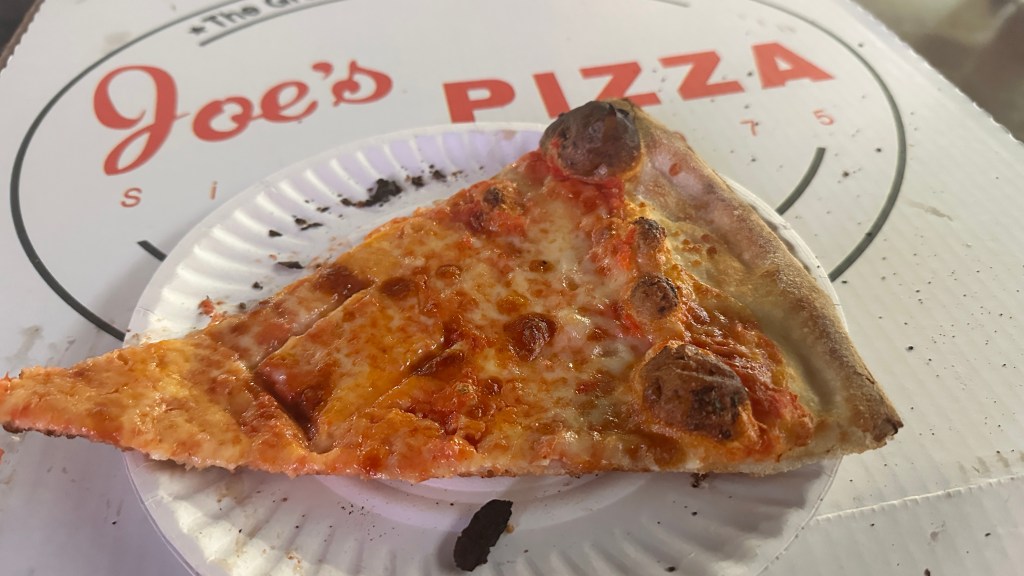
Joe’s Pizza on Broadway.
All the pizza people have a consensus that this is an exemplary NY slice and I was curious to give it a shot. The first thing you notice is the line – this was a random Tuesday in February and it stretched down the block. A quick peek inside showed that there were only a handful of tables and most people were sitting on the benches outside eating their pizza in the cold. I did some quick mental math and saw the line was going to be at least 45 minutes at the pace it was moving at so I did the logical thing and called in an order. I used the time to wander around and poke into some stores that were open and when I came back I walked in an grabbed my pie. However all the benches were taken and there were no seats available inside so I did the needful and ate with the box perched on the trash can outside on the sidewalk. The pizza was good – a perfect balance of sauce and cheese with a crispy crust with zero flop. I wasn’t blown away like some people were (perhaps because I’ve eaten a lot of NY style pizza over the years) but it was a really good slice that is a true representation of NY Style

Score 9.7

Lombardi’s – Little Italy
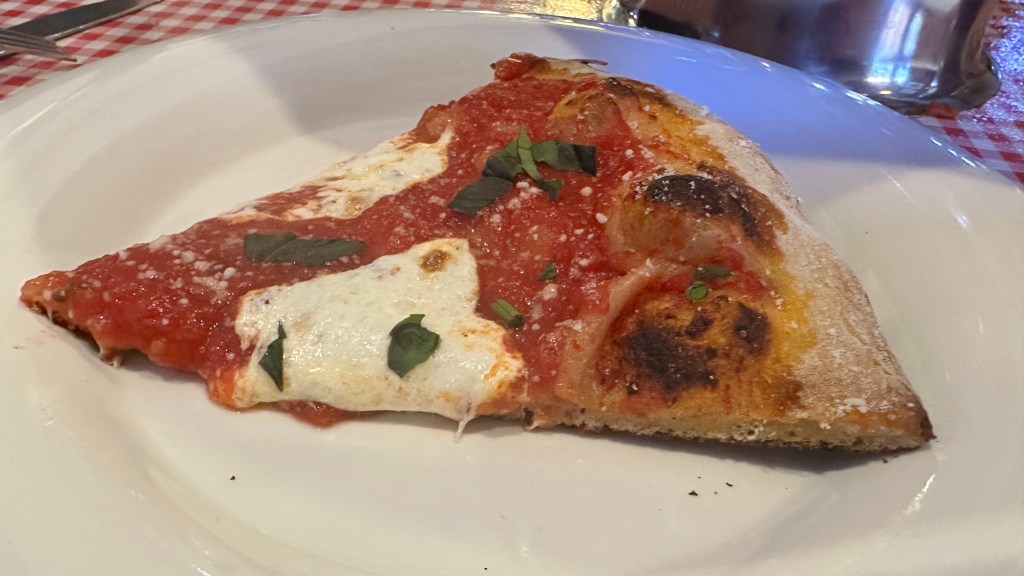
There are mixed reviews of this place – some state that they used to be great but when the owners changed it all went downhill. I decided that since it’s been there forever and is a landmark it still needed a visit. It’s a quaint place in the heart of little Italy and had the requisite red and white checkered tablecloths and pictures of celebrities who came to eat there. I ordered the margherita style pizza and a root beer (classic pairing) and he brought me a 8 ounce fountain root beer (no free refill signs are all over the place, mind you) so that’s not a great start. If you’re going to charge 4 bucks for a fountain soda make it at least 20 ounces. Then the pizza came out and it was tiny – I re-read the menu and the size of the pizza is mentioned there but 28 bucks for a 12 inch pizza? It also was dry and the sauce was too salty and the cheese was barely there. It’s obvious whoever owns it now is trading on the reputation of the original and is cost cutting wherever possible. If it was 10 bucks I’d have been more charitable – I’ve had NY dollar slices that had more flavor. The fact I was the only one there during prime lunch hour should have been my first clue.

Score 4.7

Rubirosa – Little Italy

This one snuck up on me – I had no idea this place was here but every reddit thread and pizza forum that talked about NYC pizza said this was the go to thin crust spot. It’s a small corner spot in little Italy and when I went they were pretty crowded – I got a spot at the bar and was waffling between the tie dye pizza and classic cheese when the bartender offered up that I could get half and half. I decided to give it a try so i could try both options. The pizza came out and it was huge and the crust was super thin and shattered when you bit into it. The cheese pizza was tasty but I felt like the sauce was a bit one note and the pesto glaze on the tye dye was good but it felt like there was something else in the pesto that gave it an off flavor. I still enjoyed the pizza for what it was – a good example of thin crust pizza. While I was there I noticed a lot of people were actually getting the pasta. If I wasn’t pressed for time and have eaten have a giant pizza I’d have tried some because it looked amazing. Next time I’m in the area I might need to stop in for some.

Pizza Al Taglio

If you’ve ever strolled through the streets of Rome, hungry and indecisive, there’s a good chance you’ve been saved by pizza al taglio. This Roman-style pizza—whose name literally means “pizza by the cut”—is the ultimate street food. It’s baked in large rectangular trays, displayed like edible works of art behind glass counters, and cut to order with a pair of scissors before being sold by weight. That’s right—no fixed sizes, no set slices. Just point, pay, and enjoy. It’s casual, customizable, and quintessentially Italian.

Unlike the more famous Neapolitan pizza, which is all about thin, floppy, charred rounds meant to be eaten immediately, pizza al taglio is designed for on-the-go indulgence. The dough is the real star here: a high-hydration, long-fermented masterpiece that bakes up with a crisp, airy bottom and a chewy, cloud-like interior. It’s almost focaccia-like, but with the unmistakable lightness and crispness that makes it pure pizza. This texture is achieved through a slow-rising process, often fermented for up to 72 hours, which develops deep, complex flavors while making it wonderfully digestible.

Pizza al taglio was born in the working-class neighborhoods of Rome in the mid-20th century, when bakers began using large, communal ovens to produce pizza in a way that was efficient, scalable, and—most importantly—affordable. Unlike traditional round pizzas, which required individual attention in a wood-fired oven, pizza al taglio was baked in electric ovens, making it easier to produce in bulk. Over time, it evolved into a beloved staple of Roman street food culture, found in bustling forni (bakeries), dedicated pizza shops, and even gas stations, where it somehow still manages to taste amazing.

One of the most exciting things about pizza al taglio is the sheer variety of toppings. Since it’s baked in large trays, pizzaiolos get creative, covering the dough with anything from classic Margherita-style tomatoes and mozzarella to seasonal vegetables, cured meats, cheeses, and even seafood. Some places lean into gourmet territory, using ingredients like truffle cream, burrata, or zucchini flowers. Others keep it old-school with patate e rosmarino (thinly sliced potatoes and rosemary) or pizza bianca, a simple but addictive combination of olive oil, salt, and crunch. And of course, there’s the Roman legend: pizza rossa, a saucy, cheese-free masterpiece that’s nothing more than slow-simmered tomatoes, olive oil, and a sprinkle of salt, proving that less is sometimes more.

One of the great things about pizza al taglio is that it’s not just a lunch or dinner food. Romans grab a slice for breakfast, a mid-morning snack, or a late-night bite after a few rounds of aperitivi. It’s the kind of food that fits any occasion, from a quick pit stop between sightseeing to a leisurely afternoon spent nibbling and people-watching in a sun-drenched piazza.

Beyond Rome, pizza al taglio has started gaining international fame, with high-end pizzerias and bakeries across Europe and the U.S. replicating its signature texture and style. Some places still stick to tradition, baking their pies in electric ovens just like in Rome, while others experiment with wood-fired or even gas ovens to add different flavor profiles. No matter where you find it, one thing remains constant: pizza al taglio is the perfect balance of crunch, chew, and endless possibility.

So, the next time you’re in Rome—or even in a Roman-inspired pizzeria somewhere far from the Eternal City—skip the full pizza, head to the counter, and order yourself a few scissor-cut slices of pizza al taglio. Whether you go for a classic or an inventive topping, you’ll be biting into a piece of Rome’s culinary soul—one crispy, chewy, perfectly portable square at a time.

Toppings Topping Toppings!

In the beginning, and some weeks through this year I didn’t feel up for the research and effort new styles of pizza required so I went to my standard New York style pizza dough and just played with different toppings. [Shout out to Tony Gemignani’s method for a great dough] This was usually informed by whatever was fresh at the grocer, leftover cheese in the fridge or sometimes even what I had in the pantry. Instead of making a bunch of different posts – I decided to collate them all into one post since they all share the same base.

Three Cheese Pizza
This is a pretty standard pizza found in the NJ/NY area but I mixed it up by starting with a heavy layer of Parmesan, then dry mozzarella, then finishing with chunks of fresh mozzarella. I liked the clean milky taste of the fresh mozzarella as a counterpoint to the salty parmesan. A healthy dusting of Sicilian oregano and we have a winner!

Brooklyn Pie
What to do when it’s tomato season and you have an amazing fresh tomato at peak ripeness? Make a Brooklyn pie of course. The sauce base is just pureed pure plum tomatoes, large slices of fresh mozzarella (having an Italian Deli in town sure is helpful),s ome thin slices of said tomato and basil leaves from the garden

Prosciutto Pizza
I had some delicious prosciutto left over from something and decided to use it on a pizza. I knew one thing up front, you shouldn’t fire the pizza with the prosciutto on it so I went with a simple sauce of just pureed tomatoes and I wanted a light cheese so fresh mozzarella was the pick here. I fired it in the ooni and as soon as it came out I layered on the paper thin prosciutto and watched the fat start to melt into the pizza and knew this was going to be amazing. The trick it the meat has to be thin – none of this grocery store prepackaged stuff – go to an Italian deli and get it sliced super thin for best results.

Roasted Red Pepper Pizza
I had a bunch of jarred red peppers left over from a recipe and decided they needed to end up on a pizza. I knew that they had a flavor punch and were oily so some dry mozzarella was the go to here and I knew I wanted to ramp up the flavor a bit so I made a more robust sauce and added some red pepper flakes to it to counter the sweetness of the red peppers with a bit of heat. The only notes I had was to cut the red peppers into smaller slices, the texture of an entire red pepper was a bit much

Tex-Mex Pizza
Jersey Corn is some good corn – sweet and plentiful in the early fall and what else utilizes a lot of corn? Tex Mex cooking, that’s what. I tinkered with this a few times as the first try was pretty bland and I learned that the high heat of the pizza oven just isn’t enough to cook the corn so charring it on a grill before it goes on the pizza was the key there. I used pepper jack as the cheese and thin sliced red onions to provide a sweet element. Adding a bit of salsa at the end was universally panned as a bad option so if I make this again that salsa will remain in the pantry!

Meat Lovers Pizza
I don’t know why I waited to long to bust this bad boy out – I love pizza and I love meat so this marriage seemed to be destiny. I didn’t want to have a greasy mess to I limited it to sweet Italian sausage, meatballs, pepperoni, and crumbled bacon. Hmmm.. healthy. I cooked the bacon in the oven until crisp and added it at the end because otherwise it would have been a greasy mess. This was amazing – every bit was a meat enhanced flavor experience and if my cholesterol would allow it, I’d eat this all the time!

BBQ Chicken Pizza
Have a bunch of leftover BBQ chicken? Throw it on a pizza (I mean, that’s my first thought for most leftovers really). I knew I wanted to have that summer BBQ vibe for this pizza so I started thinking what can I grill to add some smoky flavor to this and settled on some corn and red onions. Grilling them up until they were slightly charred and adding them right at the end of the firing turned out to work great. The general feedback was the flavors were good but it was missing something – I’ll keep working on this until I figure it out. I suggested BBQ sauce and we tried a little bit on a slice and that’s.. not the answer.

Pineapple Pizza
Pineapple on pizza is nothing short of an insult to the very soul of Italian cuisine, a culinary abomination that defies centuries of tradition and the fundamental principles of balance, flavor, and respect for ingredients. Italian cooking is rooted in the idea that simplicity, seasonality, and harmony between flavors create perfection, and yet this tropical atrocity throws all of that out the window by introducing an aggressively sweet, watery, and acidic fruit onto a dish that was never meant to accommodate such an outlandish ingredient. The sheer audacity of pairing pineapple’s syrupy sugariness with the rich, savory depth of tomato sauce and mozzarella is an assault on the palate, a chaotic clash that drowns out the natural umami of the cheese and ruins the delicate interplay of flavors that make pizza an art form. Italians have spent centuries perfecting pizza, from the humble Neapolitan Margherita to the crisp Roman al taglio, all with an emphasis on balance and authenticity—yet somehow, this foreign corruption has spread like a virus, defiling menus worldwide. It is an offense not only to taste but to history, a mockery of the craftsmanship and passion that goes into every true Italian pizza. If there were any culinary justice in the world, pineapple on pizza would be banned outright, confined to the realm of misguided food experiments never to be spoken of again in the presence of serious pizza lovers.

But my wife loves it, so here we are. Happy wife and all that.

Sun dried tomato and artichoke with hot honey and basil oil

While brainstorming on what pizza to make that week I decided to raid the pantry and see what we’ve got. I found a bottle of sundried tomatoes, some artichoke hearts, some hot honey and a mostly empty bottle of basil oil. I looked at my pantry haul and shrugged ‘yeah. these should all go on a pizza together’ I opted for a simple tomato sauce as the oil from the sun dried tomatoes packs a ton of flavor and would overpower any delicate flavors I had on there. Some mozzarella mixed with provolone provided a nice salty background note the artichoke hearts got slightly charred in the oven which was a nice flavor. I added the. honey and oil at the end to preserve their delicate fresh flavors. The pizza was.. OK there was just too much going on. Too many flavors and textures competing. Sometimes that works but in this case it detracted from the finished product. It wasn’t bad though, so I did eat it but next time I’d go simpler.

SIX Cheese Pizza
We did three cheeses – lets go bigger! Four cheese? NO! FIVE CHEESE? HAHA Try SIX CHEESE! Is this because you had a bunch of leftover cheese in your fridge you wanted to use up? Yes. That’s exactly how this came about. I had some provolone, fontina, mozzarella, fresh mozzarella, ricotta and parmesan. I used a standard tomato base and ensured an even mix of the fontina, provolone, and mozzarella to ensure a good coverage. I started with a heavy dusting of parmesan, added the mixed cheeses then fired that bad boy in the oven. When I pulled it out I dropped dollops of ricotta across the pizza and dusted with oregano and basil. This lactose bomb was delicious and I ate almost the entire thing somehow all the cheeses worked in synergy and created a singularity of cheese. 6/5 Stars

Tre Sugo
I stole this idea from a pizza place near me – they made a standard pizza cheese first then striped three different sauces over the pizza – Tomato sauce, Pesto, and vodka sauce. I really liked that idea. They did it with a spiral pattern with one of those spinning sauce dispenser things but that seemed like too much work so I just striped the entire pizza in strips of different sauces so every bite you got a bit of each. It was really good – the only drawback was that the pesto was really strong and tended to overpower the other two sauces. I think if I make this again, I’ll make it a pesto cream sauce which I think would complement the other sauces better.

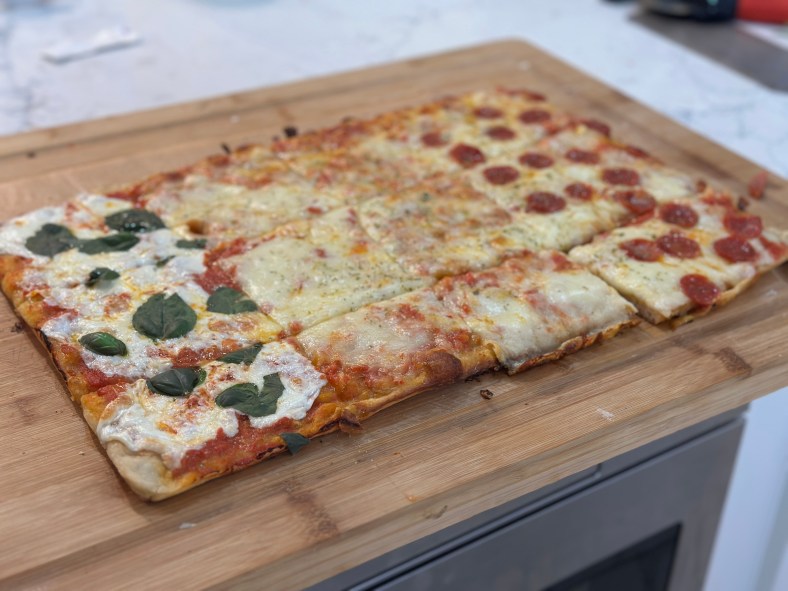
sfincione

If you think pizza means a thin, round, crisp-bottomed crust with neatly arranged toppings, sfincione (pronounced sfeen-cho-nay) is here to shake up your expectations. This is not your typical pizza—it’s thick, spongy, loaded with flavor, and dripping with history. The name itself comes from the Latin spongia, meaning sponge, which is fitting given its airy, focaccia-like texture. But while it shares some DNA with focaccia, sfincione is an entity all its own, thanks to its signature sauce and toppings that make it uniquely Sicilian.

Sfincione traces its roots back centuries, long before the modern pizza we know today took over the streets of Naples. Sicily, with its complex history of Greek, Arab, Norman, and Spanish influences, has always been a place of culinary fusion, and sfincione is no exception. Legend has it that this hearty, sauce-laden creation originated in Palermo, specifically in the kitchens of monasteries, where nuns baked it for religious feasts. It was a special treat, richer and more flavorful than everyday bread, but still simple and affordable enough for the common people. Unlike Neapolitan pizza, which became an icon of street food, sfincione was traditionally made at home, particularly around Christmastime, when families would gather to bake enormous trays of it to share.

What sets sfincione apart is its unapologetically bold sauce—a slow-cooked blend of tomatoes, onions, olive oil, and sometimes anchovies, creating a deeply savory and slightly sweet flavor. Unlike the fresh tomato-and-basil simplicity of Neapolitan pizza, sfincione’s sauce is more like a jammy, concentrated stew, meant to seep into the soft, porous dough. Speaking of the dough, it’s thicker and softer than most other pizza styles, but never heavy. It bakes up light and airy on the inside, with a crispy, olive oil-kissed crust on the bottom.

The toppings are just as distinctive. Instead of the classic mozzarella that dominates most pizzas, sfincione is typically topped with caciocavallo, a cheese that brings a sharp, tangy bite. If you’ve never had caciocavallo, imagine a firmer, more pungent cousin of provolone. Some versions also include grated pecorino for extra saltiness. Another key ingredient is the breadcrumb topping—yes, breadcrumbs on pizza! Sicilians have a knack for using breadcrumbs as a way to add texture and stretch ingredients further, and here they serve the dual purpose of soaking up all that rich sauce while adding a satisfying crunch.

Sfincione’s appearance might surprise those used to picture-perfect, symmetrical pizzas. It’s often baked in large, rectangular trays and cut into square slices, its surface an uneven, glorious mess of sauce, cheese, and crispy bits. Some versions are even more rustic, with no cheese at all, relying solely on the onions, anchovies, and breadcrumbs for flavor. This is especially true in Bagheria, a small town near Palermo, where locals fiercely defend their cheese-less, extra oniony version of sfincione as the “real” one.

Though sfincione remains a Sicilian specialty, it has made its way beyond the island. Sicilian immigrants carried their pizza traditions with them to the United States, where sfincione became the blueprint for what we now call Sicilian-style pizza—a thicker, rectangular pie that’s popular in pizzerias from New York to Detroit. But there’s a key difference: American Sicilian pizza usually has mozzarella and a more standard tomato sauce, whereas authentic sfincione stays true to its roots with its onion-laden, breadcrumb-topped goodness.

In Sicily, you don’t have to look far to find sfincione. Bakeries, street vendors, and old-school panifici (bread shops) sell it fresh from the oven, its scent wafting through the air, luring hungry passersby. It’s often sold in squares, wrapped in brown paper, and eaten on the go. In Palermo, you’ll even find sfincionari, street vendors who peddle their wares from three-wheeled carts, calling out “Scarsu di carni, ma chinu di sustanza!” which roughly translates to, “Low on meat, but full of substance!”—a proud nod to the pizza’s humble, meat-free but flavor-packed nature.

Sfincione is more than just a regional variation of pizza—it’s a slice of Sicilian history, a reflection of the island’s resourcefulness, and a testament to how a few simple ingredients can create something utterly delicious. Whether you’re lucky enough to try it in a bustling Sicilian market or decide to bake it at home, one thing is certain: sfincione is a pizza that tells a story, one crunchy, saucy, cheesy bite at a time.

Trenton Tomato Pie

f you think all pizza is just a variation of the same thing, Trenton Tomato Pie is here to prove you wrong. This New Jersey-born specialty isn’t just a pizza—it’s a philosophy. A distant cousin of the classic New York slice and the coal-fired legends of New Haven, Trenton Tomato Pie flips the script on what most people expect from a pizza by doing one simple, yet game-changing thing: the sauce goes on top.

Trenton Tomato Pie traces its roots back to the early 1900s, when Italian immigrants, particularly those from Naples, were bringing their pizza-making skills to the U.S. While New York and New Haven developed their own famous styles, Trenton (now officially called Hamilton Township, though locals still cling to the old name) was busy crafting something uniquely its own. The earliest and most legendary name in the game is Joe’s Tomato Pie, opened in 1910, but it was De Lorenzo’s Tomato Pies, established in 1936, that cemented the style’s reputation. These family-run pizzerias helped define what Trenton-style pizza was all about: a crisp, thin, yet sturdy crust, a restrained amount of cheese, and the signature move—ladling the tomato sauce over the cheese before baking.

Now, let’s talk about what makes Trenton Tomato Pie different from your average slice. The dough is stretched thin but remains firm enough to hold up under the weight of its toppings without going soggy. Unlike the airier Sicilian-style or the charred chew of a Neapolitan pie, this crust has just the right amount of crunch without being cracker-like. It’s baked in a deck oven—usually gas-fired, though some places use coal—resulting in an evenly cooked base with a golden brown, slightly blistered edge.

The cheese, typically low-moisture mozzarella, is applied sparingly, creating a more balanced bite where no single ingredient overwhelms the others. Then comes the defining feature: the tomato sauce. Unlike many pizzas where the sauce is buried beneath a blanket of cheese, Trenton Tomato Pie does it in reverse. The sauce is spooned over the cheese in dollops or a swirling pattern, allowing it to shine as the dominant flavor. This isn’t a basic, thin tomato sauce either—it’s chunky, vibrant, and slightly sweet, often made from hand-crushed San Marzano or Jersey tomatoes, simmered down just enough to concentrate the natural sweetness without losing that fresh, tangy punch.

Toppings on a Trenton Tomato Pie are kept relatively simple. Pepperoni, sausage, mushrooms, and anchovies are all common, but purists argue that the best way to experience this style is with just the essentials—dough, cheese, and sauce. That way, you can fully appreciate the interplay of textures and flavors without any distractions. One standout variation, though, is clam tomato pie, a nod to New Haven-style apizza, which adds briny, garlicky clams to the mix for a coastal twist.

Despite being overshadowed by its big-city neighbors, Trenton Tomato Pie has a fiercely loyal following. Institutions like De Lorenzo’s and Papa’s Tomato Pies (which claims to be the oldest continuously operating pizzeria in the U.S.) keep the tradition alive, serving up these old-school pies to both nostalgic locals and pizza pilgrims who’ve come to see what all the fuss is about.

In a world where pizza is often loaded with excessive toppings, heavy cheese, and thick layers of sauce, Trenton Tomato Pie stands as a testament to restraint and balance. It’s a pizza for those who appreciate the art of simplicity—where each ingredient gets its moment to shine. If you ever find yourself in New Jersey, seeking out an authentic Trenton Tomato Pie should be at the top of your food bucket list. One bite, and you’ll understand why this under-the-radar classic deserves a spot in the pantheon of America’s greatest pizzas.