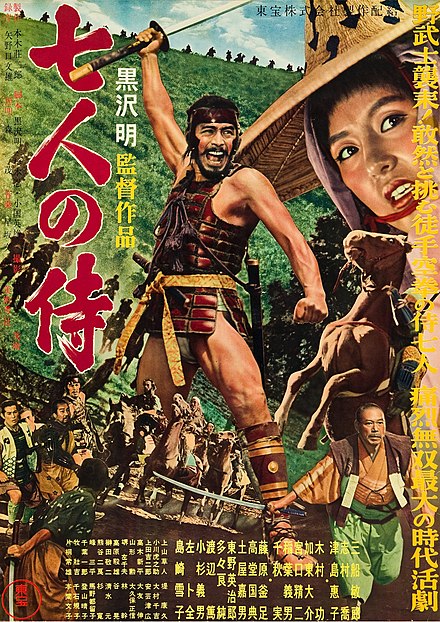
Ah, let me dive into Akira Kurosawa’s epic masterpiece about medieval gig work!
The story kicks off in 16th-century Japan, where a village of farmers discovers that bandits are planning to raid them once their harvest is ready. (Apparently, bandits in feudal Japan were considerate enough to give advance notice of their robberies.) The villagers, tired of being the medieval equivalent of a free grocery store, decide to hire samurai for protection. Their budget? Room, board, and all the rice they can eat – which, in feudal Japan’s version of a job posting, translates to “unpaid internship with meals included.”
Enter Kambei, a wise, experienced samurai who’s first seen shaving his head to rescue a kidnapped child. (If that’s not the definition of a perfect job interview, I don’t know what is.) Despite the less-than-attractive compensation package, Kambei takes pity on the villagers and agrees to help. He then starts assembling his team like it’s Ocean’s Eleven: Medieval Edition.
The recruitment process brings together a colorful crew: Katsushirō, an eager young samurai wannabe; Gorobei, who can catch arrows mid-flight (a skill that, surprisingly, does come in handy); Kyūzō, a serious master swordsman; Heihachi, the funny one who’s good with an axe; Shichirōji, Kambei’s old war buddy; and the scene-stealing Kikuchiyo (Toshiro Mifune), a wild card who’s clearly not a real samurai but makes up for it with enough energy to power a small village.
Once they reach the village, our samurai find that their job includes not just fighting bandits, but also being part-time therapists for a community with major trust issues. The farmers have hidden their women and valuables, because historically, samurai haven’t exactly been the most courteous house guests. Kikuchiyo, revealed to be a farmer’s son himself, calls out both sides for their prejudices in what must be feudal Japan’s first diversity and inclusion seminar.
While waiting for the bandits, the samurai turn the village into a fortress and train the farmers in the art of war, which goes about as well as you’d expect when teaching rice farmers to use spears. Meanwhile, young Katsushirō falls for a local farmer’s daughter, because apparently no one told him that workplace romances are complicated.
When the bandits finally attack, what follows is a series of increasingly intense battles in the rain (because Kurosawa never met a fight scene he couldn’t make more dramatic with weather). The samurai’s clever tactics and the farmers’ newfound courage turn the tide, but victory comes at a cost – four of the samurai die in the fighting, proving that even in medieval Japan, the mortality rate for temporary contract work was unreasonably high.
The film ends with the surviving samurai watching the farmers happily planting rice, leading Kambei to muse that the real winners are the villagers, while samurai just keep losing. (Though you could argue that the real losers were the bandits, who probably should have just applied for farming jobs instead.)
The whole thing serves as a poignant reminder that sometimes the best-paying jobs aren’t the most rewarding, and that if you’re going to hire security consultants, maybe offer better benefits than just rice.
In the end, “Seven Samurai” became so influential that it spawned numerous remakes, including “The Magnificent Seven,” proving that the concept of protecting villagers from bandits transcends both cultures and centuries – though the payment plans remain consistently poor.
5/5 Samurai Swords – Really just a classic movie. I love the idea of Samurai and have watched a LOT of these kind of movies (in addition to kung fu movies) such as Zatoichi and the Hidden Fortress. It’s really well acted and after a short while the subtitles became less obtrusive and and got pulled into the story. It was really well paced – the silences and ambient sounds were well placed and the on screen deaths were meaningful – hard to do character development with so many characters but Kurosawa pulled it off.
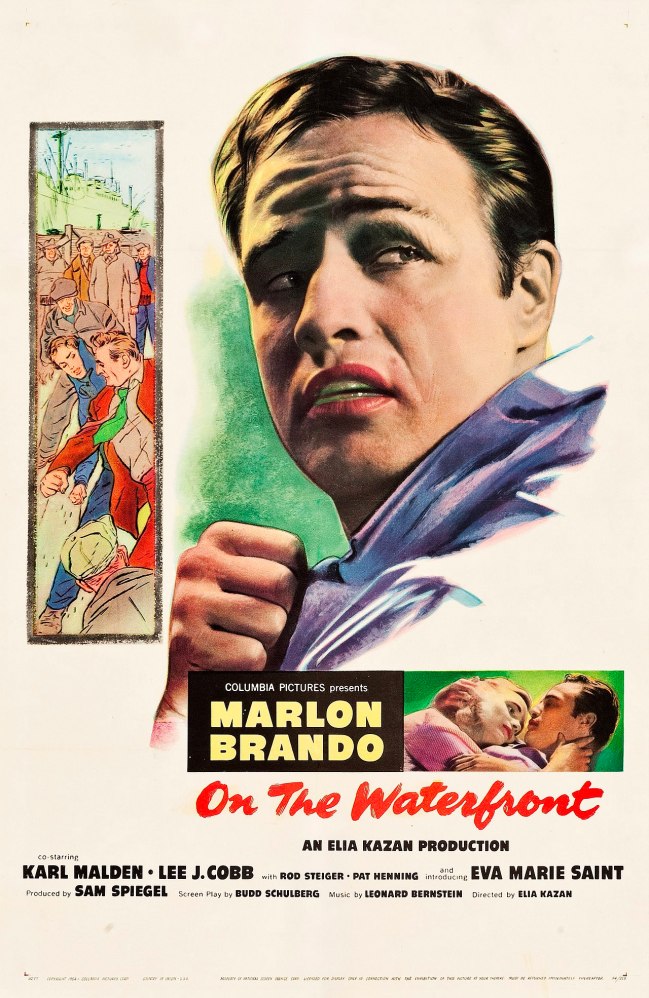
Ah, let me dive into Elia Kazan’s gritty masterpiece about corruption, conscience, and questionable career choices in the longshoremen industry!
The story follows Terry Malloy (Marlon Brando), an ex-boxer turned dockworker who spends his days doing the bidding of union boss Johnny Friendly – when he’s not tending to his rooftop pigeon coop, that is. (Nothing says “sensitive tough guy” quite like racing pigeons.) Terry’s brother Charley works as Friendly’s lawyer, making corruption a real family business.
The trouble starts when Terry unknowingly helps set up the murder of Joey Doyle, a dockworker who was planning to testify against Friendly’s corrupt union. Terry thought they were just going to “talk” to Joey, but instead, Joey takes an unscheduled flying lesson off a roof. Oops.
Enter Edie Doyle (Eva Marie Saint), Joey’s sister, who’s determined to find out who killed her brother. She’s also apparently the only person in this waterfront neighborhood who owns clothes that aren’t covered in grime. Terry starts falling for her, which really complicates his whole “pretend-nothing-happened” strategy. Meanwhile, the persistent Father Barry (Karl Malden) keeps popping up like a clerical whack-a-mole, giving waterfront sermons about standing up to corruption and making Terry feel guilty.
As Terry gets closer to Edie and more conflicted about his role in Joey’s death, Friendly starts getting nervous. More dock workers end up dead, including Kayo Dugan, who’s crushed by a “mysteriously” dropped load of whiskey cases. (OSHA would have had a field day with these working conditions.)
The turning point comes when Friendly orders Charley to make sure Terry doesn’t testify to the Crime Commission. In the famous taxi scene, Charley pulls a gun on his own brother, leading to Terry’s heartbreaking “I coulda been a contender” speech about how Charley ruined his boxing career by making him throw fights. Instead of killing Terry, Charley lets him go – and ends up dead himself, hung from a hook in an alley. (Friendly isn’t big on subtlety.)
This finally pushes Terry over the edge. He testifies against Friendly, which makes him about as popular on the docks as a punctured life vest. In the final showdown, Terry gets beaten to a pulp by Friendly and his goons, but refuses to stay down. He staggers to his feet and leads the other workers into the warehouse, breaking Friendly’s control over the dock.
The movie ends with Terry bloody but unbowed, having finally stood up for what’s right – though you have to wonder if maybe he should have considered a career change to something less dangerous, like professional alligator wrestling.
The whole thing serves as a powerful reminder that sometimes doing the right thing means getting punched in the face repeatedly, and that keeping pigeons is apparently the universal signal for “complicated character with a hidden soft side.”
5 punch drunk stars. I loved this movie – it’s got everything – romance! mobsters! Brando chewing the scenery! Brando quietly brooding! The famous ‘I could have been a contender!’ speech – just oozing 50’s cool guy vibes. The plot was a bit thin as a morality tale but it was overall well acted and engaging and worth the watch.
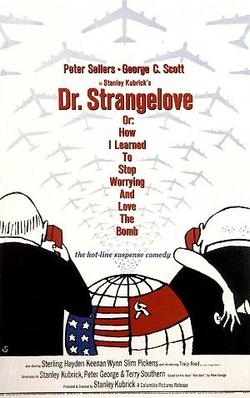
Ah, let me break down Stanley Kubrick’s darkly hilarious Cold War satire where everyone’s trying their best to avoid nuclear annihilation… and somehow making everything worse!
The film kicks off when General Jack D. Ripper, a man whose grip on reality is about as firm as his grip on proper bodily fluid management, decides to launch a nuclear attack on the USSR. His reasoning? He’s convinced the Soviets are corrupting America’s “precious bodily fluids” through fluoridation. (This is what happens when you get your medical information from questionable sources.)
Group Captain Lionel Mandrake, a British RAF officer, finds himself trapped at the base with the paranoid Ripper, trying desperately to get the recall code. Meanwhile, President Merkin Muffley (Peter Sellers in one of his three roles) assembles his advisors in the War Room, including the enthusiastically hawkish General Buck Turgidson, who treats potential nuclear war like an exciting football game.
Enter Dr. Strangelove himself (Sellers again), a wheelchair-bound ex-Nazi scientist whose right arm occasionally decides to recreate the Nazi salute (talk about muscle memory issues). He’s supposedly the expert, though his expertise seems mainly focused on underground bunkers and their potential for repopulating the Earth – with a special emphasis on the male-to-female ratio that would be “necessary.”
The situation gets even more complicated when we learn about the Soviet “Doomsday Machine” – a device designed to automatically trigger world-ending nuclear destruction if the USSR is attacked. The Soviets built it as a deterrent but hadn’t announced it yet because, as the Soviet Ambassador explains, they were saving it for a special occasion. (Because nothing says “surprise party” like mutually assured destruction.)
As bombers approach their targets, Major T.J. “King” Kong (Slim Pickens) leads his crew with cowboy enthusiasm, determined to complete their mission despite increasingly obvious signs that maybe they shouldn’t. This culminates in the iconic scene of Kong riding a nuclear bomb like a rodeo bull, which probably wasn’t in the Air Force training manual.
The film ends with a montage of nuclear explosions set to the cheery “We’ll Meet Again,” because sometimes gallows humor is the only appropriate response to the potential end of civilization.
Through it all, the film serves as a brilliant satire of Cold War politics, military bureaucracy, and the absurdity of nuclear deterrence – reminding us that sometimes the biggest threat to humanity isn’t our weapons, but the people in charge of them who insist they know exactly what they’re doing. It also suggests that maybe, just maybe, putting world-ending weapons in the hands of people worried about their precious bodily fluids isn’t the best idea.
The whole thing makes you wonder if somewhere, in some war room, there’s still a General Turgidson explaining how we can “win” a nuclear war with only 10-20 million casualties, “tops.”
4/5 ICMBs. I love Peter Seller’s comedy and him playing three roles in this movie probably set the standard for Eddie Murphy to follow in the 80’s. The comedy is absurdist and really reflects the time the movie was made and released. I’m not sure it would be very successful outside of that time however as the brand of humor is pretty specific. Overall though, superbly acted throughout even if it went a bit long in spots.
Let me lay out this twisted treasure hunt of a Western, where everyone’s moral compass spins like a broken slot machine!
The story kicks off during the Civil War, introducing us to our three protagonists – though “protagonists” might be stretching it for at least two of them. There’s “Blondie” (Clint Eastwood) who’s “the Good,” though his goodness seems mainly to consist of being slightly less awful than everyone else. Then there’s Angel Eyes (Lee Van Cleef), “the Bad,” who will cheerfully kill anyone as long as he’s been paid for it (he’s very professional about his awfulness). And finally, there’s Tuco (Eli Wallach), “the Ugly,” a fast-talking bandit who’s about as trustworthy as a rattlesnake in a sock drawer.
The film opens with Blondie and Tuco running a scam where Blondie turns in Tuco for the bounty, then shoots the rope at his hanging (usually waiting until the last possible second, because apparently Blondie has a flair for the dramatic). They split the money and move on to the next town. That is until Blondie decides to end their partnership by abandoning Tuco in the desert – which, as far as workplace resignations go, is pretty extreme.
Tuco survives (because cockroaches and Tuco are nature’s great survivors) and spends the next portion of the movie trying to get revenge on Blondie. This leads to him forcing Blondie to walk through the desert without water, which seems fair – though you’ve got to wonder if these guys have heard of mediation.
The plot kicks into high gear when they stumble across a dying Confederate soldier who reveals the location of $200,000 in Confederate gold. The catch? He tells Tuco the name of the cemetery where it’s buried and tells Blondie the name on the grave. Now they’re forced to work together, which goes about as well as you’d expect for two guys who just finished trying to kill each other.
Enter Angel Eyes, who’s been tracking this gold too. What follows is a three-way dance of alliances, betrayals, and Mexican standoffs, all while the Civil War rages around them like an inconvenient background event. Our three anti-heroes keep crossing paths with the war, getting wrapped up in prison camps and battles, though they remain impressively focused on their gold hunt despite the minor distraction of America tearing itself apart.
It all culminates in the famous three-way showdown in a massive circular graveyard, because if you’re going to have a Mexican standoff, you might as well do it somewhere photogenic. After enough tension to snap a piano wire, Blondie emerges victorious, sharing the gold with Tuco – except he’s left Tuco’s share out of reach while he’s tied up, because old habits die hard.
The whole thing is set to Ennio Morricone’s iconic score, which manages to turn “wah-WAH-wah” into high art. The film basically created the template for every subsequent movie where people squint at each other while pointing guns, which turns out to be quite a few movies.
And there you have it – a story that proves that maybe the real treasure was the enemies we made along the way, and that having a cool theme song makes everything you do about 300% more awesome.
5 Pistoleros out of 5. I’ll admit I love a good western – the genre has thinned out in recent years and not all of them a great but this is Clint Eastwood in his prime and he’s facing off against a great supporting cast (much better than that chair on the stage). The score is iconic – ecstasy of gold is right up there with what I consider one of the most iconic movie songs of all time (first place if you pretend John Williams doesn’t exist) [do yourself a favor and listen to Metallica’s cover if you haven’t its amazing]
If I didn’t have a series of other things to do this year – this would have probably knocked me into a Western movie rabbit hole. I still might go on one after this challenge is over because this movie is still resonating with me months after I watched it.
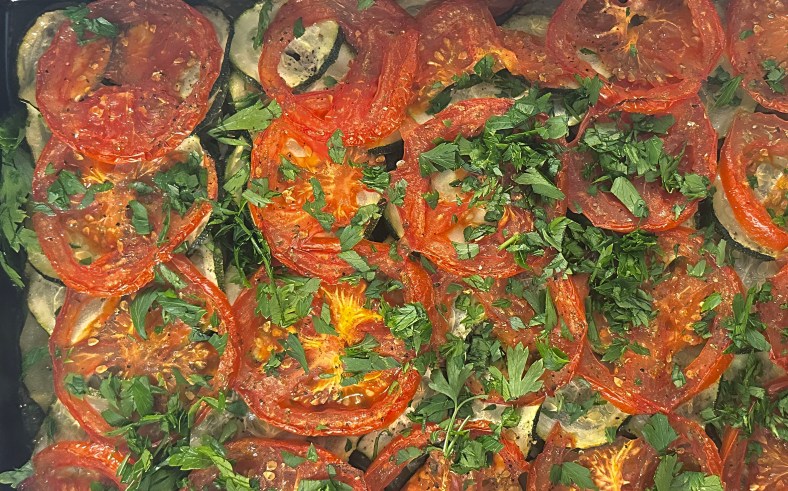
Briam is a traditional Greek vegetable dish that showcases the Mediterranean diet’s emphasis on simple, wholesome ingredients. It consists primarily of sliced summer vegetables – typically eggplant, zucchini, potatoes, and tomatoes – layered in a baking dish and generously drizzled with olive oil. Red onions, garlic, and fresh herbs like parsley and oregano are added for extra flavor.
The dish has a rich, comforting taste with each vegetable maintaining its distinct character while melding together through slow roasting. The tomatoes and olive oil create a light sauce that brings everything together, while the edges of the vegetables become slightly crispy, adding textural contrast. When properly cooked, the potatoes become tender, the zucchini maintains a slight bite, and the eggplant develops a creamy texture.
Briam is believed to have originated in Turkey and spread throughout the Balkans, with each region developing its own variation. In Greece, it’s particularly popular during summer when the vegetables are at their peak. It’s a prime example of “ladera,” Greek dishes cooked in olive oil, and reflects the resourceful nature of Mediterranean cooking where simple ingredients are transformed into satisfying meals.
I made the dish with peak summer vegetables and it was really quite good – so much so that next summer I have plans to make it again, perhaps with some tweaks!
Maafe has its origins in the Manding (Mande) people, who historically inhabited present-day Senegal, Mali, and Guinea. It is believed to have been created centuries ago, when groundnuts (peanuts) were introduced to Africa through Portuguese traders in the 16th century.
Over time, peanuts became a staple crop in West Africa, leading to the development of rich, peanut-based stews like Maafe. The dish spread across the Sahel region, becoming a fundamental part of the cuisines of Mali, Gambia, Guinea, Nigeria, and Ivory Coast.
While Maafe is most closely associated with Senegal, it is widely popular across Francophone West Africa, with slight variations in ingredients and cooking techniques depending on the region.
What is Maafe?
At its core, Maafe is a peanut-based stew, thickened with tomatoes, spices, and vegetables, and often served with rice, couscous, or fufu. The dish’s rich, nutty flavor is balanced by the acidity of tomatoes, the savoriness of slow-cooked meat, and the earthy warmth of West African spices.
Essential Ingredients of Maafe:
Meat (or Protein): Typically chicken, beef, lamb, or even fish. Some vegetarian versions use tofu or chickpeas.
Peanut Butter (Groundnut Paste): The defining ingredient, giving the dish its signature creamy texture and nutty richness.
Tomatoes & Tomato Paste: Adds depth, acidity, and umami.
Onions & Garlic: Provide a strong aromatic base.
Vegetables: Often includes carrots, sweet potatoes, cabbage, okra, or potatoes for added heartiness.
Spices:
Ginger & Bay Leaves – For warmth and fragrance.
Chili Peppers or Scotch Bonnet – For a spicy kick (Maafe can be mild or fiery!).
Cumin & Coriander – For subtle earthiness.
Stock or Water: Helps create the luscious, thick sauce.
Some regional versions add coconut milk for extra creaminess, while others incorporate mustard, tamarind, or fermented locust beans for a deeper umami flavor.
Tasting Notes: A Perfect Balance of Nutty, Savory, and Spicy
A bowl of Maafe is deeply satisfying and complex:
The peanut butter gives it a creamy, silky texture, coating every bite with rich, nutty flavor.
The tomatoes add a bright acidity, balancing the richness of the groundnuts.
The meat is fork-tender, infused with the slow-simmered spices and sauce.
The vegetables absorb the flavorful broth, adding natural sweetness and texture.
The spices and chili bring a gentle heat, making every bite warming and fragrant.
Maafe’s comforting richness makes it the perfect dish for both everyday meals and festive occasions.
How Maafe is Served
Maafe is traditionally enjoyed as a communal meal, served with a starchy base to soak up the flavorful sauce.
Common Accompaniments:
Steamed White Rice – The most common pairing, allowing the peanut sauce to shine.
Couscous – Popular in Senegal and Mali, giving a light, fluffy contrast to the thick stew.
Fufu (Pounded Yam or Cassava) – A traditional West African choice, perfect for scooping up the sauce.
Bread – Sometimes served with crusty baguette (a French colonial influence).
In Senegal, Maafe is often eaten family-style, with people gathered around a large communal bowl, scooping up the stew with rice or bread.
Beyond Senegal: Maafe’s Influence Across West Africa
While Maafe is most famous in Senegal, it has many variations across West Africa:
In Mali, it’s called Tigadegena and often includes more vegetables.
In Gambia and Guinea, it is spicier and sometimes made with fish instead of meat.
In Nigeria and Ghana, peanut stews are similar but use local spices and ingredients.
No matter the version, the rich, nutty, and deeply comforting essence of Maafe remains the same.
Why Maafe is One of Senegal’s Most Beloved Dishes
✔ Rich & Flavorful – A perfect harmony of peanuts, tomatoes, and spices. ✔ Comforting & Hearty – A warming, satisfying meal that fills you up. ✔ Versatile – Can be made with chicken, beef, lamb, fish, or even vegetarian. ✔ A Dish with History – A centuries-old recipe with deep cultural roots in West Africa. ✔ Perfect for Sharing – A communal dish that brings people together over good food.
Whether you’re enjoying it in Dakar, Bamako, or your own kitchen, Maafe is a taste of West African tradition in every spoonful.
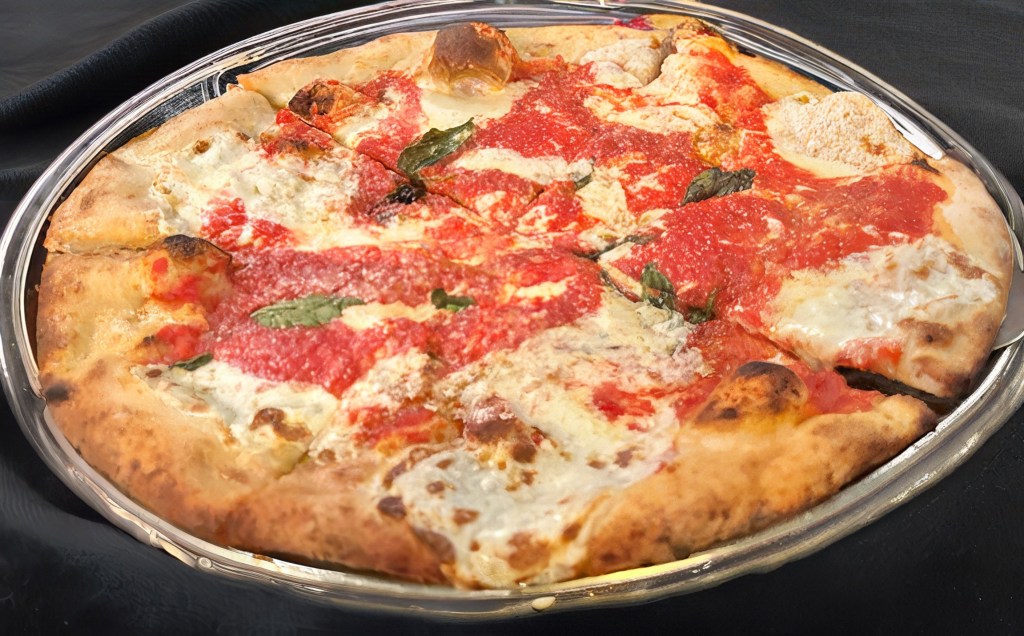
Margherita Sbagliata is a pizza that turns tradition on its head while still honoring the essence of what makes a classic Margherita so beloved. In Italian, “sbagliata” means “mistaken” or “wrong,” a word that suggests a happy accident or an intentional twist on the original. Much like the Negroni Sbagliato, where prosecco replaces gin for a lighter, sparkling take on the cocktail, Margherita Sbagliata takes the familiar ingredients of a traditional Pizza Margherita and rearranges them in a way that challenges expectations while delivering a completely satisfying experience.
At first glance, it might not even look like a Margherita pizza. The typical structure—red tomato sauce, white mozzarella, and green basil, meant to mirror the Italian flag—is flipped, reimagined, or even deconstructed depending on the pizzeria or chef making it. In some versions, the tomato is no longer the base but instead appears in chunks, roasted or semi-dried, scattered atop a white pizza, where a layer of fior di latte or burrata takes center stage. The result is a pizza that still tastes unmistakably like a Margherita but with a different balance of textures and flavors. Instead of a thin layer of tomato sauce seeping into the dough, the concentrated bursts of roasted or blistered cherry tomatoes add a more intense, almost jammy sweetness that contrasts beautifully with the creaminess of the cheese.
Another version of the Margherita Sbagliata plays with the cooking process, adding the tomato only after the pizza has baked, rather than spreading it onto the dough before it goes into the oven. This method, sometimes referred to as a reverse Margherita, allows the crust to develop a deeper char and crispness without absorbing moisture from the sauce, resulting in a more defined chew and crunch. When the pizza comes out of the oven, crushed or puréed tomatoes—sometimes raw, sometimes lightly cooked—are spooned over the bubbling cheese, creating a fresh and slightly unexpected contrast between the warm crust and the bright acidity of the tomato.
Some interpretations go even further, introducing ingredients like stracciatella, ricotta, or even smoked mozzarella to enhance the richness of the cheese element. Instead of the traditional basil leaf, some versions finish with a basil-infused oil or delicate microgreens, offering the herbal note in a more subtle, modern way. The flexibility of Margherita Sbagliata makes it an exciting canvas for chefs to experiment with while still keeping it firmly rooted in Italian tradition.
Despite the changes in presentation and technique, the fundamental appeal of this pizza remains the same as the original Margherita: a perfect harmony of dough, tomato, cheese, and basil. The “mistaken” part of its name is, in reality, anything but a mistake—it’s a rethinking of a classic that brings out different elements of its flavor profile, sometimes highlighting the brightness of the tomatoes, sometimes leaning into the creaminess of the cheese, sometimes emphasizing the crispness of the crust. It’s a variation that celebrates tradition while embracing the creativity that has always been a part of Italian cooking.
In Naples, where pizza is treated with near-religious devotion, you’re more likely to find the traditional Margherita reigning supreme, but in cities like Rome, Milan, and even international pizza hubs in New York or London, Margherita Sbagliata has carved out a niche as a modern, inventive alternative. Whether ordered in a trendy pizzeria or recreated at home with high-quality ingredients, it offers a fresh perspective on something familiar, proving that even a classic like the Margherita still has room for reinvention.
This one was a bit more of a challenge than I originally anticipated. While I don’t frequent fast food places with any regularity I did hit them up a couple of times a month when I was in a hurry or was leaving work late and needed to grab something for myself on the way home. Tacking on “junk” food also ramped up the difficulty because I do love snacking throughout the day. Given all these factors, I knew that I would need to plan accordingly to counteract some pretty ingrained habits.
I stocked up on healthy snacks like nuts and fruit and in order to not grab a McMuffin on the way to work (a sometimes vice I quite enjoy) I opted to make this 30 days the one where I did intermittent fasting as well. By avoiding breakfast altogether there’s no need to figure out what I needed to replace my weekly stop with.
The first week was the roughest – mostly due to having to reprogram some habits that were pretty ingrained. Late afternoon hunger hit and where I would normally grab some chips or something like that I opted for some cheese or fruit. It just didn’t hit the same though. When I switched to some bread and olive oil with some spices in it that really became my go to snack.. sometimes with a bit of mozzarella or some fruit I think it was the savoriness I was missing which the peppery olive oil seemed to satisfy.
The weeks after because easier as I settled into a routine. The fasting helped by resetting my hunger signals (which has happened all the other time I fasted as well) allowing me to make more reasoned choices instead of just deciding to grab a burger or slice of pizza for lunch I opted for healthy choices instead.
I did, however, have pizza during this but it was pizza I made myself so I knew it was clean and had no chemicals or any additives but towards the end I really was craving a burger and fries.. so at the end of the 30 days I went to Red Robin with my kids and housed a burger and fries with complete abandon.
While my taste buds were happy the rest of my body was like ‘Bruv – what you doing?’ and I regretted not easing my way into a junk food meal – maybe a small burger and fries would have been a better option? I guess we’ll never know…
Regardless I found the month off junk food to be a mixed bag. I thought I’d feel healthier and have more energy but it was about the same which I found really odd. I know that the food is really not great for me so I’ve committed to eating less of it overall but cutting it out entirely? I don’t think that’s really something I’m willing to do as pizza and burgers are my comfort foods and my go-to when I just need something to slam my salt and fat receptors and kick off my dopamine rush.
Billy Wilder’s “Sunset Boulevard” kicks off with possibly the most attention-grabbing opener in film history – our narrator is floating face-down in a swimming pool, and he’s, well, dead. Talk about starting with a bang! This deceased fellow is Joe Gillis, a down-on-his-luck screenwriter who then takes us back six months to explain how he ended up as pool decor.
It all starts with Joe running from repo men trying to snag his car (because apparently being a Hollywood writer wasn’t quite as glamorous as the brochures suggested). During his escape, he conveniently gets a flat tire and pulls into what appears to be an abandoned mansion on Sunset Boulevard. Except it’s not abandoned – it’s the home of Norma Desmond, a forgotten silent film star who’s been living in her own private time capsule with her intensely creepy butler, Max.
Norma, who’s about as stable as a Jenga tower in an earthquake, has written a massive screenplay about Salome that she’s convinced will be her “return” (don’t you dare say “comeback”!). She hires Joe to edit it, though “traps” might be a better word. Soon enough, Joe finds himself installed as Norma’s kept man, living in luxury but feeling increasingly like a pet hamster in a gilded cage. The woman buys him expensive clothes, throws lavish parties where she’s the only guest, and watches her old silent films with the kind of devotion usually reserved for religious experiences.
Meanwhile, Joe starts secretly working on a screenplay with Betty Schaefer, a young script reader who’s engaged to his best friend Artie. Because apparently Joe hasn’t noticed he’s living in a film noir and this can only end badly. As Joe and Betty fall in love, Norma becomes increasingly unstable, attempting suicide when she thinks Joe might leave her (manipulation level: expert).
The whole thing comes to a head when Joe finally tries to break free. He tells Norma he’s leaving and that her dream comeback is never going to happen – her fan letters have been written by Max all along (who, in a twist that would make Freud need a lie-down, turns out to be both her ex-husband AND her former director). Norma, taking rejection as well as you’d expect from someone who hasn’t heard the word “no” since 1925, shoots Joe three times, bringing us full circle to our swimming pool opening.
The finale is pure Hollywood grotesque – Norma, completely detached from reality, descends her grand staircase believing she’s filming her great comeback scene, while the police and news cameras capture her final performance. “I’m ready for my close-up, Mr. DeMille,” she announces to the waiting cameras, having fully retreated into her own private fantasy world where she’s still the greatest star of them all.
And there you have it – a cautionary tale about Hollywood, fame, delusion, and why you should always pay your car payment on time. Also, maybe don’t move in with mysterious former silent film stars, no matter how good their pool looks.
4/5 sad stars. I’ve always heard the line ‘I’m ready for my closeup Mr. Deville’ and I never knew where it was from until I saw this movie. It was a really good film – if a little unsettling. This poor woman a victim of Hollywood and it’s pursuit of beauty and youth has a mental break and is essentially taken advantage of by Joe who’s really in it for the free house and cash. I feel like Joe got what was coming to him – I mean he stole his best friend’s gal as well – the guy is morally bankrupt and I didn’t feel bad at all that she John Wick’d his ass
OK. So I like pizza. I mean.. you say you like pizza sure.. but not like I do. I don’t think I’ve gone pizza-less for more than a week my entire life. When I was just starting my career and saving money I used to get 2 for 1 pizzas on Tuesdays from the local pizza place and just eat slices of pizza for dinner until I had a few paychecks in the bank and could… get fresher pizza. I mean, one of my goals is to make 50 different pizzas.. during COVID I bought a 50 pound bag of flour and we ate a LOT of pizza.
One of the things I never really did was go visit popular or famous pizza places (sometimes arguing I can make them just as well at home). While I was trying to come up with 50 goals I was really struggling with the last few and thought to myself “You know what, you need to fit more pizza into this” so that’s where this goal came from.
I took in a lot of top 10 pizza lists, reddit rankings, barstool pizza reviews (one bite, everyone knows the rules) and other sources of pizza knowledge to create a list of places I should go. You’ll notice that most of the are in the Northeast which we all know is the mecca of good pizza. Sorry all you other states trying to claim your doughy bread casseroles are pizza.. the tri-state area is where it’s at.
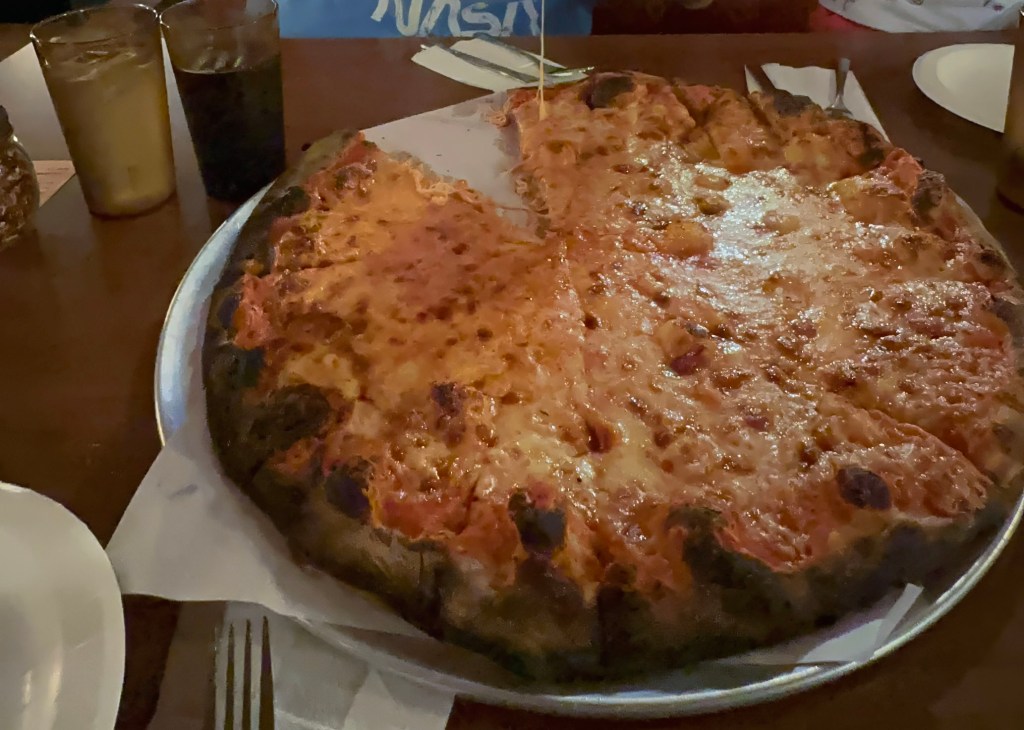
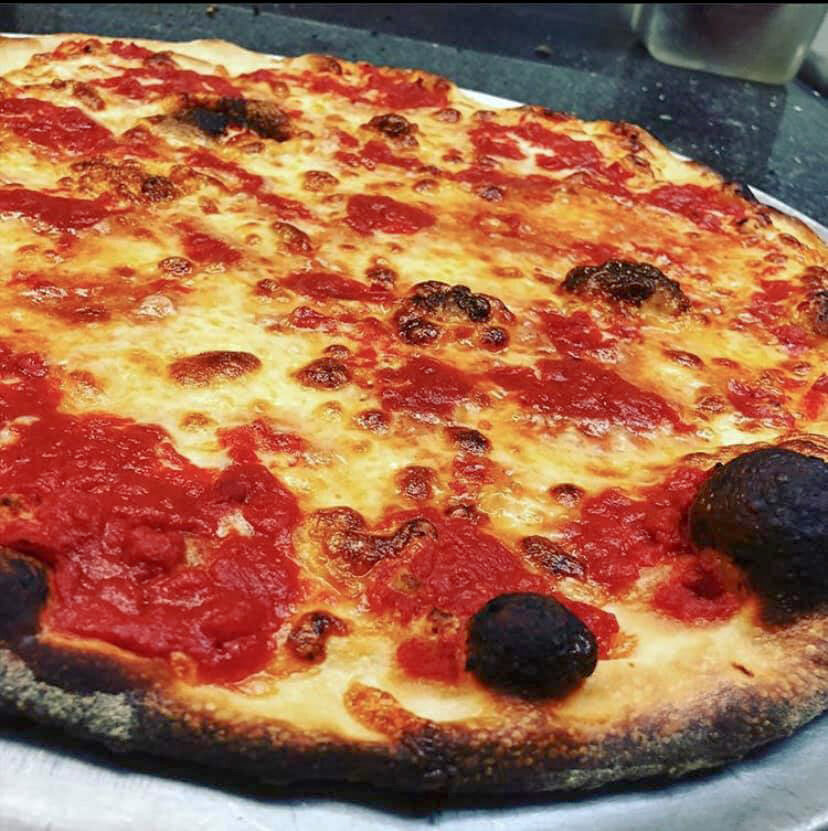
Modern Apizza – New Haven, CT Considered one of the top thee New Haven pizza places – this was recommended on nearly every list I researched. Located away from downtown New Haven in a relatively quiet neighborhood it’s unassuming other than the giant metal slice of pizza sculpture. We got there somewhat early so we didn’t wait for a seat (there was a pretty long line when we left). The place was relatively small but the service was fast and the pizza arrived perfectly charred with a strong tomato aroma. The first slice had an epic cheese pull – they don’t skimp on the cheese here! It had a strong tomato taste and chewy tangy cheese that melted altogether into what I consider a perfect slice. The crust was thin and crispy but strong enough to hold up all that cheese and had it’s own character.
Score: 9.2
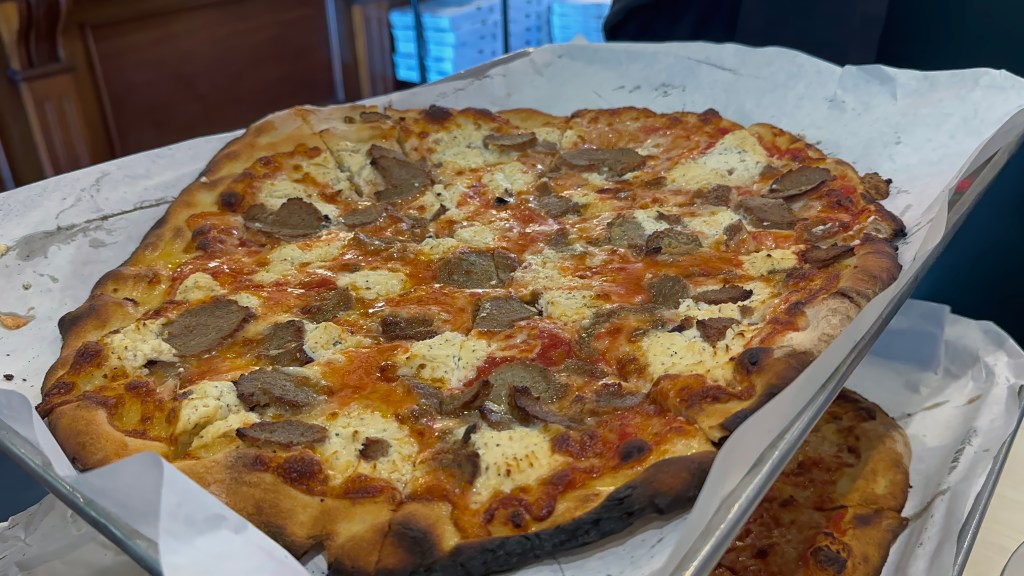
Frank Pepe’s Pizza – New Haven, CT The second of the big three, this is one I’ve been to before. It’s one of the most popular pizza places (as well as the oldest) and as such there’s usually a long line. On super busy days they open an overflow seating area but I’ve never been there when that has happened so I got to sit in the main restaurant. It’s a treat because the pizza oven is visible from the front room and you can see the staff working like a well oiled machine feeding the pizzas into the coal fired ovens with excessively large pizza peels. This time around I got my usual cheese pizza but also ordered a meatball pie with ricotta. The pies arrived in a timely manner and the cheese pizza was nice and charred. The sauce wasn’t too heavily spiced and they had a really light hand on the cheese. Even with the light hand there was some oil pooling which detracted from the experience. The crust was thin and crispy with little to no dip when you picked up the slices. The meatball pie with ricotta though was a revelation – instead of dabs of ricotta like most pizza places they dabbed on ravioli filling and each bite of the filling was amazing. I can see why this place is so popular – even after so many years they are still slinging some high quality pies.
Score 8.9
Papa’s Tomato Pies – Robbinsville NJ
Located in Robbinsville NJ (originally from Chambersburg in Trenton until they moved about 15 years ago) this iconic tomato pie place continues the trend of famous pizza places located right next to other (see Sally’s and Pepe’s) as DeLorenzo’s is right down the road. Tomato pies are a bit of a misnomer as they aren’t like Philly tomato pies (an abomination they dare to call a pizza) they just put down the cheese first then sauce it with hand crushed tomatoes and a dusting of spices/cheese. The crust is well done but not charred like New Haven style and the tomatoes are sweet which is a great counterpart to the savory cheese that they use. They offer a mustard pie which is intriguing but I opted for the straight plain pie which is the bar I rate each place at. There’s quite the debate amongst the locals which one is best – I side with Papa’s as they hit the right amount of well done with the pie while DeLo’s can come out really dry and overcooked.
Score: 8.7
DeLorenzo’s Tomato Pies – Robbinsville NJ
Located right down the street from Papa’s this place was also originally in Trenton before they moved to Robbinsville. There’s two locations in the area – this one which is based off the original and another one by the train station in Hamilton. I prefer this place as it feels more authentic. The pizza is cracker thin and really well done. The tomatoes are sweet and they use a good amount of cheese. They also cut the pizza in random shapes which I’m sure is a cute way to be different but it ends up with huge slices and tiny side slices. Just cut it into 8 slices – lets be civilized. They have a no Parmesan cheese rule which I support and here’s an important caveat: These pizzas do not travel well. You can get them to go but its a completely different experience. You need to eat them in the restaurant right out of the oven for the optimal experience. I’ve eaten here a few times and it’s hit or miss with how well done it is. Sometimes it is legitimately overcooked and dry and sharp crust splinters attack your gums like an angry wolverine. However when they hit the mark it really is an amazing pizza experience
Score: 8.7
John’s of Bleecker Street – NYC
Consistently at the top of NY Pizza rankings; John’s is a tiny pizza place on Bleecker street offering up some traditional NY style pizzas. Waited in line for about 40 minutes on a Saturday night (I was already in the city with friends and we wanted some good pizza) and got stuffed into a tiny booth with barely any room to breathe let alone eat. Ordered the plain cheese and the white pie – both highly recommended. The pizzas came out pretty quick – most likely due to the fact they had so few booths in the place they really needed to move pies to get that turnover they want. The cheese pull was fantastic and the dough was crispy and flavorful. The sauce was very simple – just some crushed tomatoes but it tasted a bit flat – I suspect it needed some salt or something else to dress it up. I enjoyed the very old school decor and ambiance – it felt very old NY.
Score: 8.5
Grimaldi’s – NYC
Classic Neo-neapolitan pies – not crispy like NY, or soft like Naples somewhere in the middle. This time around we hit up the one that was located in what used to be the Limelight nightclub. It was a bit of a mental struggle to reconcile my memories of the club with taking my kids there for pizza. Of course I didn’t fill in the kids about all the fun I had there.. but I did explain to them people used to come here to listen to music and dance. They seemed to get a kick out of that. The pizza came out pretty fast but like John’s the cheese/sauce lock was off and there was a bit too much bare crust at the edges. However the sauce as really savory and packed full of flavor and the cheese was a great balance. It really was a great tasting pie and I’d say comparable to the one located in Brooklyn. Overall the balance was just right and the crust was light and a bit crispy – the sweet spot for this type of pizza.
Score: 9.1
Pizzeria Errico Porzio Lungomare – Naples, Italy
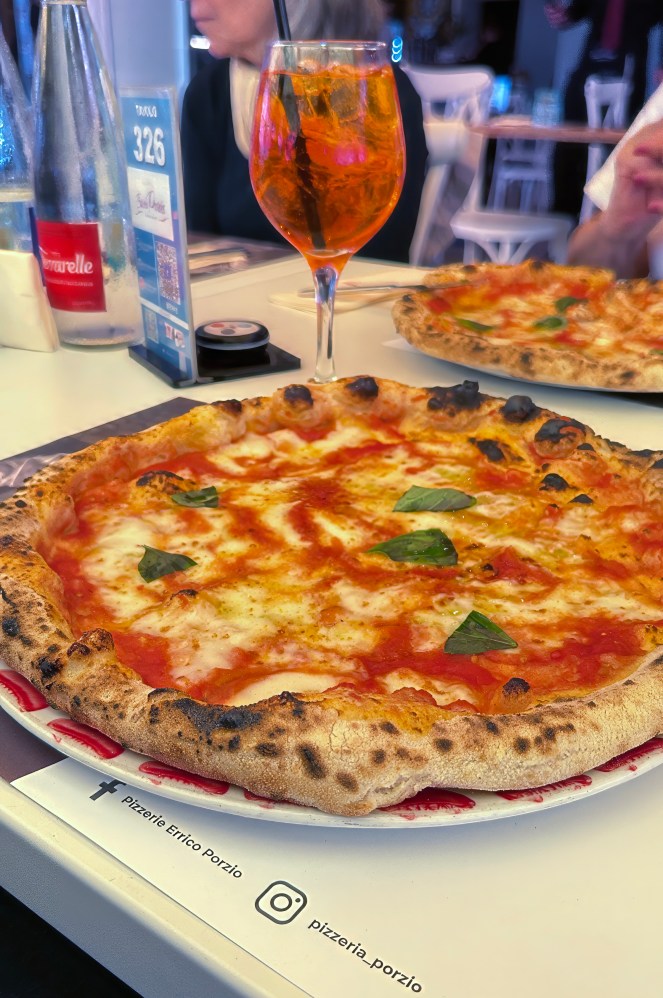
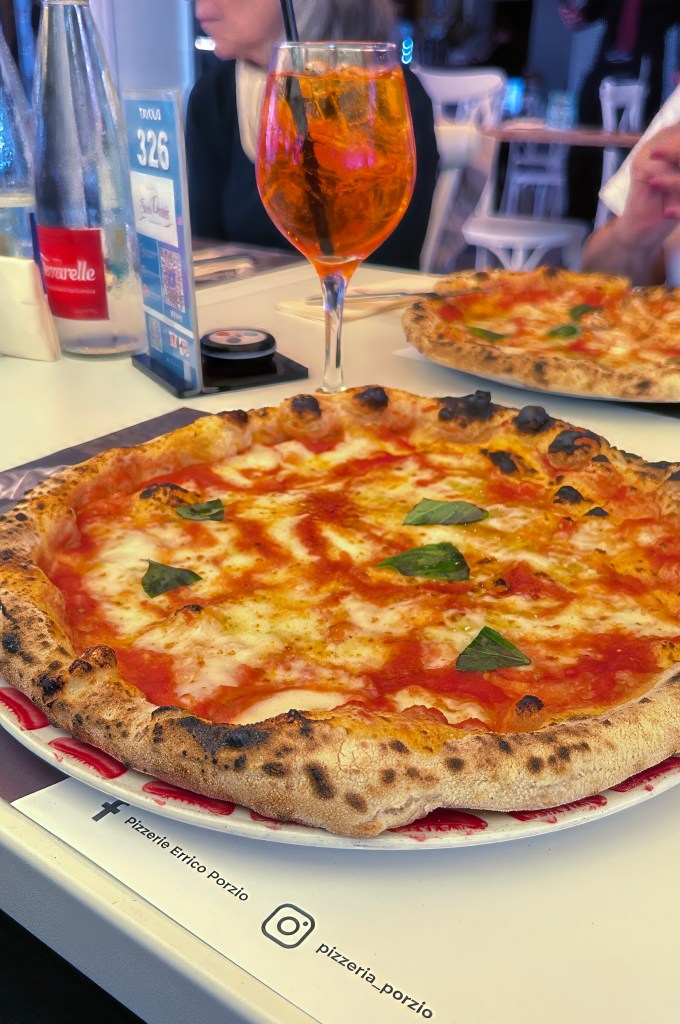
One of my goals this year was to visit my father’s home town in Italy and see the family I had there. I explained to them that I was looking for the best Neapolitan pizza they had and he really talked up this pizzaolo Errico Porzio – showing me his Instagram and saying he’s a pretty big deal in Naples. One afternoon we’re walking along the Lungomare and my step mom is starving so I try to be helpful and say ‘Che Ore Mangiamo?’ to my cousin and we just happened to be right by this pizzeria so we stopped in to see what all the fuss is about. I of course just got the classic margherita pizza (with the obligatory spritz) – if you’re going to the source you need to get the classics! Maybe it was the hype, the fact I was in Naples facing the bay with Vesuvius in the background.. but this had to be one of the best pizzas I’ve ever eaten. The dough was soft but with a hint of crunchiness, the sauce was unadorned and has that san marzano sweetness.. the kiss of the wood fire. Just.. 🤌 Bonus: As I was getting ready to leave my cousin notices Errico walking through and calls him over to take a photo with me which was a pretty cool experience. I tried to express how good the pizza was in Italian then he asked me some rapid fire questions in Italian and I had no idea what he said haha
Score: 9.8
BAR – New Haven CT
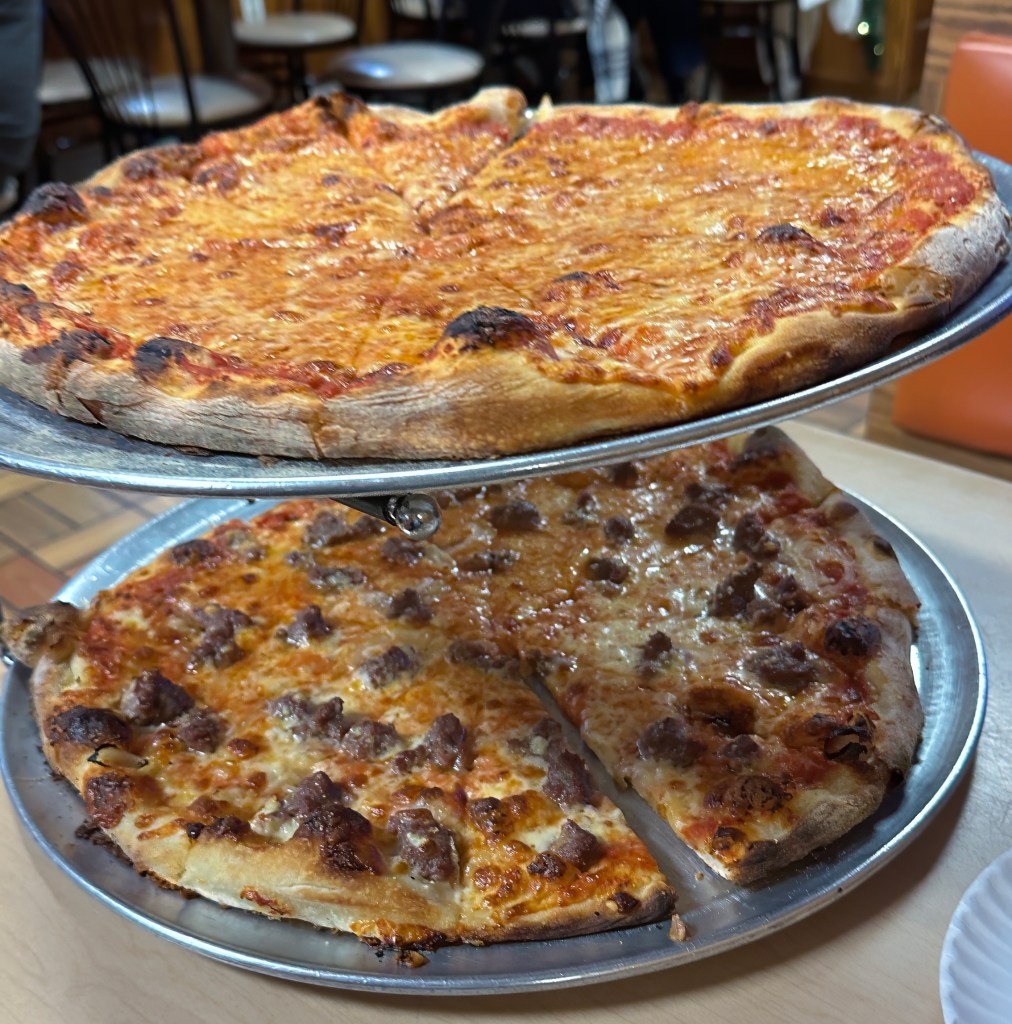
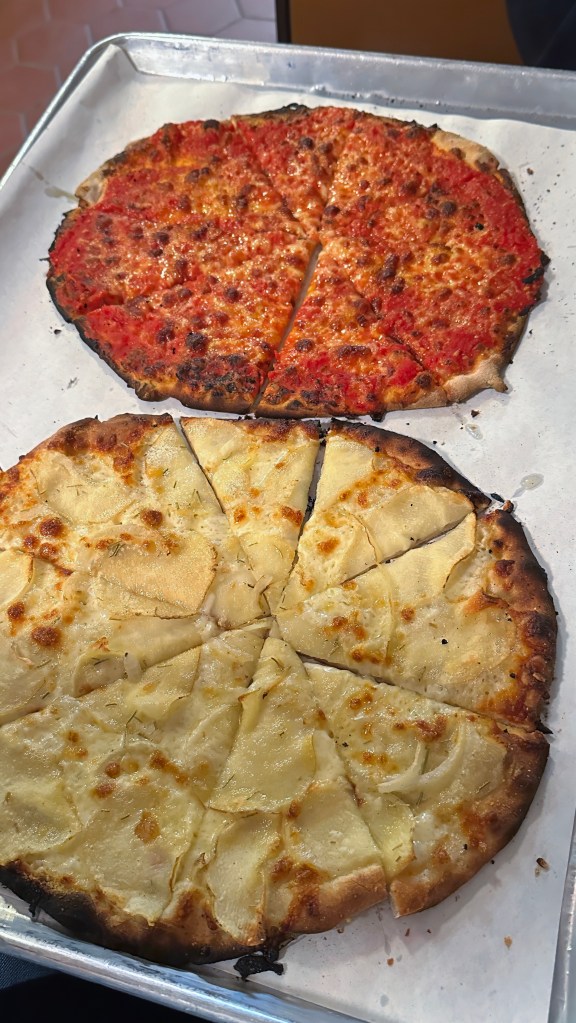
I wasn’t sure about this place – the people on the internet were raving about it but it just seemed like a brewery which happened to serve pizza which I wasn’t optimistic about. I was in New Haven with a buddy for a quick pizza run so we decided to try a new place and see what the hype was. We got there and had to go to the bar to order – and we decided to order two medium pies (we were hungry) one plain and one white pie. We also got a few beers to tide us over – mine was a cherry wheat beer that really was quite good. When the pies arrived I though we made a mistake the medium pies came out in a full sheet pan. They where massive. I don’t even want to know what the large pie was served on. Daunted by the acres of pizza in front of us we dug in. The sauce was flat and lacked any real flavor – it was almost watery and the cheese was overcooked and dry. The crust was extremely thin and cracker like but lacked any defining flavors. The white pie fared better but the garlic in it was a bit overpowering I think to compensate for the lack of flavors elsewhere. Overall a middling experience – It’s still pizza in the end but after eating at the other New Haven spots this really didn’t live up to the hype.
Score: 6.2
Zuppardi’s – New Haven CT
Another highly recommended place, it as a bit off the beaten path in West Haven CT in a residential neighborhood. It really seemed out of place it’s all just residential houses then BAM pizza place.. then more houses. I suspect it was here before the neighborhood rose around it. Either way it was a bit different from the other New Haven spots in that it used a gas oven and put out pretty standard round pies. We ordered the usual plain cheese then a meatball and onion. The cheese pizza was pretty good – nice char on the crust, tangy sauce and a lot of cheese but it didn’t stand out compared to other New Haven spots and really felt like a NJ/NY pie. The meatball pie was interesting that the onions were sliced so thin they melted into the sauce and provided a kick of flavor without the usual onion texture. I was so impressed I ordered a fancy mandolin the next day so I could start experimenting with super thin slices of toppings. Overall a really good pizza but nothing about it made it stand out compared to all the other spots I visited.
Score: 8.2
Sally’s – New Haven CT
I’m going to tiptoe the line of heresy here and say I really don’t care for the apizza at Sally’s. The sauce has way too much going on, the cheese is a bit heavy and it takes forever to get your pizza (easily the longest wait I’ve had this year). I understand for some people it’s their favorite of the big three but the couple of times I’ve eaten here I’ve been underwhelmed. Now, I’m not saying it’s not good – it’s just not the pizza I like. I like my sauce to be plain – I sauce my pizzas with just tomatoes and a bit of salt. When you start doctoring your sauce to amp up the flavor you start to lose me. The person I was with loved the pizza and rated it higher than some of the other places so I can see that it’s completely subjective. The pizza had a good char and generous toppings so I can’t find fault there but all this being said this is me rating pizzas that I am eating so the score will reflect that it’s not something I particularly enjoy.
Score: 8.0
Federicis – Freehold NJ
I’m not sure this rises to the level of ‘Fame’ but if does show up quite frequently in “Best Pizza in NJ” lists. The crust is thin – I mean really thin – it was such a crispy and thin crust that I ate 4 slices and barely felt full. The plain cheese is good with a nice mozzarella stretch and the sauce is lightly flavored but tomato forward. The only issue I had is that I was expecting the thin crust pizzas to be approaching well done but this pizza was very light – I felt like it was taken out of the oven a bit too early as the crust was a pale blonde color with just a little bit of char on the ears. I still enjoyed the pizza but the under cooked cracker thin crust gave it a bit of a bowling alley pizza vibe that it had to work hard to overcome.










 50for50tony.me