Worldwide Food Tour – England

A Dish Born from Frugality and Tradition

Few dishes in British cuisine are as cherished and steeped in tradition as Yorkshire pudding. Though humble in its ingredients, this golden, airy delight is an essential component of a traditional Sunday roast dinner in England. Originally devised as a way to make the most of a meager pantry, Yorkshire pudding has become a symbol of British culinary ingenuity, transforming simple batter into a crispy-yet-pillowy accompaniment.

Hailing from Yorkshire in northern England, this dish has been enjoyed for centuries, evolving from a frugal side dish to a nationally beloved comfort food. Whether served with roast beef and gravy, as part of a full meal, or even as a dessert with jam, Yorkshire pudding is a testament to the versatility of British cooking.


The History: A Clever Way to Stretch a Meal

Yorkshire pudding has its roots in the 18th century, when it was first recorded as “dripping pudding.” Before ovens had regulated temperatures, large joints of meat were roasted on spits over an open fire, with fat and juices dripping down into a pan placed below. Cooks in Yorkshire realized that if they poured a simple batter of flour, eggs, and milk into that pan, it would puff up and become a satisfying, crispy, and slightly chewy dish—perfect for filling up hungry diners before the costly meat was served.

The earliest known recipe appeared in Hannah Glasse’s 1747 cookbook, “The Art of Cookery Made Plain and Easy,” where it was officially named Yorkshire Pudding. Over time, the dish became a staple across England, particularly as a companion to roast beef in a traditional Sunday roast.

The importance of Yorkshire pudding in British culture is so profound that in 2008, the Royal Society of Chemistry even declared that a proper Yorkshire pudding must rise at least four inches to be considered authentic!


What is Yorkshire Pudding?

Despite its name, Yorkshire pudding is not a dessert like an American pudding but rather a savory baked dish made from a thin, pancake-like batter. It is light and airy on the inside while crispy and golden on the outside.

A classic Yorkshire pudding is made from four key ingredients:

  • Flour – Provides structure and crispness
  • Eggs – Help create a light, fluffy texture
  • Milk – Adds richness and forms a smooth batter
  • Beef Drippings or Oil – Essential for achieving a crisp, golden exterior

The secret to a successful Yorkshire pudding lies in extremely hot fat and a very hot oven. The batter is poured into preheated, smoking-hot muffin tins or a roasting pan with beef drippings, causing an instant sizzle that helps create the classic dramatic rise and hollow center.

It can be made in individual portions (muffin-sized) or as a large, pan-baked pudding that is sliced and served.


Tasting Notes: A Delicate Balance of Crisp and Airy

A well-made Yorkshire pudding delivers a satisfying contrast in textures:

  • The exterior is crisp and golden-brown, with a delicate crunch that shatters slightly as you bite in.
  • The interior is soft, eggy, and airy, almost like a popover or a soufflé, but with a bit more chew.
  • The flavor is rich and slightly savory, enhanced by the depth of the beef drippings if used. However, it remains neutral enough to soak up gravy, meat juices, or even sweet toppings like jam when served in different contexts.

Yorkshire pudding is best enjoyed fresh from the oven, when its textures are at their peak.


How Yorkshire Pudding is Served

1. The Classic: With Roast Beef and Gravy

The most traditional way to enjoy Yorkshire pudding is alongside roast beef, gravy, and vegetables in a Sunday roast dinner. The pudding is perfect for sopping up the rich, meaty juices, adding both texture and flavor to the meal.

2. As a Starter (Old Tradition)

Historically, Yorkshire pudding was served before the main meal, drizzled with gravy. This was a way to fill diners up cheaply before the more expensive meat was served.

3. Toad in the Hole

Another British classic, Toad in the Hole, takes the Yorkshire pudding batter and bakes sausages inside it, creating a heartier, more substantial dish.

4. As a Dessert

In some parts of England, Yorkshire pudding is even served as a sweet dish, topped with golden syrup, jam, or even cream—a testament to its versatility.


Beyond Yorkshire: A Dish Loved Around the World

While Yorkshire pudding is most famous in England, similar dishes exist in various forms across the world. The American popover is nearly identical, and the Dutch baby pancake shares many similarities but leans more toward the sweet side.

Today, Yorkshire pudding is a staple in British households and pub menus, and its reputation continues to spread globally. Whether paired with a roast, sausages, or even something sweet, Yorkshire pudding remains a timeless, comforting delight that embodies the heart and soul of English cuisine.


St. Louis Style Pizza

If you’ve never had St. Louis-style pizza, get ready for something totally unexpected. This Missouri-born creation defies every traditional pizza rule in the best way possible—starting with the fact that it’s cut into squares, not slices. That’s right, in St. Louis, pizza isn’t served in the familiar triangle shape but instead in a grid of bite-sized squares, thanks to what’s known as the “party cut” or “tavern cut.” But the unique slicing method is just the beginning of what sets this style apart.

First and foremost, the crust is unlike any other. Instead of a chewy, airy dough, St. Louis-style pizza has an ultra-thin, cracker-like crust that snaps rather than bends. There’s no yeast involved, which means the dough stays flat and crispy, giving each bite a satisfying crunch. This makes it one of the few pizzas that you definitely cannot fold—and honestly, you wouldn’t want to. The crisp texture is the backbone of the entire experience.

Then there’s the cheese—and this is where things get really St. Louis. Unlike most pizzas that use mozzarella, St. Louis-style pizza is topped with Provel cheese, a hyper-local blend of cheddar, Swiss, and provolone. Provel is an acquired taste—it’s ultra-melty, creamy, and has a slight smoky, buttery flavor. While some people love its gooey texture, others find it almost too processed. But for St. Louisans, Provel is non-negotiable. You’ll even find it in toasted ravioli, another local specialty. If you order a St. Louis-style pizza outside of Missouri, chances are they’ll swap in mozzarella, but if you want the real deal, it’s gotta be Provel.

As for the sauce, St. Louis keeps things sweet and tangy. Unlike the bright, acidic sauces of Neapolitan or New York-style pizza, St. Louis pizza sauce often has a touch of sugar, creating a slight sweetness that balances the saltiness of the Provel cheese. It’s usually spread in a thin layer, so the sauce never overwhelms the crispy crust.

And finally, we have the toppings. Since the crust is thin and crispy, St. Louis-style pizza can handle a lot of toppings without getting soggy. Popular choices include Italian sausage, pepperoni, mushrooms, onions, and green peppers, though some places get more creative. One classic St. Louis topping combo is bacon and onion, a salty-sweet mix that plays well with the Provel.

While the “who invented St. Louis pizza?” debate continues, one name always comes up: Imo’s Pizza. Founded in 1964 by Ed and Margie Imo, this family-owned business turned the local style into a full-blown institution. Today, Imo’s is to St. Louis what Domino’s is to the rest of America—a citywide staple with dozens of locations serving up thin, crispy, Provel-smothered pies.

Outside of Missouri, St. Louis-style pizza remains a bit of a cult favorite. Some people can’t get enough of the crispy crust and melty Provel, while others struggle to embrace its unconventional approach. But love it or hate it, St. Louis-style pizza is one of the most distinct and proudly regional pizzas in the U.S. It’s not trying to be New York, Neapolitan, or Chicago deep-dish—it’s doing its own thing, unapologetically.

So, if you ever find yourself in St. Louis, forget the debate over whether Provel is real cheese, embrace the party cut, and dive into a crispy, cheesy, square-shaped bite of Missouri’s finest. Just don’t ask for a slice.

Goal Met – 5 a.m. Wake Up Call

I’m not going to lie – this sucked pretty bad. I’m partially to blame, as I waited to long to do this and had to do it in the middle of winter when it was pitch black at 5am and the house was freezing.  This whole idea stemmed from the five am club book that was making its rounds on social media. The book had a whole structure on how to utilize the time breaking it down into discrete segments which might have worked if I had done this in the summer.

I did do some planning however – I made a pitcher of iced tea from some high caffeine tea and had it ready to go so as soon as I woke up I drank a glass of that and a glass of water to help wake my body up.  I stumbled down into my office, the only place I could make some noise without waking up the kids. I did some light stretching to try to get some blood flowing then started working on my curated to do list.

That’s where I started to see some issue – my brain just wasn’t ready for structured work and it took the tea about 40 minutes to really kick in before I felt awake enough to trust what I was doing would be accurate. So I switched to more creative tasks where accuracy wasn’t that necessary.  Notably the short story I was working on – in fact during this week I wrote about 10,000 words which was almost double what I had so far (writers block can be a real pain sometimes) – I settled into a habit where I’d sketch out the next few plot points that I needed to hit then just wrote for an hour or more letting the words just come out. I’d spend the last 30 minutes reviewing what I wrote and making some light edits to strengthen the structure (mostly due to changes made later in the story)

I actually felt really productive in those two hours but getting up at five was a real struggle as I’m not a morning person but oddly enough I never felt the spark to write late at night so I really did have better results with that five am wake up call. I just couldn’t see myself continuing it for any length of time as I really like staying up late – those few hours after the kids go to bed are the prime hours for me to be creative or get tasks done or even relax with a baseball game or even some video game time.  It’s hard to do all that at five am in the morning (possible, but not easy)

I’m glad I gave this a shot  – in fact my body adapted pretty quickly and by the third day I was waking up on my own before the alarms would go off. I tried hard to get to bed by 10 each night but sometimes I got distracted with something and looked up and realized it was 11:30 which means I wasn’t falling asleep until at least midnight – those few times were particularly brutal.

Goal Met – 50 Hours of Italian Learning

Ciao! Come Stai? Io vorrei studiaro il parlaro Italian. Stavo Andado Italia in maggio e Io Volevo imparare molto Italiano.

Ok, that’s about as much butchered Italian as I’m going to subject you to. It’s a lot easier for me to read and understand than to write or speak as conjugating the verbs correctly is easier to do when you are looking at them in front of you.

This one was a slog at time as learning a new language is a tough thing to do – there’s a lot of rules you need to be sure of and in the beginning it was pretty easy as everything I was learning was in present tense but when we started looking at all the tenses it got complicated very quickly. 

I was using a mixture of learning methods for this. The primary one was the Babbel app as it allowed me to learn in 10-20 minute increments and was really good for vocabulary reinforcement.  I mixed in a few Youtube teachers focusing in on structure and grammar as those things aren’t as focused in the app and listening to Italian content (even in the background) helped my brain normalize the language (this trick I picked up from a few different teachers)

It did actually help me a little when I travelled to Italy as I could navigate the shops and pay for things using Italian which felt like an accomplishment as small as it was. I could read most of the signs and figure things out using context clues so I felt like I was putting my learning to use. Once I got back I kept at it figuring if I keep learning the next time I go back, I’ll be even better prepared!

I felt like using multiple sources of learning was the right approach as each offered a different perspective and where they crossed over, the learnings were reinforced. I started working Italian words into my daily life to entertain my kids and I made sure to pronounce them as Italian as possible to annoy my wife.

This is one of the things I’m opting to carry over into the future as I really want to strengthen my language skills and it’s still a challenge to me which means I’m engaging that learning process that I’ve worked so hard to develop this year.

Ciao Tutti!

Goal Met: Write a Song

I’ve been playing guitar for years and in the last five or so I’ve been mixing in vocals and learning new songs but they’re all someone else’s song. I’ve always wanted to write my own songs but never really went through the process. I did have a notebook (electronic) where I jotted down ideas, snippets of a verse, a few chorus lines, even just some ideas or rhyming words that I thought might be interesting. However, I never really did anything with it.

I decided that one of my goals this years was to sit down, sort through these ideas and come up with at least one full song. It was a struggle sorting through those notes to find ones that spoke to me and even more of a struggle to fill in the rest of the song. I watched some songwriter videos on YouTube and studied the structure of a lot of my favorite tunes and as inspiring at they were I still struggled to write a song that flowed the way I wanted it to.

The first song was one I wanted to write for my daughter for years – from the viewpoint of a father telling his little girl that no matter what happens she will always have a home with him. I had a handful of lyrics I’ve written over the years and with a little cleanup and polish I had a few verses I thought were pretty good and the chorus was where I struggled then in my notes I saw a line  that just said ‘flying or falling’  and from that line the entire chorus was born and the name of the song ‘Flying or Falling’ (This turned out to be a common theme as there are a LOT of songs on Apple Music with that title) – the bridge came easy as well, I think once I had momentum on this song whatever creative blocker there was just vanished.  Since my voice was in rough shape due to an ongoing fight with some sort of illness I wasn’t happy with the vocals as they were – however in my other goal of researching AI and various tools I found a site that lets you upload a melody and create a song using AI singers to ‘cover’ your song and while it was a long process of trial and error I finally got something I thought was the exact sound I was going for- they even added a full band accompaniment which was really awesome.
 

A few weeks later I wanted to work on another song – feeling inspired from this one. I had just one idea jotted down in my notebook “You say we’re like ships passing in the night, we’re on the same sea’ and I built an entire song from that idea weaving in elements of being lost at sea, the light finally breaking and being able to navigate again. I mixed in references to the sea and nautical terms but tried to not overdo it and this song came really easy to me because it was just me talking to my wife after she had a hard day really – just in lyrical format. I wanted it to be a slower tempo song with some piano work (of which I am not very skilled at all) so I worked out the melody line on guitar and then had the AI transpose it to Piano and went with a female singer because after a few hours of trial and error trying to get it right whatever combo I hit gave me something haunting yet powerful. I really love this song and am proud of it and my wife cried when she heard it (well to be fair she cried at the song for my daughter too)


I gave them both the songs as a valentines day present which went over well. My son wanted to know where his song was, so I’m working on my magnum opus – a song about dinosaurs dance battling in space.

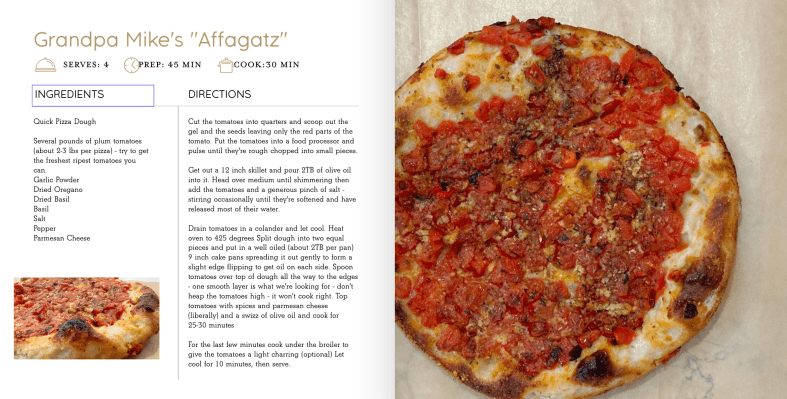
Goal Met: Create Family Cookbook

I love cooking. Most of my skills in this area were honed when I worked as a line cook in various restaurants but they started watching people in my family cook.  My grandmother was your typical Italian Nonna, always at the stove making something delicious. My mom wasn’t what you’d call a great cook (she liked to overcook everything “just to be safe”) but she had a handful of go-to recipes that we all loved. There were other people who had signature dishes that they always brought out during the holidays.

Over time I started developing my own recipes and I was pretty haphazard about where I kept all my notes. Most of the ones I really liked made it into a small notebook that saw a lot of use (it’s currently held together at the binding my duct tape) but there were papers stuffed into folders, notes written into cookbooks with alternate ingredients / timings and in text files on my computer.

I decided to collect them all into one definitive source a ‘family cookbook’ that my kids could one day reference when they want to make the nostalgic meals that they remember from their childhood or have a recipe be passed down to another generation.

My recipes were easy – bit by bit I imported  them into OneNote and formatted them into a logical cookbook format (ingredients, methodology, cook time, etc.). My family’s  recipes were a bit harder as most of them were never written down. I narrowed them down to a few that I felt were important enough to include then dredged my memory to try to recall the ingredients and methods that were used. I had to get creative and try different approaches but I think I came as close as I possibly could.  I did have a copy of my grandmother’s recipe notebook which contained all her baking recipes. The only issue there was it was written completely in Italian. Luckily I was learning Italian this year as well so it was a win-win translating the ingredients and instruction into English!

As I was developing these I took lots of pictures but there were some recipes where I either didn’t have a photo or the ones I did have weren’t very good. I absolutely was shameless in finding a stock photos that looked exactly like what I made only with better lighting. I wasn’t trying to publish this book so I didn’t concern myself with the ethics of that decision, I just know some of these stock photos were really good and representative of what I was putting out.

I tinkered with InDesign to see if I could make a standard cookbook but instead opted for a web service as their drag and drop methodology was much easier to work with and I could see in real time what the results would be.

All in all I was happy with how it turned out – going to wait until a sale comes around on the book publishing site before I get a physical copy – sometimes those coupons they send can be a real value!

Heat

Imagine if somebody made a crime thriller that’s actually two movies in perfect balance: a cop movie and a heist movie doing an intricate dance around each other until they collide in an explosion of gunfire and existential crisis. That’s Michael Mann’s “Heat,” a film that treats both sides of the law with such careful attention that you’ll find yourself rooting for everyone and no one at the same time.

Al Pacino plays Lt. Vincent Hanna, a detective who’s married to his job (and also his third wife, but the job is definitely his true love). Robert De Niro is Neil McCauley, a professional thief who lives by the motto “Don’t let yourself get attached to anything you are not willing to walk out on in 30 seconds flat if you feel the heat around the corner.” Spoiler alert: both of these life choices are going to prove problematic.

The film opens with a precision-engineered armored car heist that establishes McCauley’s crew as the Ocean’s Eleven of armed robbery, if Ocean’s Eleven were directed by a perfectionist with a fetish for metallic blue color grading. This brings them to the attention of Hanna’s department, setting up a cat-and-mouse game between two men who might actually be the same cat, just wearing different uniforms.

At its heart, “Heat” is a movie about work-life balance, if your work happens to involve either robbing banks or stopping bank robbers. Both leads are essentially workaholics who happen to be on opposite sides of the law. Their infamous coffee shop scene (the first time Pacino and De Niro ever shared the screen together) plays like the world’s most intense job interview, if job interviews involved discussing your philosophy on murder.

What Makes It Sizzle:

  • The downtown L.A. shootout that redefined what a movie gunfight could sound like (so realistic that the military uses it for training)
  • Michael Mann’s signature style turning Los Angeles into a chrome and steel urban jungle
  • A supporting cast so deep it makes other movies’ supporting casts look like amateur hour
  • Character development that gives everyone, even minor players, clear motivations and stakes
  • The most intense coffee shop conversation in cinema history
  • Dante Spinotti’s cinematography making Los Angeles look like a noir painting come to life

What Makes It Simmer:

  • At nearly three hours, it demands a serious time commitment
  • Some viewers might find the pacing deliberately methodical
  • The domestic drama subplots occasionally feel less engaging than the main story
  • If you’re expecting non-stop action, you might be surprised by how much time is spent on character development

The Verdict:
“Heat” is what happens when you take a crime thriller and treat it with the gravity of a Shakespeare play. It’s a meditation on duality, professionalism, and the cost of dedication wrapped in the clothes of a cops-and-robbers movie. Mann crafts a Los Angeles that feels both real and mythic, where every street corner could be the setting for either a philosophical discussion or a firefight.

The film’s greatest achievement is making you understand and empathize with both sides while never letting you forget that this can only end one way. It’s like watching two grandmasters play chess, if chess pieces were armed with automatic weapons and had complicated home lives.

Rating: 5 out of 5 precision-timed heists

Hard Boiled

If you’ve ever watched an action movie and thought “This needs more… everything,” then John Woo’s “Hard Boiled” is your cinematic all-you-can-eat buffet. This is what happens when you take Hong Kong action cinema, crank it up to 11, break off the dial, and keep cranking anyway.

Chow Yun-fat stars as Tequila (yes, that’s his name, and it’s probably the most normal thing about this movie), a clarinet-playing supercop who apparently attended the “Shoot First, Shoot Again, Maybe Ask Questions While Shooting” School of Law Enforcement. When his partner gets killed in a spectacularly violent teahouse shootout (because in this world, even teahouses aren’t safe), Tequila embarks on a revenge mission that makes Rambo look like a pacifist.

Enter Tony Leung as Alan, an undercover cop so deep in the criminal underworld he probably has to remind himself which side he’s on every morning. Together, they form the kind of buddy-cop duo that doesn’t so much bend the rules as shoot them full of holes while diving sideways in slow motion.

The plot? Well, there’s gun smuggling, triads, and corrupt cops, but let’s be honest – the plot is basically “How many amazing action sequences can we string together before the audience passes out from excitement?” The answer, it turns out, is “a lot.” The finale alone, set in a hospital (because nothing says “careful consideration for public safety” like a extended gunfight in a hospital), is a 40-minute symphony of choreographed chaos that makes you wonder if the film’s budget was just “all the bullets in Hong Kong.”

What Makes It Shoot Straight:

  • Action sequences that redefine what’s possible in action cinema
  • Chow Yun-fat’s ability to make dual-wielding pistols while sliding down stairs look like the most natural thing in the world
  • Tony Leung bringing actual dramatic depth to his role between the explosions
  • John Woo’s masterful direction that turns violence into ballet
  • The hospital sequence that somehow keeps topping itself for a full 40 minutes
  • More slow motion doves than a bird sanctuary having an existential crisis

What Makes It Misfire:

  • The plot can be harder to follow than a bullet trajectory in a mirror maze
  • Some of the dubbing in international versions is… let’s say “enthusiastic”
  • If you’re looking for subtle character development, you might have to look between the explosions
  • The physics are more “poetic” than “actual”

The Verdict:
“Hard Boiled” is what happens when you let action cinema off its leash and feed it nothing but adrenaline and gun powder. It’s excessive, melodramatic, and absolutely glorious. This is a movie where people don’t just dive through windows – they dive through windows while shooting two guns at two different targets while a dove flies past in slow motion… and that’s one of the more restrained scenes.

Is it over the top? Of course it is. The top is a distant memory to this film. “Hard Boiled” looked at the top, scoffed, and then shot it while jumping through the air in slow motion. But that’s exactly why it works. This isn’t just action cinema – it’s action cinema pushed to its logical (and sometimes illogical) extreme.

Rating: 5 out of 5 strategically placed doves

P.S. Try counting the number of bullets fired in this movie. Actually, don’t – you’ll run out of numbers. Also, pay special attention to the matchstick Tequila keeps in his mouth. It’s probably the only thing in the movie that doesn’t explode at some point.

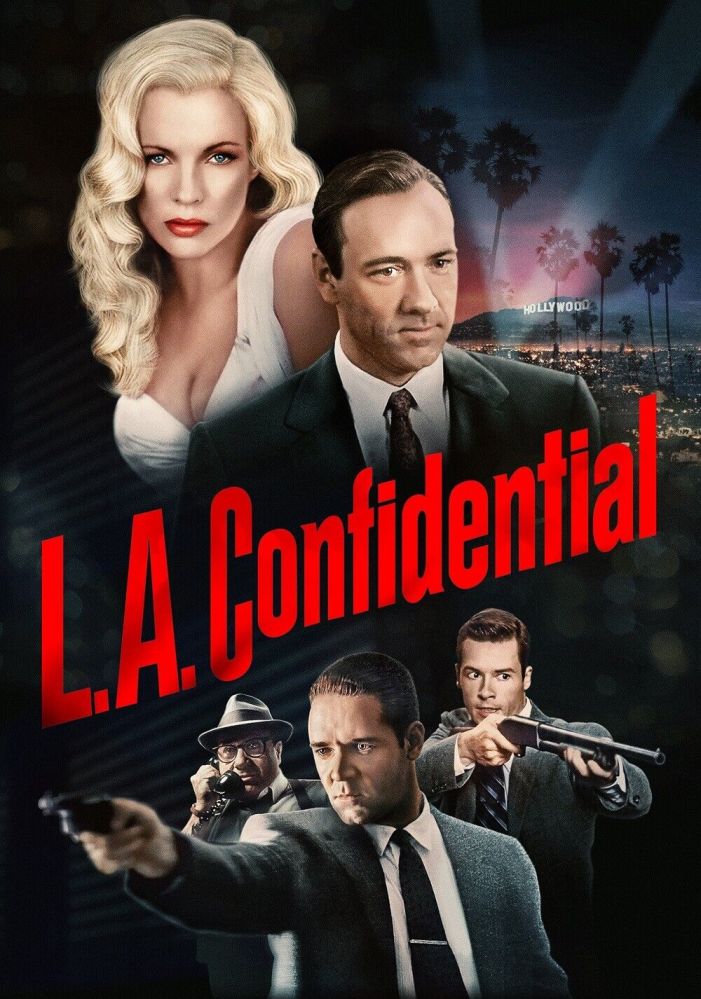
LA Confidential

Welcome to 1950s Los Angeles, where the men are crooked, the women are dangerous, and everyone’s eyebrows are perfectly sculpted. Curtis Hanson’s “L.A. Confidential” is what happens when you take film noir, inject it with Hollywood steroids, and tell it to solve a murder case that’s more twisted than a pretzel in a tornado.

Our trio of troubled cops includes Guy Pearce as Ed Exley, the kind of straight-arrow officer who probably wrote detention slips in kindergarten; Russell Crowe as Bud White, whose anger management technique is to manage to get angry at absolutely everyone; and Kevin Spacey as Jack Vincennes, a cop so slick he makes his own hair gel out of pure swagger. Together, they form the world’s most dysfunctional crime-solving team since somebody thought it was a good idea to give Sherlock Holmes a cocaine habit.

The plot kicks off with the Nite Owl Massacre, a multiple homicide that’s about as straightforward as quantum physics explained by a drunk physicist. What starts as a simple coffee shop shooting spirals into a labyrinth of corruption that involves dirty cops, Hollywood prostitutes (who look like movie stars), movie stars (who act like prostitutes), and enough double-crosses to make a geometry teacher dizzy.

Enter Kim Basinger as Lynn Bracken, a Veronica Lake lookalike who’s caught in the middle of all this mess. She’s the kind of dame that makes smart men stupid and stupid men even stupider – which in 1950s L.A. is really saying something. Her presence in the story adds layers of complexity to both the plot and the already complicated relationships between our three cops, who apparently never got the memo about bros before… well, you know.

The film weaves together so many subplots it should come with a road map and GPS. We’ve got tabloid journalism (Danny DeVito as Sid Hudgens, who never met a scandal he couldn’t make juicier), police corruption (James Cromwell as Captain Dudley Smith, whose Irish brogue could charm the scales off a snake), and a prostitution ring that gives new meaning to the term “plastic surgery.” All of this somehow ties together in a way that makes perfect sense, assuming you’ve been taking detailed notes and perhaps consulted a private detective.

What Makes It Shine Brighter Than a Hollywood Premiere:

  • Dialogue sharp enough to shave with
  • A plot more intricate than a Rube Goldberg machine, but twice as satisfying when it all comes together
  • Period detail so precise you can practically smell the cigarette smoke and casual misogyny
  • Career-defining performances from the entire cast, especially the then-unknown Aussie duo of Pearce and Crowe
  • Brian Helgeland’s screenplay, which somehow makes following three protagonists feel as natural as falling down stairs

What Makes It Shadier Than a Palm Tree at Midnight:

  • You might need to watch it twice to catch all the plot threads (though that’s hardly a punishment)
  • The first hour requires more concentration than defusing a bomb
  • Some viewers might need a flowchart to keep track of who’s betraying whom
  • The authentic period attitudes toward women and minorities might make modern viewers cringe

The Final Verdict:
“L.A. Confidential” is what happens when you take every film noir cliché in the book, feed them through a meat grinder of excellent writing, phenomenal acting, and pitch-perfect direction, and serve them up on a plate garnished with Hollywood corruption and garnished with murder. It’s a movie so good it makes you wish all police procedurals involved corrupt cops, glamorous prostitutes, and Danny DeVito running a scandal magazine.

This is the kind of film that reminds you why people fell in love with movies in the first place. It’s complex without being confusing, stylish without being shallow, and nostalgic without being naive. It’s like Raymond Chandler and James Ellroy had a baby, and that baby grew up to be the coolest kid in film school.

Rating: 5 out of 5 slightly tarnished badges

P.S. Keep an eye out for the scene where Exley interrogates a suspect while pretending to be way more hardboiled than he actually is. It’s like watching a Boy Scout try to impersonate Dirty Harry, and it’s absolutely perfect. Also, count how many times someone lights a cigarette – you could turn it into a drinking game, but you’d be unconscious before the second act.

Malcolm X

Spike Lee’s “Malcolm X” isn’t just a movie – it’s a movement captured on film, a three-hour-plus journey through one of the most complex and transformative figures in American history. And let me tell you, if you think you know Malcolm X’s story from your history books, this film will make you think again.

The film follows Malcolm Little’s evolution from a small-time hustler (played with explosive charisma by Denzel Washington in what should have won him the Oscar) to the powerful, controversial, and ultimately transformative figure known as Malcolm X. It’s a journey that takes us from the streets of Boston and Harlem to the holy cities of the Middle East, and from militant black nationalism to a more universal, though no less revolutionary, vision of human rights.

Lee structures the film like a religious conversion narrative – which, in many ways, it is. We begin with Malcolm as a “red” conk-wearing hustler, running numbers and pulling scams with his buddy Shorty (played by Spike Lee himself). This section plays almost like a gangster film, with its zoot suits, lindy hop dancing, and jazz soundtrack. But beneath the flash, we see the systematic racism that shaped Malcolm’s early worldview.

The prison sequence marks the first transformation, as Malcolm encounters the teachings of the Nation of Islam through fellow inmate Brother Baines. Washington brilliantly portrays Malcolm’s awakening, showing us a man literally remaking himself through education and religious conviction. His famous scene practicing writing on prison paper – starting with “A” and filling every inch of space – is a masterclass in showing intellectual awakening on screen.

As Malcolm X, the Nation of Islam minister, Washington captures both the fire and intelligence that made Malcolm such a magnetic speaker. The film doesn’t shy away from his more controversial statements but contextualizes them within the reality of 1960s America. When Malcolm speaks, whether to small groups or massive crowds, you understand why people listened.

The final act deals with Malcolm’s break from the Nation of Islam, his pilgrimage to Mecca, and his evolution toward a more inclusive worldview – while never abandoning his commitment to black empowerment and human rights. It’s here that the film reaches its tragic but transcendent conclusion, with Lee skillfully weaving documentary footage into the narrative.

What Soars:

  • Denzel Washington’s performance is a tour de force that captures Malcolm’s intelligence, charisma, and evolution
  • Ernest Dickerson’s cinematography shifts with each phase of Malcolm’s life, from the vibrant colors of his hustler days to the stark clarity of his later years
  • The supporting cast, particularly Angela Bassett as Betty Shabazz, brings depth to every scene
  • Spike Lee’s direction balances intimate personal moments with sweeping historical drama
  • The use of actual footage and photographs grounds the film in historical reality

What Struggles:

  • At 3 hours and 22 minutes, the film demands significant viewer commitment
  • Some of the early period sequences can feel slightly stylized
  • The complexity of Malcolm’s political and religious ideas sometimes gets simplified
  • The film’s structure occasionally makes it feel like multiple movies in one

The Verdict:
“Malcolm X” is more than a biopic – it’s an American epic that forces us to confront our nation’s painful history while celebrating the possibility of personal transformation. It’s a film that understands its subject was not just a historical figure but a living, breathing, evolving human being who contained multitudes.

Lee and Washington don’t give us a sanitized hero or a simple villain, but rather a man who constantly questioned, grew, and fought for what he believed was right, even as those beliefs changed. It’s a film that reminds us that the past isn’t past, that the questions Malcolm X grappled with – about justice, identity, resistance, and human dignity – remain urgently relevant.

Rating: 5 out of 5 raised fists

P.S. Pay attention to the film’s opening credits sequence, which intercuts the American flag with footage of the Rodney King beating – a reminder that Malcolm’s story isn’t just history, but a continuing conversation about race and justice in America. Also, the fact that Spike Lee had to reach out to prominent African American artists and athletes to help fund the film’s completion adds another layer to its significance as a piece of cultural history.