The Great Dictator

In what might be history’s most audacious case of “dress for the job you want, not the job you have,” Charlie Chaplin plays both a mild-mannered Jewish barber and his exact doppelganger, Adenoid Hynkel, the power-hungry dictator of Tomania (subtle, Charlie, real subtle). Our story begins in the trenches of World War I, where our unnamed barber heroically bumbles his way through a series of military mishaps, including accidentally piloting a plane upside down while carrying an important officer. Because apparently that’s how you survive war – with slapstick.

Fast forward to the barber waking up in 1939, after spending twenty years in the hospital with convenient plot-device amnesia. He returns to his barbershop in the Jewish ghetto, completely oblivious to the fact that his hometown has become the center stage for Hynkel’s anti-Semitic regime. Talk about missing a few newsletters during your hospital stay.

The ghetto sequences showcase some of Chaplin’s finest moments of resistance-through-comedy. Our barber befriends Hannah (Paulette Goddard), who’s made it her personal mission to bonk storm troopers with frying pans. He also gains the protection of Schultz, a high-ranking officer who recognizes him as the soldier who saved his life during the war (in that upside-down plane, no less – funny how these things come full circle).

Meanwhile, in a palace that looks like what would happen if you let a megalomaniac loose in IKEA, Dictator Hynkel is busy being a walking parody of Hitler. He practices speeches in mock German (which is really just gibberish peppered with occasional words like “wiener schnitzel” and “sauerkraut”), dances with an inflatable world globe in a scene that somehow manages to be both hilarious and terrifying, and throws temper tantrums that would make a toddler say “maybe dial it back a bit.”

The political satire kicks into high gear when Benzino Napaloni (Jack Oakie), the dictator of Bacteria, comes to visit. Their relationship is a masterclass in fragile masculinity, with both dictators trying to out-dictator each other. They compete over chair heights during a barbershop scene (yes, really), engage in a food fight at a formal dinner, and generally behave like schoolyard bullies who’ve been given countries to run. Their mustache-to-power ratio is off the charts.

Things take a turn when Schultz objects to Hynkel’s increasingly aggressive policies and ends up fleeing to the ghetto with a death sentence on his head. He and the barber organize a resistance movement, which goes about as well as you’d expect from a group led by an amnesiac barber and a defected officer with questionable planning skills. They end up in a concentration camp, but manage to escape wearing soldier uniforms (because apparently security protocols in Tomania were somewhat lax).

Through a series of coincidences that would make Charles Dickens say “that’s a bit much,” Hynkel goes duck hunting, falls into a lake, and gets arrested by his own troops who mistake him for the barber. Meanwhile, the barber, in stolen military gear, is mistaken for Hynkel just as the dictator is about to give a victory speech about invading Austria. Instead of doing the sensible thing and running for the hills, our barber-turned-accidental-dictator decides to give an impassioned speech about democracy, peace, and human dignity.

The film ends with Hannah listening to the speech on the radio in her new home in recently-invaded Austria. She’s inspired by the message of hope, though one might question the long-term viability of a resistance plan that involves accidentally replacing a dictator with his look-alike and hoping nobody notices the sudden personality change and complete reversal of all policies. But hey, in for a penny, in for a pound.

Chaplin’s film manages to be simultaneously slapstick comedy, pointed political satire, and earnest humanitarian plea. Released in 1940, when America was still officially neutral in World War II, the film was either an act of incredible courage or spectacular madness – or perhaps the special kind of genius that comes from being both. While some of the plot turns might require Olympic-level suspension of disbelief, the film’s core message about the absurdity of hatred and the power of human dignity remains as relevant as ever. Plus, where else are you going to see Hitler and Mussolini caricatures having a food fight?

(caption AI assisted)

I’d give this 4/5 stars. Mostly because it’s an audacious film and relevant to modern times. I can just imagine Trump and Putin having the chair size fight and it makes me giggle (which helps keep the night terrors away) Chaplin still has comedic chops especially with his physical comedy and although the plot contrivances are hard to believe they do land pretty well. After watching most of Chaplin’s silent movies during this project it was neat to see him speaking and he really does a great job. I’m a bit sad to not have any more of his films on my viewing schedule this year but I might loop back when this over and fill in the gaps.
City Lights

Category: Silent Film, Comedy

Starring: Charlie Chaplin

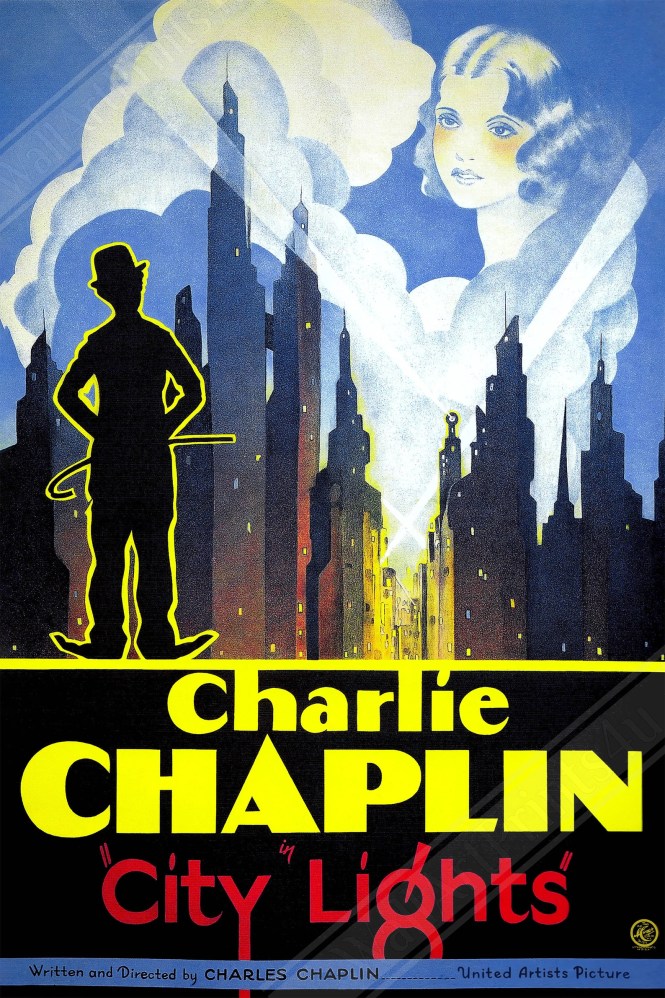
Another Chaplin movie (a lot of his seem to make most ‘best movie’ lists and I can start to see why.  In this particular one he reprise the role of the tramp and the movie opens with him taking a nap under a tarp that is later revealed to be a statue that is having a big unveiling.  The usual slapstick shenanigans happen and he eventually escapes the authorities. He then meets a flower girl who is selling flowers and is instantly smitten.

As he’s leaving the flower girl hears a fancy car with a chauffeur and thinks it’s the tramp. Later that night the tramp is down by the water and he sees someone trying to kill themselves. He saves them from the attempt and it turns out the guy’s a millionaire and he takes the tramp back to his house to keep the party going. The guy’s a complete lush and when the tramp asks him for money to buy more flowers from the flower girl he peels off a few from a fat stack and sends him on the way telling him to take his car – a very nice Rolls Royce.

The thing is – the millionaire only really remembers the tramp when he’s hammered – once he’s sober he is a cruel and abrupt stereotype of a 1920’s tycoon.  It’s something that is repeated a few times with the millionaire who always seems to find the tramp when he’s sauced out of his mind.

Meanwhile the tramp keeps visiting his blind girl and one day she isn’t at her usual street corner. He eventually tracks her down and finds out that she is ill, so he keeps her company by reading her a newspaper. One of the articles is about a doctor who has a procedure to restore sight – the girl smiles and said it’d be wonderful because then she can see him. The tramp knowing he’s pretending to be rich and is aware of his looks isn’t enthused with this idea. However, as he’s leaving he finds an eviction notice and realizes her family is getting kicked out of the apartment.   Determined to help her he decides to get the money to pay her back rent.

The problem is he’s visited the blind girl too many times and the foreman fires him. One of his buddies ropes him into a fixed fight to make some cash but the crooked boxer takes off because the police are coming the his replacement is a giant of a man with murder in his eyes.  A comical drawn out boxing match happens which includes the tramp hitting the boxer with a shovel, the boxer punching the police, and general mayhem. However, the boxer eventually beats the tramp and he goes away without the money needed for the girl.

It’s at this time that the millionaire rolls up on the tramp, three sheets to the wind, and invites him to party (again). They have a good time and the tramp asks if he can give him the money for the girl. The rich guy says sure – and all seems to be solved, except that at that moment burglars break into the house and rob it – with the tramp making his getaway by running from the police (something he does quite frequently, to be honest)

Knowing that it’s a matter of time he runs to the girl and gives her the money – telling her that he’ll see her “in a while” shortly after the police find and arrest him. A while later he gets out of prison and goes to her street corner, only to find her gone.  One day as he’s walking down the street he looks in a store window and there she is! She runs a florist shop now and her sight has been restored! He nervously starts to approach but some newsboys who have taken a dislike to him start harassing him and she sees it through the window. She offers him a coin and a flower and when she touches his hand she realizes who he is and they share a smile.

4/5 – At this point the whole tramp gets the girl thing seems to have been done this is just another angle on it. The deranged millionaire was pretty funny and the slapstick bits are pretty consistent and humorous. Chaplin’s ability to express emotion without words is without peer and I can see why he dominated the silent film industry and his fame endures to this day.

Modern Times – 1936

Silent Film – 1936
Charlie Chaplin

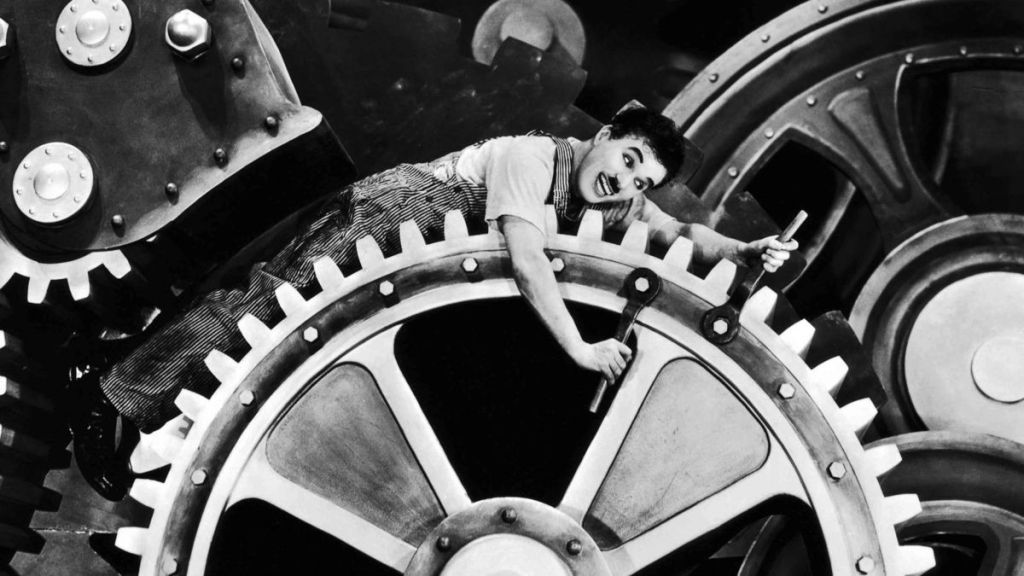
Another visit to Chaplin’s tramp character. This time he’s working in a factory where everything is regimented and watched over (very big brother like) by the boss via television screens. Chaplin’s character is starting to show stress from the repetitive nature of the work and then goes off the rails in a madcap dash around the factory -eventually getting stuck in the gears in a pretty famous scene

He’s committed to a hospital and when he gets out accidentally gets involved in an anti govt protest and ends up in jail. At some point in prison he ingests a bag of cocaine and goes full Tony Montana (only without the guns) and in his rush around the station he stops a breakout attempt without even realizing what he’s doing.  The cops are so thankful they give him a cushy cell with lots of amenities which the tramp seems to really enjoy. However – his time in prison is soon to be over and he unsuccessfully tries to convince the police that he belongs back in prison since he gets three meals a day and a comfortable place to sleep.

One released he struggles to find a job – eventually finding work using a letter of recommendation from the police captain at a shipyard where he’s given a simple job of hammering some piles in – however he didn’t understand the instructions (in true tramp style) and ends up launching a ship that… wasn’t quite ready to be launched. Dejected from his inability to find work he’s walking down the street when he sees a young girl stealing bread and when the cops ask him what happened he said he stole the bread trying to get back to his cushy prison cell.  Witnesses tell the police that he didn’t really do it and he’s freed back onto the streets.

Really determined to go back to jail – he goes to a restaurant and eats a ton of food and then doesn’t pay – tracking down a cop to come arrest him for it.  He’s locked up in a paddy wagon – and lo and behold, the girl from earlier is in the wagon with him! He tries his charm on her and she seems to vibe with him.. When suddenly the paddy wagon crashes and they escape in the chaos.

He tries to go straight for the girl and takes a job as a night watchman at a department store  – he has a great time roller skating around and sharing what the store has to offer with her but then three goons break in and try to rob the place – the tramp realizes they’re fellow factory workers who are just hungry and desperate. He decides not to call the police and falls asleep in a very unfortunate location where he is discovered the next day and promptly fired.

The girl gets a job dancing in a nightclub and convinces the owner that the Tramp is a singer and waiter but he’s terrible at the waiting part and his last chance is the singing performance. He’s really nervous but the girl helps him write the words on his cuffs so he won’t forget them – but he loses the cuffs during the dancing part! What’s he to do? That’s right.. He channels his inner Eminem and goes full five mile on them: Chaplin Modern Times ‘non-sense song’

Things are seeming up for these two lovebirds, but then the police track the girl down from her previous escape and her and the Tramp are forced to flee once again.  The stop at the site of the road and the girl desparis at they have nothing left but the tramp reassures her and they set off down the road into whatever awaits them.

4/5 – Great move and one of Chaplin’s finest performances

I think this is the first time you hear Chaplin’s voice in one of this films and he uses it to sing a nonsense song that somehow conveys an idea without using an actual language (he made it all up). The slapstick comedy was tight and funny and the camera work and direction was engaging.  Some of the ‘special effects’ were really well done practical effects that he sold with his conviction and body control.  Reading into it somewhat it was a commentary on industrialization and the political climate of the time and has eerie echoes into the current day with AI threatening to displace a lot of people’s jobs. It was one of the last silent films of the era and Chaplin’s last performance as the tramp and I’m glad he got to set off into whatever future awaited him with someone by his side.

Gold Rush [1925]

Charlie Chaplin

Silent Movie / Comedy

In a reprisal of Chaplin’s ‘tramp’ persona he heads off to the Alaskan territory with just his cane (and woefully underdressed) looking to capitalize on the gold rush.  He runs into a storm and takes shelter in what seems to be an abandoned cabin – but its currently being used by an escaped criminal who isn’t too happy with the new company. He chases Chaplin off in a comical wind/storm scene but then a prospector (Big Jim) who found gold seeks shelter from the storm in the cabin and overpowers the criminal. There’s an uneasy standoff where the three men begin to starve and they draw straws to see who goes out into the storm to get food. The criminal is sent off and promptly finds bounty hunters looking for him who have a nice sled full of supplies. He shoots them and steals their supplies and promptly vanishes from the movie (I’m not really sure why he even was in the plot except maybe as an antagonist for the staged cabin scenes)

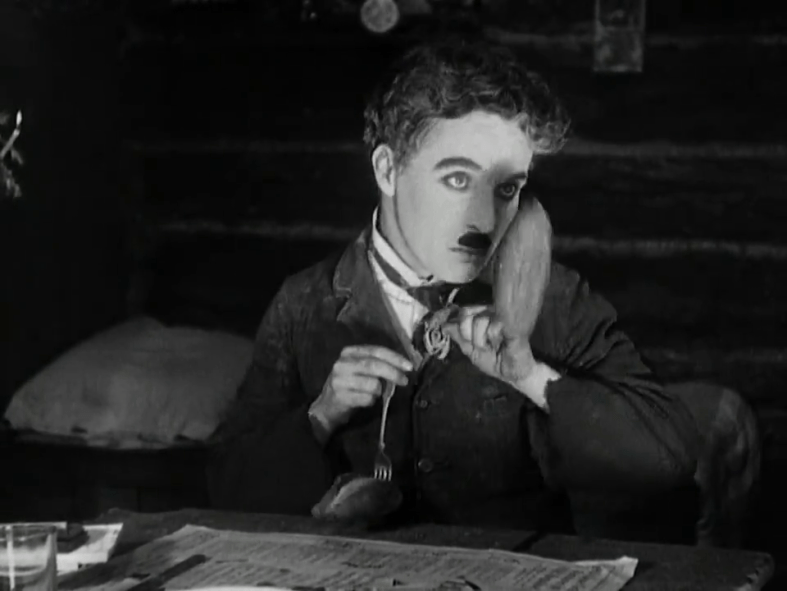
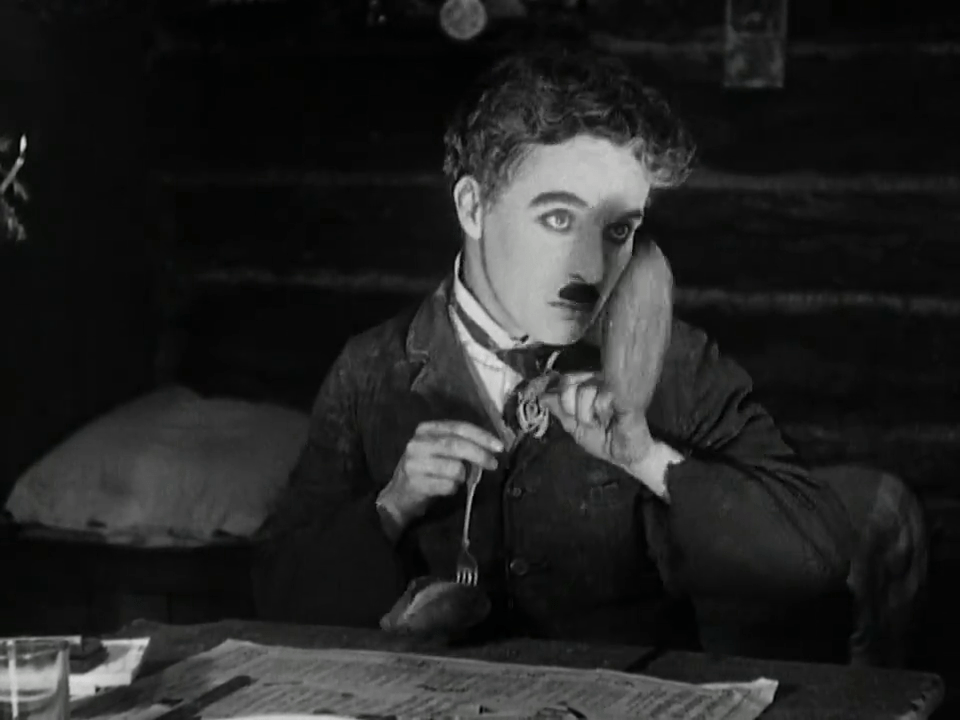
Cut back to the cabin and there’s the famous scene of Chaplin boiling his shoe to have something to eat (imagery featured frequently in images of hobos) and then Big Jim being delirious due to hunger and imagining Chaplin as a giant delicious chicken they have a quick chase and then big Jim comes to his senses and leaves to find his gold only to be assaulted by that criminal guy and left unconscious in the snow!

Cut to a different movie altogether for a while for a weird romance subplot where Chaplin meets a dancer who flirts with him to anger another guy and then agrees to go to dinner with Chaplin on NYE. On NYE Chaplin sets up his cabin all nice and then does the famous dancing roll bit (Oceana roll) then falls asleep waiting for her to arrive. She never does (quite a sad bit where he looks in the window and see her dancing with that handsome fella. He wanders off and then Georgia and her friends go to cause trouble for ‘the tramp’ but then see all the effort he want to for the party and she clearly feels guilty at her behavior. Later Chaplin goes into the party to confront them when big Jim rolls in (having lost his memory after the assault) and grabs Chaplin and says ‘we need to find the cabin! Then we can find my gold and I’ll share it with you!’ — so they head back to the cabin and get some rest before they head out but then a crazy storm blows in and blows the entire cabin to a cliff edge!

They wake up and a funny bit ensues where they walk back and forth and the cabin teeters on the edge but they think it might be a hangover but then when Chaplin opens the door he sees he’s dangling off a cliff and then they spend a few minutes figuring out how to escape but fate has smiled on them – the storm blew them right to big Jim’s mine! They’re rich!

Cut to them dressed fancily in furs and smoking cigars walking on a ship to sail back to America as millionaires – we see Chaplin’s girl also sailing out as it seems things didn’t work out with handsome man (she never really seemed that into him to begin with). Some various hijinks ensue where she shows she’s a somewhat good and remorseful person (offering to pay for his ticket when the crew thinks he’s a stowaway) and Chaplin goes in for the kiss and roll credits.

4/5 stars – The movie is iconic for a reason – so many tropes were born from this movie as well as call backs in many modern movies (the bread roll dance in Benny and Joon, countless eating your boots scenes.. Etc.) and for a silent movie it conveyed both comedy and pathos very effectively you forget it’s a silent movie and are drawn into the narrative completely.

(side note: apparently there’s a 1941 version re-cut by Chaplin that includes his own score and narrated interstitial panels. .might watch that if I have the time)