The Pianist

Roman Polanski’s The Pianist is one of those movies that doesn’t just tell a story—it makes you live inside it, smothering you in a slow, methodical descent into hell. If you came looking for a standard World War II drama with sweeping battle scenes, a rousing musical score, and an obligatory moment where someone nobly sacrifices themselves while looking up at the sky, then congratulations—you are in the wrong place. This isn’t a movie about war, heroism, or resistance fighters saving the day. This is about survival, and survival isn’t glorious. It’s humiliating. It’s degrading. It’s watching the world collapse around you while you slowly wither away in the corner, praying no one notices you exist.

Adrien Brody plays Władysław Szpilman, a Polish-Jewish pianist who starts the movie playing Chopin in a Warsaw radio station and ends it looking like a half-dead scarecrow wandering the ruins of civilization. At the beginning, he’s got everything—family, talent, a home, a nice suit. But as the Nazis tighten their grip on Warsaw, all of it gets stripped away, piece by piece, until all that’s left is a man too weak to stand, hiding in the debris like a ghost who hasn’t realized he’s dead yet. Brody is phenomenal here, and not just in the way he physically transforms from a well-fed, confident musician into a skeletal shell of himself. He barely speaks for half the movie, yet you can feel every ounce of his suffering through his eyes. He doesn’t play Szpilman as a grand, defiant survivor—he plays him as a man who keeps existing simply because he has no other choice.

And let’s talk about Polanski’s direction, because it’s surgical in the way it destroys you. The film never indulges in melodrama, never turns Szpilman into some kind of cinematic martyr. Instead, it just follows him, unflinchingly, as he endures horror after horror. One moment, he’s playing music at a party. The next, he’s watching an old man in a wheelchair get thrown off a balcony by German soldiers. A few scenes later, he’s watching his family get herded onto a train, and he knows—without a word being said—that he will never see them again. The violence here isn’t stylized, it isn’t dramatic, it’s just cold, brutal, and matter-of-fact. People are shot in the street like it’s nothing. Families disappear overnight. The world goes mad, and Szpilman can do nothing but drift through it, clutching his hunger and his silence.

By the time we reach the last act of the film, Szpilman has been reduced to a walking corpse, hiding in the ruins of Warsaw, scrounging for scraps like a stray dog. And then, in one of the most quietly devastating scenes in war movie history, he is finally discovered—by a German officer, no less. And what does he do? He plays the piano. He sits at that broken, dust-covered instrument and plays as if the world isn’t burning outside. And somehow, for just a moment, music, the very thing that defines him, becomes his salvation. Because in a world that has taken everything from him—his family, his dignity, his home—his ability to create something beautiful is the only thing he has left.

The Pianist is not an easy watch. It’s not meant to be. It’s the kind of film that leaves you sitting in stunned silence when the credits roll, the kind that makes you feel like you’ve lived through something rather than just watched it. It doesn’t ask for your tears, but it takes them anyway. It’s a masterpiece, yes, but in the most haunting way possible—the kind of masterpiece that lingers in your bones long after the screen goes black.

The Hurt Locker

Kathryn Bigelow’s The Hurt Locker isn’t just a war movie—it’s a 131-minute stress test for your central nervous system. This isn’t one of those big, sweeping, patriotic spectacles where war is just a backdrop for heroism, camaraderie, and some dude writing sentimental letters home while soft orchestral music swells. No, this is war as pure, undiluted anxiety. This is war as an abusive relationship between a man and a bomb suit. This is war where every trash bag, abandoned car, and suspiciously placed goat could be the last thing you ever see. And the best part? You get to spend all of it inside the increasingly unhinged mind of Staff Sergeant William James, played with reckless brilliance by Jeremy Renner.

Renner’s James is not your typical movie soldier. He’s not here to brood about the morality of war or deliver grand monologues about duty and sacrifice. No, this man treats bomb disposal the way a daredevil treats BASE jumping, except instead of a parachute, he has a pair of wire cutters and a questionable amount of impulse control. He’s the guy who looks at a bomb that could level a city block and thinks, “I wonder how close I can get before this thing turns me into confetti.” He sweats adrenaline, makes every safety protocol weep, and approaches each explosive like it just insulted his mother. The man is addicted to war, which the movie kindly reminds us is “a drug.” Yeah, no kidding.

And while James is out here treating life like a Call of Duty lobby, his team—played by Anthony Mackie and Brian Geraghty—spends most of the movie vacillating between barely concealed terror and wanting to punch him in the face. Mackie’s Sanborn is the no-nonsense professional who, shockingly, does not appreciate James’ bomb-defusing-by-vibes-only approach. Meanwhile, Geraghty’s Eldridge is the poor guy who looks like he wandered into this war zone by accident and now can’t figure out how to leave. Their dynamic is basically “daredevil maniac and the two exhausted guys who have to keep him from dying,” which would be hilarious if it weren’t also completely terrifying.

But what really makes The Hurt Locker stand out isn’t just the tension—it’s how relentlessly it drags you into the chaos. Bigelow’s direction makes you feel like you’re right there in the dirt, sweating through your shirt, wondering if the old man watching you from a rooftop is just a guy enjoying the sunset or someone about to set off an IED with his Nokia brick phone. The handheld camerawork, the rapid cuts, the eerie silence that hangs in the air right before everything goes to hell—it all adds up to a film that doesn’t just depict war; it immerses you in it.

And yet, for all its high-octane suspense, The Hurt Locker isn’t about action—it’s about obsession. It’s about how, for some people, the war never really ends, even when they leave the battlefield. James might be able to dismantle bombs with his bare hands, but he can’t dismantle the part of himself that craves the rush. There’s a moment near the end where he stands in a grocery store aisle, staring blankly at an endless row of cereal boxes, completely lost. The choices are overwhelming. The stakes are non-existent. There’s no life-or-death tension, no adrenaline, no purpose. He looks more afraid in that moment than he does when he’s facing down a car bomb. Because the truth is, war is the only place he truly feels alive.

So yeah, The Hurt Locker is a masterpiece, but it’s the kind of masterpiece that leaves you slightly nauseous, vaguely anxious, and questioning whether you should have watched something with talking animals instead. It’s a film that doesn’t glorify war, but it does understand the terrifying allure of it. It grabs you by the collar, drags you into the dirt, and doesn’t let go until you’re just as rattled as the men on screen. And if you somehow make it through the whole thing without stress-eating an entire bag of chips, congratulations—you’re either a robot or William James himself.

Selma

Here’s the thing about Selma: it’s a movie that takes one of the most pivotal moments in American history and refuses to wrap it in the usual Hollywood gloss. No, this isn’t a feel-good, triumphal march where the music swells and justice is delivered with a bow on top. This is history as it was—messy, brutal, defiant, and driven by people who were not mythic figures but human beings who got tired of waiting for America to live up to its own promises.

Ava DuVernay, the mastermind behind this historical gut-punch, directs with such precision that you almost feel like you’re sitting in the rooms where Martin Luther King Jr. (played by David Oyelowo, who, let’s be honest, deserved every award that year and then some) and his fellow activists are making impossible decisions. The film doesn’t deify King; instead, it shows him as a leader who carried the weight of a movement on his shoulders while still being a husband, a father, and a man who, for all his strength, had moments of doubt. This isn’t the King of sanitized history books, but a flesh-and-blood person with an impossible mission. And somehow, Oyelowo nails every note of it, capturing the gravity, the exhaustion, and that unmistakable power in his voice.

The supporting cast is equally incredible. Carmen Ejogo as Coretta Scott King doesn’t just stand by his side—she holds her own, radiating both grace and quiet strength. Tom Wilkinson as LBJ? Oh, he plays the complicated, not-quite-the-ally-he-should’ve-been president with the right balance of charm and political calculation. And Tim Roth as George Wallace? Slimy as ever, which means he did the job right. But it’s not just about individual performances; it’s about how every person on screen embodies the weight of the moment.

Let’s talk about the march itself—the one from Selma to Montgomery. This movie does not pull its punches when it comes to showing the violent resistance these protesters faced. The Edmund Pettus Bridge sequence is one of the most harrowing moments put to screen—tear gas, batons, bodies trampled—and DuVernay films it in a way that makes you feel the impact of every blow. It’s not over-dramatized; it’s just raw and real. And it’s a stark reminder that these fights for civil rights weren’t won with speeches alone but with blood, resilience, and an unwavering belief in justice.

And can we take a moment to talk about the cinematography? Bradford Young, the cinematographer, gives this film a look that feels intimate yet grand, capturing both the quiet moments of personal struggle and the large-scale protests with equal beauty. The lighting, the framing—everything feels deliberate and urgent, like a call to action rather than a history lesson.

By the time you get to the end, when King delivers his “How Long? Not Long” speech, if you don’t feel something stirring deep in your soul, check your pulse. Because this is not just a movie; it’s a necessary reminder of what happens when people refuse to sit down and shut up in the face of injustice. It doesn’t matter if you know the history—this film makes you feel it. And that, more than anything, is what makes Selma great.

The Artist

If The Artist were a person, it would be that charming, slightly eccentric friend who’s always impeccably dressed and seems to have stepped out of a time machine just to make your life a bit more interesting. This is a film that dares you not to fall in love with it. Set in the late 1920s through the early 1930s, it’s a delightful homage to the silent film era, filled with all the drama, romance, and slapstick comedy that made those early flicks so captivating.

Jean Dujardin plays George Valentin, a silent movie star with a dazzling smile and a charismatic presence that could give Clark Gable a run for his money. But, alas, the arrival of talkies threatens to end his reign as the king of Hollywood. Enter Bérénice Bejo as Peppy Miller, a young dancer with a cute little beauty mark and dreams as big as her grin. She’s the face of the new Hollywood wave, and her star rises as George’s begins to wane. The chemistry between Dujardin and Bejo is electric—half the time, you’re grinning at their antics and the other half, you’re hoping they figure out their lives and just kiss already.

Director Michel Hazanavicius does something extraordinary with The Artist: he makes silence loud. In a world where we’re bombarded by constant noise, the lack of spoken dialogue in this film amplifies every gesture, every glance, every tap of a dance shoe. The music, oh, the music! It swoops in, filling the gaps, elevating the emotional stakes, and turning simple scenes into operatic moments. Ludovic Bource’s score is a character in its own right, narrating the highs and lows with such precision that you’d swear it’s whispering secrets about the characters directly into your ear.

Then there’s the dog. Uggie, the Jack Russell terrier, almost steals the show. Whether he’s saving his master from a burning film reel or doing a jaunty little dance, Uggie encapsulates the spirit of The Artist: playful, touching, and unapologetically entertaining.

What makes The Artist truly remarkable, though, is how it manages to speak volumes about the transition from silent films to talkies—a metaphor for any sort of change and the fear it brings. It’s both a love letter to a bygone era and a reminder that art, no matter the format, is timeless. The film tugs at your nostalgia with one hand and slaps you with a reality check with the other. It’s a silent film that loudly celebrates the joy of movies, reminding us why we fell in love with cinema in the first place.

By the time the credits roll, if you aren’t a little in love with George, Peppy, and yes, even Uggie, then maybe silent films—and charming eccentrics—are just not for you. But for everyone else, The Artist is a reminder that sometimes, the best way to say something meaningful is to just shut up and let the pictures do the talking.

Everything Everywhere All At Once

If Everything Everywhere All at Once were a person, it would be the most chaotic, over-caffeinated, emotionally unstable, and absurdly wise friend you have—the one who somehow makes you laugh, cry, and question the meaning of life in the span of a single conversation. This movie isn’t just a film; it’s a full-body experience. It grabs you by the collar, hurls you through the multiverse at breakneck speed, and somehow, by the end, makes you believe in the power of googly eyes and a well-placed hug.

At the heart of this madness is Michelle Yeoh, who plays Evelyn Wang, a middle-aged laundromat owner drowning in tax problems, an unraveling marriage, an increasingly distant daughter, and, oh yeah, an unexpected multiversal war where she’s the universe’s last hope. So, you know, a normal Tuesday. Yeoh is a revelation—switching from exhausted immigrant mother to kung-fu master to hot-dog-fingered romantic to literally a rock, all while making you feel every ounce of her existential crisis. It’s like watching an entire lifetime of performances crammed into one movie, and she absolutely owns every second.

And then there’s Ke Huy Quan, who storms back into Hollywood like he never left, delivering one of the most heartbreakingly pure performances as Waymond, Evelyn’s kind, soft-spoken husband who turns out to be the most quietly profound character in the entire film. One minute he’s bumbling with fanny-pack dad energy, the next he’s slicing through goons with said fanny pack, and then, just when you think you have him figured out, he drops the monologue about kindness that shatters your soul into a million pieces. This is the kind of performance that makes you want to hug every nice person you’ve ever met.

And then there’s Stephanie Hsu as Joy/Jobu Tupaki, who, honestly, might be one of the most hilariously terrifying antagonists ever put to screen. She’s nihilism in a glittering Elvis suit, flipping between existential despair and chaotic slapstick, and somehow, amidst all the ridiculousness, she delivers a gut-punch performance about generational trauma, identity, and the all-consuming fear of never being enough. If you thought your mom made you feel guilty, imagine if she could literally fight you across infinite universes.

But let’s talk about how this movie does what it does. The Daniels (Daniel Kwan and Daniel Scheinert) direct this film like two absolute lunatics who somehow got their hands on an A24 budget and decided to use it to make the most emotionally resonant fever dream imaginable. The editing is on another level—flipping between universes, tones, and aspect ratios like it’s no big deal. One moment it’s a high-stakes kung-fu battle, the next it’s a heartfelt conversation between two literal rocks, and somehow, both scenes hit just as hard.

And the action? Gloriously absurd. You will never see another movie where a butt-plug-fueled martial arts battle exists in the same space as an Oscar-worthy meditation on love and acceptance. The fight choreography is top-tier—equal parts Jackie Chan homage and absurdist comedy—because why shouldn’t a fight scene involve a guy using a keyboard like nunchucks?

And let’s not forget the emotional core of it all. Because underneath the hot-dog fingers, the raccoon puppeteering (yes, Raccacoonie is real and magnificent), and the existential bagel of doom, this is a story about a mother and a daughter, about learning to choose love and kindness even when life is messy and incomprehensible. It’s about the small, quiet moments that make existence meaningful—even if you are just a rock on a hill.

By the time the credits roll, you’re left feeling emotionally drained in the best way possible. Everything Everywhere All at Once is absurd, heartfelt, hilarious, existential, and genuinely one of the most original films ever made. It’s a love letter to chaos, to immigrant families, to kindness, and to the fact that sometimes, the only way to fight existential dread is to put googly eyes on everything.

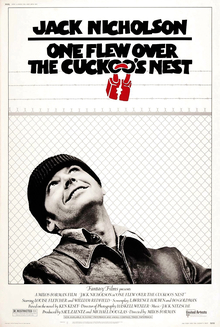
One Flew Over The Cuckoos Nest

When Your Prison Escape Plan Needs a Second Draft

Ever had one of those days where you try to dodge work by checking yourself into a mental hospital? No? Well, meet Randle Patrick McMurphy, a guy whose attempt to escape manual labor makes “quit your job and start a pottery business” look like a solid life choice.

McMurphy (played by Jack Nicholson, in a role that probably had method actors everywhere wondering if they should also get themselves committed) isn’t crazy – he’s just crazy like a fox who really didn’t think his plan through. After faking mental illness to dodge prison work duty, he finds himself in a psychiatric ward run by Nurse Ratched, a woman whose bedside manner makes Darth Vader look like a customer service trainer.

The ward is divided into two groups: the Acutes (potentially curable patients) and the Chronics (permanent residents who make the furniture look dynamic). Among the Acutes, we’ve got Billy Bibbit, whose stutter would give The King’s Speech’s Geoffrey Rush job security; Dale Harding, a man so deeply closeted he probably has winter coats in there; and Charlie Cheswick, whose emotional regulation makes a toddler at Toys “R” Us look zen. The Chronics include Chief Bromden, a Native American giant who’s perfected the art of playing deaf and mute – basically the world’s tallest mime.

McMurphy bursts into this environment like a food fight at a wine tasting. He immediately starts questioning everything: Why can’t they watch the World Series? Why does the ward’s music sound like elevator muzak composed by depressed snails? Why do their group therapy sessions feel like Twitter arguments in slow motion?

His battle with Nurse Ratched escalates from minor skirmishes over card games and TV privileges to full-scale warfare. It’s like watching a chess match where one player insists on using the pieces to act out scenes from WWE. McMurphy’s shocking discovery that many patients are there voluntarily leads to the greatest “wait, what?” moment since someone first explained cryptocurrency.

The plot thickens faster than institutional oatmeal when McMurphy organizes a ward party that makes your average college dorm shindig look like afternoon tea with the Queen. He smuggles in women and alcohol, and even gets Chief Bromden to break his silence – turns out the big guy was basically playing the world’s longest game of charades.

But because we can’t have nice things in this ward, everything goes sideways faster than a cafeteria jello cup. Billy Bibbit’s post-party encounter with Nurse Ratched proves that some people shouldn’t be allowed to weaponize guilt – it’s like watching your mom, your therapist, and your high school principal team up for an intervention, with tragic results.

The Verdict

What I Love:

  • Jack Nicholson’s performance, which makes other movie rebels look like hall monitors
  • Louise Fletcher turning passive-aggressive behavior into an Olympic sport
  • A supporting cast that could make group therapy actually worth attending
  • Direction so good it probably got Miloš Forman banned from hospital administration meetings
  • The most compelling argument against institutional healthcare since the invention of leeches

What Could’ve Been Better:

  • Might make you suspicious of every nurse offering medication
  • Will ruin your plans to fake mental illness to escape prison
  • Likely to make your next doctor’s visit more anxiety-inducing than it already was

This film swept the Academy Awards like Nurse Ratched sweeps away contraband cigarettes, winning all five major categories. It’s a masterpiece that will make you laugh, cry, and seriously reconsider any plans to avoid manual labor through institutional commitment.

Rating: 5 out of 5 suspiciously calm orderlies

P.S. – If you ever hear someone sweetly say “medication time,” run. Just run.

The Great Dictator

In what might be history’s most audacious case of “dress for the job you want, not the job you have,” Charlie Chaplin plays both a mild-mannered Jewish barber and his exact doppelganger, Adenoid Hynkel, the power-hungry dictator of Tomania (subtle, Charlie, real subtle). Our story begins in the trenches of World War I, where our unnamed barber heroically bumbles his way through a series of military mishaps, including accidentally piloting a plane upside down while carrying an important officer. Because apparently that’s how you survive war – with slapstick.

Fast forward to the barber waking up in 1939, after spending twenty years in the hospital with convenient plot-device amnesia. He returns to his barbershop in the Jewish ghetto, completely oblivious to the fact that his hometown has become the center stage for Hynkel’s anti-Semitic regime. Talk about missing a few newsletters during your hospital stay.

The ghetto sequences showcase some of Chaplin’s finest moments of resistance-through-comedy. Our barber befriends Hannah (Paulette Goddard), who’s made it her personal mission to bonk storm troopers with frying pans. He also gains the protection of Schultz, a high-ranking officer who recognizes him as the soldier who saved his life during the war (in that upside-down plane, no less – funny how these things come full circle).

Meanwhile, in a palace that looks like what would happen if you let a megalomaniac loose in IKEA, Dictator Hynkel is busy being a walking parody of Hitler. He practices speeches in mock German (which is really just gibberish peppered with occasional words like “wiener schnitzel” and “sauerkraut”), dances with an inflatable world globe in a scene that somehow manages to be both hilarious and terrifying, and throws temper tantrums that would make a toddler say “maybe dial it back a bit.”

The political satire kicks into high gear when Benzino Napaloni (Jack Oakie), the dictator of Bacteria, comes to visit. Their relationship is a masterclass in fragile masculinity, with both dictators trying to out-dictator each other. They compete over chair heights during a barbershop scene (yes, really), engage in a food fight at a formal dinner, and generally behave like schoolyard bullies who’ve been given countries to run. Their mustache-to-power ratio is off the charts.

Things take a turn when Schultz objects to Hynkel’s increasingly aggressive policies and ends up fleeing to the ghetto with a death sentence on his head. He and the barber organize a resistance movement, which goes about as well as you’d expect from a group led by an amnesiac barber and a defected officer with questionable planning skills. They end up in a concentration camp, but manage to escape wearing soldier uniforms (because apparently security protocols in Tomania were somewhat lax).

Through a series of coincidences that would make Charles Dickens say “that’s a bit much,” Hynkel goes duck hunting, falls into a lake, and gets arrested by his own troops who mistake him for the barber. Meanwhile, the barber, in stolen military gear, is mistaken for Hynkel just as the dictator is about to give a victory speech about invading Austria. Instead of doing the sensible thing and running for the hills, our barber-turned-accidental-dictator decides to give an impassioned speech about democracy, peace, and human dignity.

The film ends with Hannah listening to the speech on the radio in her new home in recently-invaded Austria. She’s inspired by the message of hope, though one might question the long-term viability of a resistance plan that involves accidentally replacing a dictator with his look-alike and hoping nobody notices the sudden personality change and complete reversal of all policies. But hey, in for a penny, in for a pound.

Chaplin’s film manages to be simultaneously slapstick comedy, pointed political satire, and earnest humanitarian plea. Released in 1940, when America was still officially neutral in World War II, the film was either an act of incredible courage or spectacular madness – or perhaps the special kind of genius that comes from being both. While some of the plot turns might require Olympic-level suspension of disbelief, the film’s core message about the absurdity of hatred and the power of human dignity remains as relevant as ever. Plus, where else are you going to see Hitler and Mussolini caricatures having a food fight?

(caption AI assisted)

I’d give this 4/5 stars. Mostly because it’s an audacious film and relevant to modern times. I can just imagine Trump and Putin having the chair size fight and it makes me giggle (which helps keep the night terrors away) Chaplin still has comedic chops especially with his physical comedy and although the plot contrivances are hard to believe they do land pretty well. After watching most of Chaplin’s silent movies during this project it was neat to see him speaking and he really does a great job. I’m a bit sad to not have any more of his films on my viewing schedule this year but I might loop back when this over and fill in the gaps.

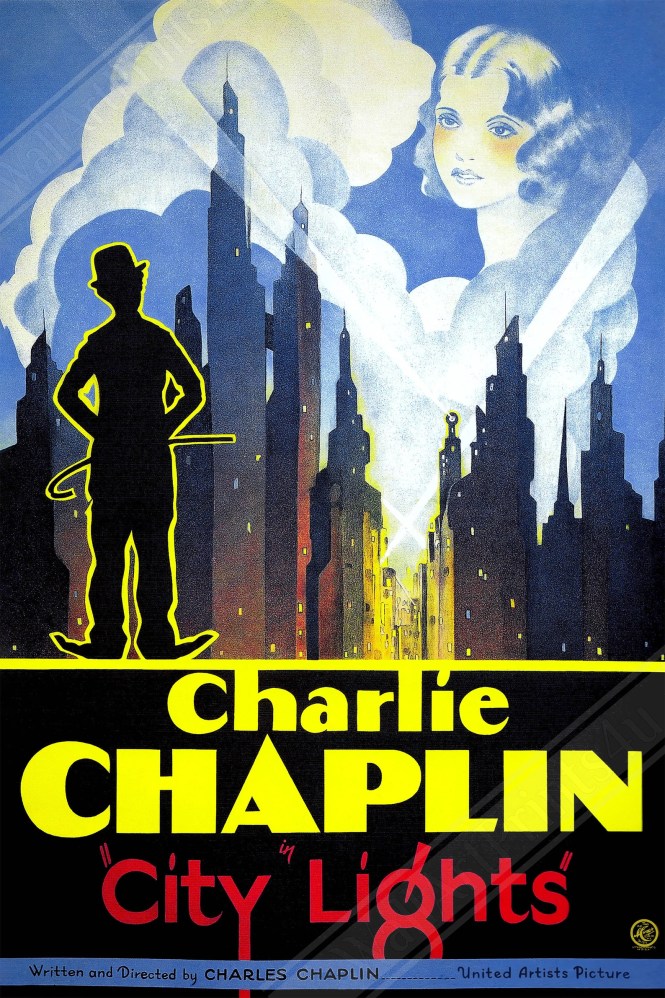
City Lights

Category: Silent Film, Comedy

Starring: Charlie Chaplin

Another Chaplin movie (a lot of his seem to make most ‘best movie’ lists and I can start to see why.  In this particular one he reprise the role of the tramp and the movie opens with him taking a nap under a tarp that is later revealed to be a statue that is having a big unveiling.  The usual slapstick shenanigans happen and he eventually escapes the authorities. He then meets a flower girl who is selling flowers and is instantly smitten.

As he’s leaving the flower girl hears a fancy car with a chauffeur and thinks it’s the tramp. Later that night the tramp is down by the water and he sees someone trying to kill themselves. He saves them from the attempt and it turns out the guy’s a millionaire and he takes the tramp back to his house to keep the party going. The guy’s a complete lush and when the tramp asks him for money to buy more flowers from the flower girl he peels off a few from a fat stack and sends him on the way telling him to take his car – a very nice Rolls Royce.

The thing is – the millionaire only really remembers the tramp when he’s hammered – once he’s sober he is a cruel and abrupt stereotype of a 1920’s tycoon.  It’s something that is repeated a few times with the millionaire who always seems to find the tramp when he’s sauced out of his mind.

Meanwhile the tramp keeps visiting his blind girl and one day she isn’t at her usual street corner. He eventually tracks her down and finds out that she is ill, so he keeps her company by reading her a newspaper. One of the articles is about a doctor who has a procedure to restore sight – the girl smiles and said it’d be wonderful because then she can see him. The tramp knowing he’s pretending to be rich and is aware of his looks isn’t enthused with this idea. However, as he’s leaving he finds an eviction notice and realizes her family is getting kicked out of the apartment.   Determined to help her he decides to get the money to pay her back rent.

The problem is he’s visited the blind girl too many times and the foreman fires him. One of his buddies ropes him into a fixed fight to make some cash but the crooked boxer takes off because the police are coming the his replacement is a giant of a man with murder in his eyes.  A comical drawn out boxing match happens which includes the tramp hitting the boxer with a shovel, the boxer punching the police, and general mayhem. However, the boxer eventually beats the tramp and he goes away without the money needed for the girl.

It’s at this time that the millionaire rolls up on the tramp, three sheets to the wind, and invites him to party (again). They have a good time and the tramp asks if he can give him the money for the girl. The rich guy says sure – and all seems to be solved, except that at that moment burglars break into the house and rob it – with the tramp making his getaway by running from the police (something he does quite frequently, to be honest)

Knowing that it’s a matter of time he runs to the girl and gives her the money – telling her that he’ll see her “in a while” shortly after the police find and arrest him. A while later he gets out of prison and goes to her street corner, only to find her gone.  One day as he’s walking down the street he looks in a store window and there she is! She runs a florist shop now and her sight has been restored! He nervously starts to approach but some newsboys who have taken a dislike to him start harassing him and she sees it through the window. She offers him a coin and a flower and when she touches his hand she realizes who he is and they share a smile.

4/5 – At this point the whole tramp gets the girl thing seems to have been done this is just another angle on it. The deranged millionaire was pretty funny and the slapstick bits are pretty consistent and humorous. Chaplin’s ability to express emotion without words is without peer and I can see why he dominated the silent film industry and his fame endures to this day.

Gold Rush [1925]

Charlie Chaplin

Silent Movie / Comedy

In a reprisal of Chaplin’s ‘tramp’ persona he heads off to the Alaskan territory with just his cane (and woefully underdressed) looking to capitalize on the gold rush.  He runs into a storm and takes shelter in what seems to be an abandoned cabin – but its currently being used by an escaped criminal who isn’t too happy with the new company. He chases Chaplin off in a comical wind/storm scene but then a prospector (Big Jim) who found gold seeks shelter from the storm in the cabin and overpowers the criminal. There’s an uneasy standoff where the three men begin to starve and they draw straws to see who goes out into the storm to get food. The criminal is sent off and promptly finds bounty hunters looking for him who have a nice sled full of supplies. He shoots them and steals their supplies and promptly vanishes from the movie (I’m not really sure why he even was in the plot except maybe as an antagonist for the staged cabin scenes)

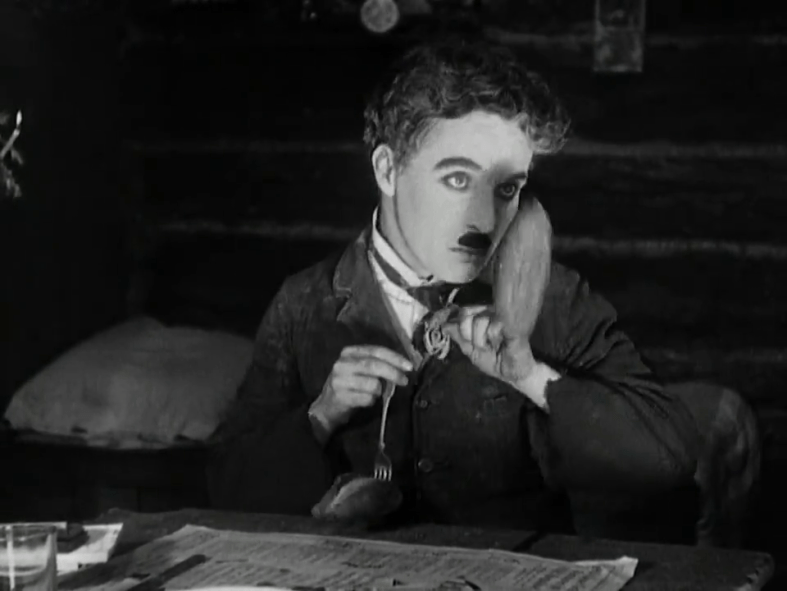
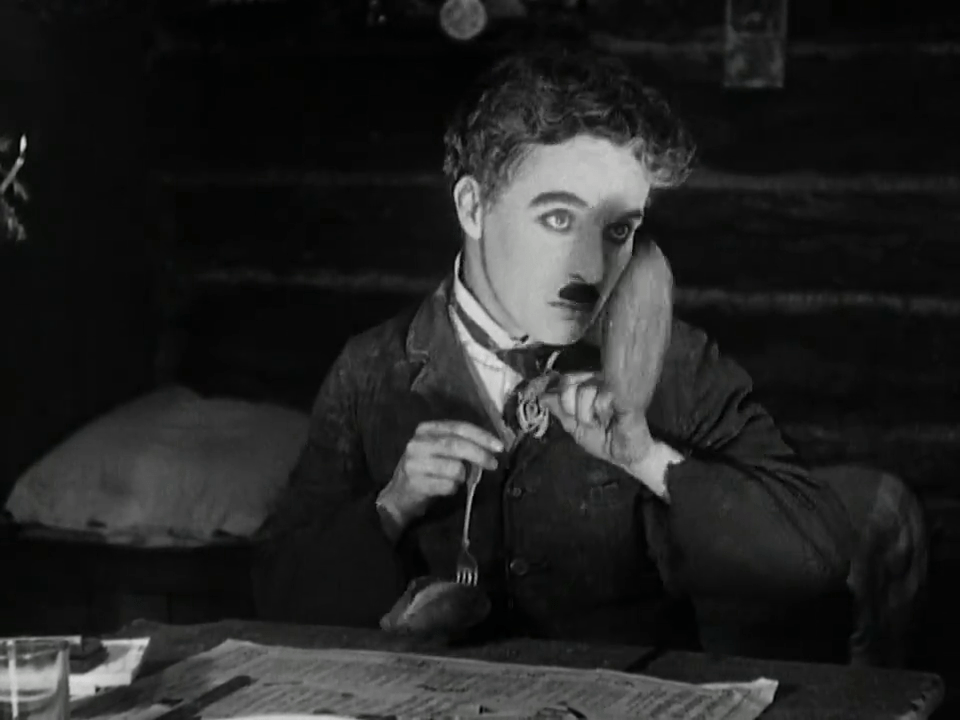
Cut back to the cabin and there’s the famous scene of Chaplin boiling his shoe to have something to eat (imagery featured frequently in images of hobos) and then Big Jim being delirious due to hunger and imagining Chaplin as a giant delicious chicken they have a quick chase and then big Jim comes to his senses and leaves to find his gold only to be assaulted by that criminal guy and left unconscious in the snow!

Cut to a different movie altogether for a while for a weird romance subplot where Chaplin meets a dancer who flirts with him to anger another guy and then agrees to go to dinner with Chaplin on NYE. On NYE Chaplin sets up his cabin all nice and then does the famous dancing roll bit (Oceana roll) then falls asleep waiting for her to arrive. She never does (quite a sad bit where he looks in the window and see her dancing with that handsome fella. He wanders off and then Georgia and her friends go to cause trouble for ‘the tramp’ but then see all the effort he want to for the party and she clearly feels guilty at her behavior. Later Chaplin goes into the party to confront them when big Jim rolls in (having lost his memory after the assault) and grabs Chaplin and says ‘we need to find the cabin! Then we can find my gold and I’ll share it with you!’ — so they head back to the cabin and get some rest before they head out but then a crazy storm blows in and blows the entire cabin to a cliff edge!

They wake up and a funny bit ensues where they walk back and forth and the cabin teeters on the edge but they think it might be a hangover but then when Chaplin opens the door he sees he’s dangling off a cliff and then they spend a few minutes figuring out how to escape but fate has smiled on them – the storm blew them right to big Jim’s mine! They’re rich!

Cut to them dressed fancily in furs and smoking cigars walking on a ship to sail back to America as millionaires – we see Chaplin’s girl also sailing out as it seems things didn’t work out with handsome man (she never really seemed that into him to begin with). Some various hijinks ensue where she shows she’s a somewhat good and remorseful person (offering to pay for his ticket when the crew thinks he’s a stowaway) and Chaplin goes in for the kiss and roll credits.

4/5 stars – The movie is iconic for a reason – so many tropes were born from this movie as well as call backs in many modern movies (the bread roll dance in Benny and Joon, countless eating your boots scenes.. Etc.) and for a silent movie it conveyed both comedy and pathos very effectively you forget it’s a silent movie and are drawn into the narrative completely.

(side note: apparently there’s a 1941 version re-cut by Chaplin that includes his own score and narrated interstitial panels. .might watch that if I have the time)

The General [1926]

Type: Silent Movie, Comedy

Starring: Buster Keaton

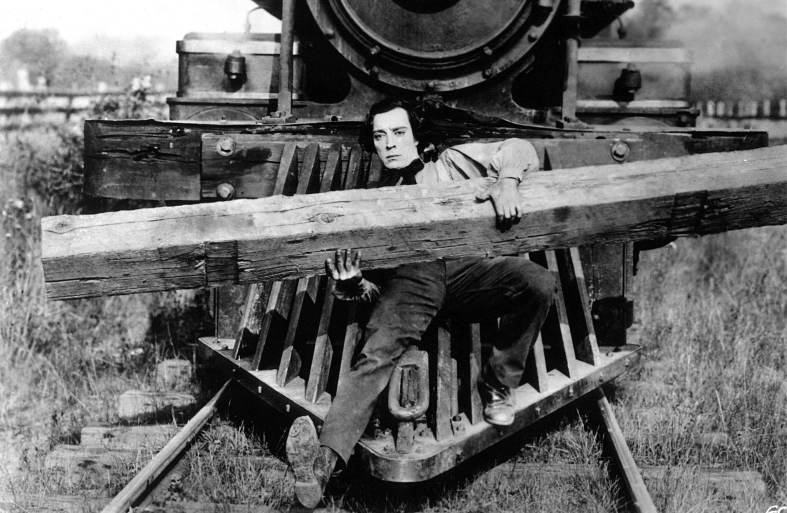
The origin of slapstick comedy in movies? This movie is 100 years old but the laughs are pretty timeless.  Keaton plays a train engineer who loves his train and Annabelle, a woman in his town. The movie is set at the outbreak of the civil war and when a general muster is called for the town Keaton tries to enlist (to impress his lady mostly) and he is deemed to important as a train engineer to fight on the front lines.

He tries several times to enlist but is rebuffed before he leaves rejected (the famous shot of Keaton sitting glumly on the train wheels as the train starts to move).  The union general sends some troops undercover to steal a train at the end of the line and then take it along the line destroying infrastructure on the way. They decide to steal Keaton’s train – and by happenstance his woman is on the train looking for something from her trunk.  He proceeds to chase the train using a variety of methods before commandeering a confederate train to chase them. He finally catches up with them and is hiding under a table when he hears plans for a union surprise raid and he sees that Anabelle is there! She’s been captured by the union and is held hostage.

He rescues her and they escape into the night.. When day breaks they see they are near a union train depot and lo and behold his train ‘The General’ is there! They sneak aboard and steal the train heading back to confederate lines being chased all the way. 

After setting a fire on a critical bridge they alert the confederate army who mount a counterattack on the union and drive them off and the Keaton gets the girl and a promotion to lieutenant

3/5

I really enjoyed the comedy elements of this movie – and Keaton did all of his own stunts, some of which were really straight dangerous! The plot existed to serve the comedy but was passable but the treatment of the actress was pretty poor (She was the inept comic relief who was dumb as a box of rocks) — yeah yeah I get it was the 1920s but it was still jarring to see.