The Lost City of Z

James Gray’s The Lost City of Z is the kind of movie that Hollywood doesn’t really make anymore—a slow-burn, introspective adventure film that’s more about obsession and existential yearning than it is about gunfights and treasure maps. If you’re expecting a swashbuckling, vine-swinging, snake-punching Indiana Jones type of adventure, I have some unfortunate news: this is not that. There are no ancient booby traps, no secret passageways, and not a single fedora in sight. What we do get is a beautifully shot, hypnotically slow descent into madness, where one man gets so consumed by the unknown that he willingly throws his entire life into the jungle, never to return.

Charlie Hunnam, shedding all remnants of his Sons of Anarchy biker aesthetic, plays Percy Fawcett, a British explorer who makes the baffling mistake of thinking, Yes, I will absolutely go deep into the Amazon rainforest in the early 1900s when absolutely everything is trying to kill me. To be fair, Percy isn’t some glory-seeking adventurer—he’s a man desperate to prove himself to a world that looks down on him. He stumbles upon the idea of a lost civilization buried in the jungle and suddenly, his life is no longer about being a husband or father—it’s about finding Zed (because the British refuse to say Zee like normal people). The deeper he goes, the more obsessed he becomes, to the point where the jungle stops being a place and becomes a state of mind.

Gray directs the film with the kind of patience that dares you to let it sink into your bones. He’s not interested in cheap thrills or exaggerated spectacle. Instead, he lets the atmosphere take over, letting the sweat, the mud, and the endless sea of trees weigh down on you like they do on Fawcett. It’s hypnotic, almost dreamlike—especially when compared to the rigid, oppressive society Fawcett returns to back home in England. Every time he steps out of the jungle, the world seems grayer, smaller, and more suffocating, as if civilization itself is the real prison.

And let’s talk about Robert Pattinson, because somehow, amid all of this, he sneaks in one of his best I’m-going-to-make-you-forget-I-was-ever-in-Twilight performances. As Fawcett’s scruffy, loyal companion Henry Costin, Pattinson disappears into the role, reminding us once again that he thrives in weird, offbeat characters with impressive facial hair. His quiet, almost resigned presence serves as a perfect counterbalance to Hunnam’s increasingly manic ambition, a reminder that for every explorer chasing glory, there’s a guy just trying not to die from malaria.

Sienna Miller also delivers a strong performance as Fawcett’s wife, Nina, a woman stuck in the impossible position of loving a man who loves something else more. She challenges him, supports him, and resents him all at once, embodying the emotional toll that Fawcett’s obsession leaves on the people around him. Because while he’s off chasing mythical cities, his real-life responsibilities—his family, his children, his entire actual existence—are left behind, gathering dust.

By the time the movie reaches its haunting final moments, it doesn’t really matter whether Fawcett found Z or not. The point isn’t about what’s real—it’s about the chase, the longing, the need to believe in something greater than yourself. The Lost City of Z isn’t about discovery; it’s about obsession. It’s about the people who are willing to walk off the edge of the map, knowing full well they might never come back.

So if you’re looking for a classic adventure movie with action-packed set pieces, this might not be your thing. But if you want a slow, meditative, and quietly devastating story about a man who willingly loses himself in the unknown—then The Lost City of Z is a journey worth taking. Just, you know, bring some bug spray.

The Pianist

Roman Polanski’s The Pianist is one of those movies that doesn’t just tell a story—it makes you live inside it, smothering you in a slow, methodical descent into hell. If you came looking for a standard World War II drama with sweeping battle scenes, a rousing musical score, and an obligatory moment where someone nobly sacrifices themselves while looking up at the sky, then congratulations—you are in the wrong place. This isn’t a movie about war, heroism, or resistance fighters saving the day. This is about survival, and survival isn’t glorious. It’s humiliating. It’s degrading. It’s watching the world collapse around you while you slowly wither away in the corner, praying no one notices you exist.

Adrien Brody plays Władysław Szpilman, a Polish-Jewish pianist who starts the movie playing Chopin in a Warsaw radio station and ends it looking like a half-dead scarecrow wandering the ruins of civilization. At the beginning, he’s got everything—family, talent, a home, a nice suit. But as the Nazis tighten their grip on Warsaw, all of it gets stripped away, piece by piece, until all that’s left is a man too weak to stand, hiding in the debris like a ghost who hasn’t realized he’s dead yet. Brody is phenomenal here, and not just in the way he physically transforms from a well-fed, confident musician into a skeletal shell of himself. He barely speaks for half the movie, yet you can feel every ounce of his suffering through his eyes. He doesn’t play Szpilman as a grand, defiant survivor—he plays him as a man who keeps existing simply because he has no other choice.

And let’s talk about Polanski’s direction, because it’s surgical in the way it destroys you. The film never indulges in melodrama, never turns Szpilman into some kind of cinematic martyr. Instead, it just follows him, unflinchingly, as he endures horror after horror. One moment, he’s playing music at a party. The next, he’s watching an old man in a wheelchair get thrown off a balcony by German soldiers. A few scenes later, he’s watching his family get herded onto a train, and he knows—without a word being said—that he will never see them again. The violence here isn’t stylized, it isn’t dramatic, it’s just cold, brutal, and matter-of-fact. People are shot in the street like it’s nothing. Families disappear overnight. The world goes mad, and Szpilman can do nothing but drift through it, clutching his hunger and his silence.

By the time we reach the last act of the film, Szpilman has been reduced to a walking corpse, hiding in the ruins of Warsaw, scrounging for scraps like a stray dog. And then, in one of the most quietly devastating scenes in war movie history, he is finally discovered—by a German officer, no less. And what does he do? He plays the piano. He sits at that broken, dust-covered instrument and plays as if the world isn’t burning outside. And somehow, for just a moment, music, the very thing that defines him, becomes his salvation. Because in a world that has taken everything from him—his family, his dignity, his home—his ability to create something beautiful is the only thing he has left.

The Pianist is not an easy watch. It’s not meant to be. It’s the kind of film that leaves you sitting in stunned silence when the credits roll, the kind that makes you feel like you’ve lived through something rather than just watched it. It doesn’t ask for your tears, but it takes them anyway. It’s a masterpiece, yes, but in the most haunting way possible—the kind of masterpiece that lingers in your bones long after the screen goes black.

The Hurt Locker

Kathryn Bigelow’s The Hurt Locker isn’t just a war movie—it’s a 131-minute stress test for your central nervous system. This isn’t one of those big, sweeping, patriotic spectacles where war is just a backdrop for heroism, camaraderie, and some dude writing sentimental letters home while soft orchestral music swells. No, this is war as pure, undiluted anxiety. This is war as an abusive relationship between a man and a bomb suit. This is war where every trash bag, abandoned car, and suspiciously placed goat could be the last thing you ever see. And the best part? You get to spend all of it inside the increasingly unhinged mind of Staff Sergeant William James, played with reckless brilliance by Jeremy Renner.

Renner’s James is not your typical movie soldier. He’s not here to brood about the morality of war or deliver grand monologues about duty and sacrifice. No, this man treats bomb disposal the way a daredevil treats BASE jumping, except instead of a parachute, he has a pair of wire cutters and a questionable amount of impulse control. He’s the guy who looks at a bomb that could level a city block and thinks, “I wonder how close I can get before this thing turns me into confetti.” He sweats adrenaline, makes every safety protocol weep, and approaches each explosive like it just insulted his mother. The man is addicted to war, which the movie kindly reminds us is “a drug.” Yeah, no kidding.

And while James is out here treating life like a Call of Duty lobby, his team—played by Anthony Mackie and Brian Geraghty—spends most of the movie vacillating between barely concealed terror and wanting to punch him in the face. Mackie’s Sanborn is the no-nonsense professional who, shockingly, does not appreciate James’ bomb-defusing-by-vibes-only approach. Meanwhile, Geraghty’s Eldridge is the poor guy who looks like he wandered into this war zone by accident and now can’t figure out how to leave. Their dynamic is basically “daredevil maniac and the two exhausted guys who have to keep him from dying,” which would be hilarious if it weren’t also completely terrifying.

But what really makes The Hurt Locker stand out isn’t just the tension—it’s how relentlessly it drags you into the chaos. Bigelow’s direction makes you feel like you’re right there in the dirt, sweating through your shirt, wondering if the old man watching you from a rooftop is just a guy enjoying the sunset or someone about to set off an IED with his Nokia brick phone. The handheld camerawork, the rapid cuts, the eerie silence that hangs in the air right before everything goes to hell—it all adds up to a film that doesn’t just depict war; it immerses you in it.

And yet, for all its high-octane suspense, The Hurt Locker isn’t about action—it’s about obsession. It’s about how, for some people, the war never really ends, even when they leave the battlefield. James might be able to dismantle bombs with his bare hands, but he can’t dismantle the part of himself that craves the rush. There’s a moment near the end where he stands in a grocery store aisle, staring blankly at an endless row of cereal boxes, completely lost. The choices are overwhelming. The stakes are non-existent. There’s no life-or-death tension, no adrenaline, no purpose. He looks more afraid in that moment than he does when he’s facing down a car bomb. Because the truth is, war is the only place he truly feels alive.

So yeah, The Hurt Locker is a masterpiece, but it’s the kind of masterpiece that leaves you slightly nauseous, vaguely anxious, and questioning whether you should have watched something with talking animals instead. It’s a film that doesn’t glorify war, but it does understand the terrifying allure of it. It grabs you by the collar, drags you into the dirt, and doesn’t let go until you’re just as rattled as the men on screen. And if you somehow make it through the whole thing without stress-eating an entire bag of chips, congratulations—you’re either a robot or William James himself.

Selma

Here’s the thing about Selma: it’s a movie that takes one of the most pivotal moments in American history and refuses to wrap it in the usual Hollywood gloss. No, this isn’t a feel-good, triumphal march where the music swells and justice is delivered with a bow on top. This is history as it was—messy, brutal, defiant, and driven by people who were not mythic figures but human beings who got tired of waiting for America to live up to its own promises.

Ava DuVernay, the mastermind behind this historical gut-punch, directs with such precision that you almost feel like you’re sitting in the rooms where Martin Luther King Jr. (played by David Oyelowo, who, let’s be honest, deserved every award that year and then some) and his fellow activists are making impossible decisions. The film doesn’t deify King; instead, it shows him as a leader who carried the weight of a movement on his shoulders while still being a husband, a father, and a man who, for all his strength, had moments of doubt. This isn’t the King of sanitized history books, but a flesh-and-blood person with an impossible mission. And somehow, Oyelowo nails every note of it, capturing the gravity, the exhaustion, and that unmistakable power in his voice.

The supporting cast is equally incredible. Carmen Ejogo as Coretta Scott King doesn’t just stand by his side—she holds her own, radiating both grace and quiet strength. Tom Wilkinson as LBJ? Oh, he plays the complicated, not-quite-the-ally-he-should’ve-been president with the right balance of charm and political calculation. And Tim Roth as George Wallace? Slimy as ever, which means he did the job right. But it’s not just about individual performances; it’s about how every person on screen embodies the weight of the moment.

Let’s talk about the march itself—the one from Selma to Montgomery. This movie does not pull its punches when it comes to showing the violent resistance these protesters faced. The Edmund Pettus Bridge sequence is one of the most harrowing moments put to screen—tear gas, batons, bodies trampled—and DuVernay films it in a way that makes you feel the impact of every blow. It’s not over-dramatized; it’s just raw and real. And it’s a stark reminder that these fights for civil rights weren’t won with speeches alone but with blood, resilience, and an unwavering belief in justice.

And can we take a moment to talk about the cinematography? Bradford Young, the cinematographer, gives this film a look that feels intimate yet grand, capturing both the quiet moments of personal struggle and the large-scale protests with equal beauty. The lighting, the framing—everything feels deliberate and urgent, like a call to action rather than a history lesson.

By the time you get to the end, when King delivers his “How Long? Not Long” speech, if you don’t feel something stirring deep in your soul, check your pulse. Because this is not just a movie; it’s a necessary reminder of what happens when people refuse to sit down and shut up in the face of injustice. It doesn’t matter if you know the history—this film makes you feel it. And that, more than anything, is what makes Selma great.

The Artist

If The Artist were a person, it would be that charming, slightly eccentric friend who’s always impeccably dressed and seems to have stepped out of a time machine just to make your life a bit more interesting. This is a film that dares you not to fall in love with it. Set in the late 1920s through the early 1930s, it’s a delightful homage to the silent film era, filled with all the drama, romance, and slapstick comedy that made those early flicks so captivating.

Jean Dujardin plays George Valentin, a silent movie star with a dazzling smile and a charismatic presence that could give Clark Gable a run for his money. But, alas, the arrival of talkies threatens to end his reign as the king of Hollywood. Enter Bérénice Bejo as Peppy Miller, a young dancer with a cute little beauty mark and dreams as big as her grin. She’s the face of the new Hollywood wave, and her star rises as George’s begins to wane. The chemistry between Dujardin and Bejo is electric—half the time, you’re grinning at their antics and the other half, you’re hoping they figure out their lives and just kiss already.

Director Michel Hazanavicius does something extraordinary with The Artist: he makes silence loud. In a world where we’re bombarded by constant noise, the lack of spoken dialogue in this film amplifies every gesture, every glance, every tap of a dance shoe. The music, oh, the music! It swoops in, filling the gaps, elevating the emotional stakes, and turning simple scenes into operatic moments. Ludovic Bource’s score is a character in its own right, narrating the highs and lows with such precision that you’d swear it’s whispering secrets about the characters directly into your ear.

Then there’s the dog. Uggie, the Jack Russell terrier, almost steals the show. Whether he’s saving his master from a burning film reel or doing a jaunty little dance, Uggie encapsulates the spirit of The Artist: playful, touching, and unapologetically entertaining.

What makes The Artist truly remarkable, though, is how it manages to speak volumes about the transition from silent films to talkies—a metaphor for any sort of change and the fear it brings. It’s both a love letter to a bygone era and a reminder that art, no matter the format, is timeless. The film tugs at your nostalgia with one hand and slaps you with a reality check with the other. It’s a silent film that loudly celebrates the joy of movies, reminding us why we fell in love with cinema in the first place.

By the time the credits roll, if you aren’t a little in love with George, Peppy, and yes, even Uggie, then maybe silent films—and charming eccentrics—are just not for you. But for everyone else, The Artist is a reminder that sometimes, the best way to say something meaningful is to just shut up and let the pictures do the talking.

Everything Everywhere All At Once

If Everything Everywhere All at Once were a person, it would be the most chaotic, over-caffeinated, emotionally unstable, and absurdly wise friend you have—the one who somehow makes you laugh, cry, and question the meaning of life in the span of a single conversation. This movie isn’t just a film; it’s a full-body experience. It grabs you by the collar, hurls you through the multiverse at breakneck speed, and somehow, by the end, makes you believe in the power of googly eyes and a well-placed hug.

At the heart of this madness is Michelle Yeoh, who plays Evelyn Wang, a middle-aged laundromat owner drowning in tax problems, an unraveling marriage, an increasingly distant daughter, and, oh yeah, an unexpected multiversal war where she’s the universe’s last hope. So, you know, a normal Tuesday. Yeoh is a revelation—switching from exhausted immigrant mother to kung-fu master to hot-dog-fingered romantic to literally a rock, all while making you feel every ounce of her existential crisis. It’s like watching an entire lifetime of performances crammed into one movie, and she absolutely owns every second.

And then there’s Ke Huy Quan, who storms back into Hollywood like he never left, delivering one of the most heartbreakingly pure performances as Waymond, Evelyn’s kind, soft-spoken husband who turns out to be the most quietly profound character in the entire film. One minute he’s bumbling with fanny-pack dad energy, the next he’s slicing through goons with said fanny pack, and then, just when you think you have him figured out, he drops the monologue about kindness that shatters your soul into a million pieces. This is the kind of performance that makes you want to hug every nice person you’ve ever met.

And then there’s Stephanie Hsu as Joy/Jobu Tupaki, who, honestly, might be one of the most hilariously terrifying antagonists ever put to screen. She’s nihilism in a glittering Elvis suit, flipping between existential despair and chaotic slapstick, and somehow, amidst all the ridiculousness, she delivers a gut-punch performance about generational trauma, identity, and the all-consuming fear of never being enough. If you thought your mom made you feel guilty, imagine if she could literally fight you across infinite universes.

But let’s talk about how this movie does what it does. The Daniels (Daniel Kwan and Daniel Scheinert) direct this film like two absolute lunatics who somehow got their hands on an A24 budget and decided to use it to make the most emotionally resonant fever dream imaginable. The editing is on another level—flipping between universes, tones, and aspect ratios like it’s no big deal. One moment it’s a high-stakes kung-fu battle, the next it’s a heartfelt conversation between two literal rocks, and somehow, both scenes hit just as hard.

And the action? Gloriously absurd. You will never see another movie where a butt-plug-fueled martial arts battle exists in the same space as an Oscar-worthy meditation on love and acceptance. The fight choreography is top-tier—equal parts Jackie Chan homage and absurdist comedy—because why shouldn’t a fight scene involve a guy using a keyboard like nunchucks?

And let’s not forget the emotional core of it all. Because underneath the hot-dog fingers, the raccoon puppeteering (yes, Raccacoonie is real and magnificent), and the existential bagel of doom, this is a story about a mother and a daughter, about learning to choose love and kindness even when life is messy and incomprehensible. It’s about the small, quiet moments that make existence meaningful—even if you are just a rock on a hill.

By the time the credits roll, you’re left feeling emotionally drained in the best way possible. Everything Everywhere All at Once is absurd, heartfelt, hilarious, existential, and genuinely one of the most original films ever made. It’s a love letter to chaos, to immigrant families, to kindness, and to the fact that sometimes, the only way to fight existential dread is to put googly eyes on everything.

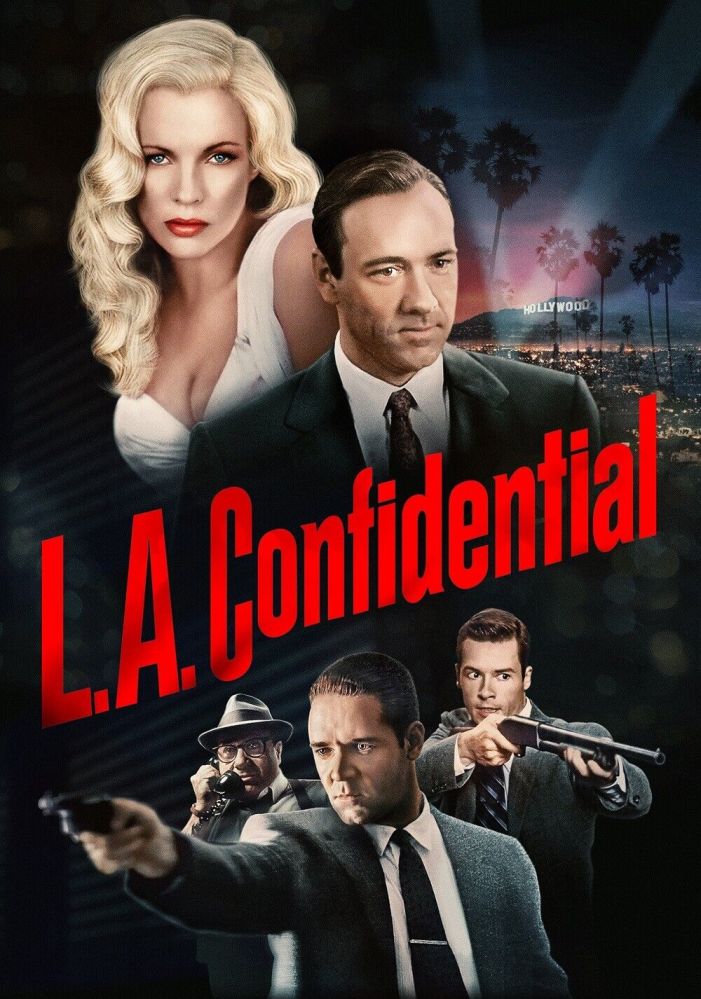
LA Confidential

Welcome to 1950s Los Angeles, where the men are crooked, the women are dangerous, and everyone’s eyebrows are perfectly sculpted. Curtis Hanson’s “L.A. Confidential” is what happens when you take film noir, inject it with Hollywood steroids, and tell it to solve a murder case that’s more twisted than a pretzel in a tornado.

Our trio of troubled cops includes Guy Pearce as Ed Exley, the kind of straight-arrow officer who probably wrote detention slips in kindergarten; Russell Crowe as Bud White, whose anger management technique is to manage to get angry at absolutely everyone; and Kevin Spacey as Jack Vincennes, a cop so slick he makes his own hair gel out of pure swagger. Together, they form the world’s most dysfunctional crime-solving team since somebody thought it was a good idea to give Sherlock Holmes a cocaine habit.

The plot kicks off with the Nite Owl Massacre, a multiple homicide that’s about as straightforward as quantum physics explained by a drunk physicist. What starts as a simple coffee shop shooting spirals into a labyrinth of corruption that involves dirty cops, Hollywood prostitutes (who look like movie stars), movie stars (who act like prostitutes), and enough double-crosses to make a geometry teacher dizzy.

Enter Kim Basinger as Lynn Bracken, a Veronica Lake lookalike who’s caught in the middle of all this mess. She’s the kind of dame that makes smart men stupid and stupid men even stupider – which in 1950s L.A. is really saying something. Her presence in the story adds layers of complexity to both the plot and the already complicated relationships between our three cops, who apparently never got the memo about bros before… well, you know.

The film weaves together so many subplots it should come with a road map and GPS. We’ve got tabloid journalism (Danny DeVito as Sid Hudgens, who never met a scandal he couldn’t make juicier), police corruption (James Cromwell as Captain Dudley Smith, whose Irish brogue could charm the scales off a snake), and a prostitution ring that gives new meaning to the term “plastic surgery.” All of this somehow ties together in a way that makes perfect sense, assuming you’ve been taking detailed notes and perhaps consulted a private detective.

What Makes It Shine Brighter Than a Hollywood Premiere:

  • Dialogue sharp enough to shave with
  • A plot more intricate than a Rube Goldberg machine, but twice as satisfying when it all comes together
  • Period detail so precise you can practically smell the cigarette smoke and casual misogyny
  • Career-defining performances from the entire cast, especially the then-unknown Aussie duo of Pearce and Crowe
  • Brian Helgeland’s screenplay, which somehow makes following three protagonists feel as natural as falling down stairs

What Makes It Shadier Than a Palm Tree at Midnight:

  • You might need to watch it twice to catch all the plot threads (though that’s hardly a punishment)
  • The first hour requires more concentration than defusing a bomb
  • Some viewers might need a flowchart to keep track of who’s betraying whom
  • The authentic period attitudes toward women and minorities might make modern viewers cringe

The Final Verdict:
“L.A. Confidential” is what happens when you take every film noir cliché in the book, feed them through a meat grinder of excellent writing, phenomenal acting, and pitch-perfect direction, and serve them up on a plate garnished with Hollywood corruption and garnished with murder. It’s a movie so good it makes you wish all police procedurals involved corrupt cops, glamorous prostitutes, and Danny DeVito running a scandal magazine.

This is the kind of film that reminds you why people fell in love with movies in the first place. It’s complex without being confusing, stylish without being shallow, and nostalgic without being naive. It’s like Raymond Chandler and James Ellroy had a baby, and that baby grew up to be the coolest kid in film school.

Rating: 5 out of 5 slightly tarnished badges

P.S. Keep an eye out for the scene where Exley interrogates a suspect while pretending to be way more hardboiled than he actually is. It’s like watching a Boy Scout try to impersonate Dirty Harry, and it’s absolutely perfect. Also, count how many times someone lights a cigarette – you could turn it into a drinking game, but you’d be unconscious before the second act.

Malcolm X

Spike Lee’s “Malcolm X” isn’t just a movie – it’s a movement captured on film, a three-hour-plus journey through one of the most complex and transformative figures in American history. And let me tell you, if you think you know Malcolm X’s story from your history books, this film will make you think again.

The film follows Malcolm Little’s evolution from a small-time hustler (played with explosive charisma by Denzel Washington in what should have won him the Oscar) to the powerful, controversial, and ultimately transformative figure known as Malcolm X. It’s a journey that takes us from the streets of Boston and Harlem to the holy cities of the Middle East, and from militant black nationalism to a more universal, though no less revolutionary, vision of human rights.

Lee structures the film like a religious conversion narrative – which, in many ways, it is. We begin with Malcolm as a “red” conk-wearing hustler, running numbers and pulling scams with his buddy Shorty (played by Spike Lee himself). This section plays almost like a gangster film, with its zoot suits, lindy hop dancing, and jazz soundtrack. But beneath the flash, we see the systematic racism that shaped Malcolm’s early worldview.

The prison sequence marks the first transformation, as Malcolm encounters the teachings of the Nation of Islam through fellow inmate Brother Baines. Washington brilliantly portrays Malcolm’s awakening, showing us a man literally remaking himself through education and religious conviction. His famous scene practicing writing on prison paper – starting with “A” and filling every inch of space – is a masterclass in showing intellectual awakening on screen.

As Malcolm X, the Nation of Islam minister, Washington captures both the fire and intelligence that made Malcolm such a magnetic speaker. The film doesn’t shy away from his more controversial statements but contextualizes them within the reality of 1960s America. When Malcolm speaks, whether to small groups or massive crowds, you understand why people listened.

The final act deals with Malcolm’s break from the Nation of Islam, his pilgrimage to Mecca, and his evolution toward a more inclusive worldview – while never abandoning his commitment to black empowerment and human rights. It’s here that the film reaches its tragic but transcendent conclusion, with Lee skillfully weaving documentary footage into the narrative.

What Soars:

  • Denzel Washington’s performance is a tour de force that captures Malcolm’s intelligence, charisma, and evolution
  • Ernest Dickerson’s cinematography shifts with each phase of Malcolm’s life, from the vibrant colors of his hustler days to the stark clarity of his later years
  • The supporting cast, particularly Angela Bassett as Betty Shabazz, brings depth to every scene
  • Spike Lee’s direction balances intimate personal moments with sweeping historical drama
  • The use of actual footage and photographs grounds the film in historical reality

What Struggles:

  • At 3 hours and 22 minutes, the film demands significant viewer commitment
  • Some of the early period sequences can feel slightly stylized
  • The complexity of Malcolm’s political and religious ideas sometimes gets simplified
  • The film’s structure occasionally makes it feel like multiple movies in one

The Verdict:
“Malcolm X” is more than a biopic – it’s an American epic that forces us to confront our nation’s painful history while celebrating the possibility of personal transformation. It’s a film that understands its subject was not just a historical figure but a living, breathing, evolving human being who contained multitudes.

Lee and Washington don’t give us a sanitized hero or a simple villain, but rather a man who constantly questioned, grew, and fought for what he believed was right, even as those beliefs changed. It’s a film that reminds us that the past isn’t past, that the questions Malcolm X grappled with – about justice, identity, resistance, and human dignity – remain urgently relevant.

Rating: 5 out of 5 raised fists

P.S. Pay attention to the film’s opening credits sequence, which intercuts the American flag with footage of the Rodney King beating – a reminder that Malcolm’s story isn’t just history, but a continuing conversation about race and justice in America. Also, the fact that Spike Lee had to reach out to prominent African American artists and athletes to help fund the film’s completion adds another layer to its significance as a piece of cultural history.

Platoon

If you’ve ever wondered what the opposite of a feel-good war movie looks like, Oliver Stone’s “Platoon” is your answer. This isn’t your grandfather’s World War II glory story – this is Vietnam in all its mud-soaked, morally ambiguous, soul-crushing reality.

Our guide through this green inferno is Chris Taylor (Charlie Sheen, back when that name meant “serious actor”), a college dropout who volunteered for Vietnam out of a naive sense of patriotic duty. Remember those idealistic college essays you wrote about making the world a better place? Yeah, this is like that, except with more leeches, less sleep, and the constant threat of stepping on a land mine.

Taylor finds himself caught between two father figures: Sergeant Elias (Willem Dafoe), the compassionate warrior who hasn’t quite lost his humanity, and Sergeant Barnes (Tom Berenger, sporting a face full of scars and a soul full of darkness), who embodies the war’s dehumanizing effects. If Elias is the platoon’s conscience, Barnes is its survival instinct gone rabid.

The film doesn’t so much unfold as it descends – into madness, into moral corruption, into the heart of darkness (and yes, that Conrad reference is entirely intentional). We watch as Taylor’s idealism crumbles faster than a cookie in a monsoon. The platoon faces not just external enemies but internal ones: fear, paranoia, and the growing realization that maybe the real war isn’t between Americans and Vietnamese, but between different visions of what America should be.

Stone, drawing from his own Vietnam experiences, crafts scenes that feel less like Hollywood set pieces and more like fever dreams. The night ambushes, where muzzle flashes briefly illuminate terrified faces. The village raid that spirals into an atrocity. The cannabis-hazed moments in the “underworld” bunker where soldiers escape through rock music and chemical recreation. It all feels horrifyingly authentic.

The film’s most iconic moment – Elias running from the NVA with his arms raised (spoiler alert: it doesn’t end well) – becomes a sort of crucifixion image, the death of whatever moral high ground America thought it had in this conflict. When Samuel Barber’s Adagio for Strings swells over scenes of destruction, it feels less like a soundtrack and more like a requiem for lost innocence.

What Makes It Hit:

  • The raw authenticity that only comes from a director who’s actually been there
  • Willem Dafoe and Tom Berenger delivering career-defining performances as the angel and devil on Taylor’s shoulders
  • Cinematography that makes you feel the suffocating heat and paranoia of the jungle
  • A supporting cast (including a young Forest Whitaker and Johnny Depp) that brings the diverse reality of Vietnam-era America to life
  • The gradual build-up of tension that makes the explosive moments all the more impactful

What Makes It Miss:

  • Some of the symbolism (good sergeant vs. evil sergeant) can feel a bit heavy-handed
  • Charlie Sheen’s performance, while solid, occasionally feels overwhelmed by his more experienced co-stars
  • The voiceover narration sometimes states themes that the visual storytelling already conveys
  • The pacing in the middle section can drag for viewers expecting constant action

The Final Word:
“Platoon” isn’t just a war movie – it’s an exorcism of America’s Vietnam demons caught on film. It’s brutal, uncompromising, and absolutely essential viewing. While “Apocalypse Now” gave us Vietnam as surreal nightmare and “Full Metal Jacket” gave us Vietnam as dark satire, “Platoon” gives us Vietnam as it was: a meat grinder that took young men’s bodies and souls.

This isn’t a movie you enjoy – it’s a movie you survive, much like the war itself. It’s also one of the most important war films ever made, precisely because it strips away all the glory and pageantry to show war’s true face. When the credits roll, you’ll feel like you’ve been through something significant, even if you’re not quite sure you want to go through it again.

Rating: 5 out of 5 shattered illusions

P.S. Watch for the scene where King (Keith David) explains the reality of who’s fighting this war: “You got your white-bread, college boys like you out here, fighting this war, alongside your poor, black, Spanish, and redneck boys who’d be the first to die.” It’s a moment of clarity that cuts through all the fog of war.

Once Upon a Time in America

The Longest Game of Criminal Musical Chairs Ever Filmed

Looking for a nice, straightforward gangster movie? Maybe try Goodfellas. Sergio Leone’s final film is what happens when you take a crime epic, throw it in a blender with a pocket watch, and hit the “timeline confetti” button. It’s nearly four hours of past, present, and “wait, when are we now?”

Our story follows David “Noodles” Aaronson (Robert De Niro) through three primary time periods: the 1920s (child gangster edition), the 1930s (successful gangster edition), and 1968 (confused old gangster edition). The film opens with Noodles in 1933 fleeing from gangsters after apparently getting his friends killed and stealing their money. Because that’s what friends are for, right?

Cut to 1968, where an older Noodles returns to New York after receiving a mysterious letter. He looks like he’s spent the last 35 years trying to figure out what exactly happened in this movie, and honestly, same. He visits a still-operating speakeasy run by Fat Moe (Larry Rapp), whose sister Deborah (Elizabeth McGovern) was the love of Noodles’ life – at least when he wasn’t too busy ruining everything.

Through a series of flashbacks more complex than a quantum physics textbook, we learn about young Noodles (Scott Tiler) and his childhood friend Max (Rusty Jacobs). They start their criminal career in Manhattan’s Lower East Side, where they meet Patsy and Cockeye, forming a gang that makes the Little Rascals look like model citizens. Their early adventures include setting a rival’s newspaper stand on fire, which seems like a lot of effort to avoid reading the morning news.

Young Noodles goes to prison for killing a rival gang member, and when he gets out, he reunites with his now-grown friends. Adult Max (James Woods) has become more ambitious than a Silicon Valley startup founder, leading the gang into bigger scores during Prohibition. The adult gang’s operations are successful enough to make them rich, but Max keeps pushing for more, because apparently being a wealthy criminal during the Depression isn’t enough of an achievement.

The film weaves through their rise to power, complicated by Noodles’ obsession with Deborah and Max’s increasingly risky schemes. There’s a subplot about a union leader named Jimmy O’Donnell that’s more confusing than trying to assemble IKEA furniture without instructions. Meanwhile, Noodles’ relationship with Deborah goes about as well as you’d expect from someone whose emotional intelligence is somewhere between a rock and a slightly smaller rock.

Everything supposedly culminates in a betrayal in 1933 that leads to the deaths of Max, Patsy, and Cockeye. But because this is Leone, nothing is what it seems. In 1968, Noodles discovers that Max faked his death, stole the gang’s money, and became a powerful political figure named Secretary Bailey. It’s like the worst high school reunion surprise ever.

The Verdict

What I Love:

  • A narrative structure that makes Christopher Nolan say “maybe that’s a bit complicated”
  • Ennio Morricone’s score that makes even scenes of people walking seem epic
  • De Niro proving he can brood in multiple decades
  • James Woods at peak James Woods-iness
  • Cinematography that makes New York look like a beautiful dream, even when it’s a nightmare

What Could’ve Been Better:

  • Might require a flowchart to follow the timeline
  • Will definitely affect your ability to tell what year it is
  • Could make you suspicious of any childhood friend who seems too ambitious

This is a film that treats time like a suggestion rather than a rule. It’s less “Once Upon a Time” and more “Several Times at Once in America.” At nearly four hours long, it’s the kind of movie that makes Lord of the Rings look like a TikTok video.

Rating: 5 out of 5 opium-induced time jumps

P.S. – If you’re planning to watch this, maybe take notes. Or better yet, bring a professional timekeeper.