Taxi Driver

Ever had insomnia so bad you decided to become a taxi driver and slowly descend into violent psychosis? Meet Travis Bickle (Robert De Niro), a Vietnam vet whose idea of a self-improvement program makes Fight Club look like a mindfulness retreat.

Travis takes a job driving a taxi on New York’s night shift, which in 1976 was about as relaxing as being a rodeo clown with vertigo. He cruises through a Times Square that makes modern-day Times Square look like Disneyland, carrying passengers that would make an Uber driver’s one-star reviews seem quaint. His journal entries reveal a man who sees the city as a cesspool that needs cleaning, though his idea of urban renewal involves significantly more ammunition than most city planners would recommend.

Our sleep-deprived protagonist becomes fixated on two women: Betsy (Cybill Shepherd), a campaign worker for presidential candidate Charles Palantine, and Iris (Jodie Foster), a 12-year-old prostitute. Because nothing says “I’m totally stable” like taking your first date to a Swedish porn film, Travis manages to spectacularly bomb his chances with Betsy faster than you can say “poor choice of venue.” Pro tip: X-rated movies are generally not considered first-date material, unless you’re dating a film critic with very specific interests.

Meanwhile, Travis’s mental state deteriorates faster than a sandwich left in a hot cab. He starts working out, buying illegal guns from sketchy salesmen (played by Steven Prince, who probably didn’t have to act much), and practicing quick-draws in front of his mirror while delivering the now-iconic “You talkin’ to me?” monologue – which, by the way, is the worst self-help affirmation ever.

His apartment turns into what would happen if an army surplus store had a baby with a pharmacy’s worth of uppers. He straps a gun to his arm using a homemade sliding mechanism that would make Q Branch jealous, shaves his hair into a mohawk that would give any barber PTSD, and generally transforms himself into a one-man army whose recruiting officer really should have checked references.

The plot accelerates when Travis fixates on “saving” Iris from her pimp, Sport (Harvey Keitel, rocking a wardrobe that makes most disco outfits look understated). He also decides that presidential candidate Palantine needs to be assassinated, because nothing says “I’m helping” like attempting to shoot a politician. When that plan fails – turns out Secret Service agents don’t appreciate mohawked guys reaching for their pockets – Travis redirects his violent salvation complex toward Sport and Iris’s other exploiters.

The finale explodes into one of cinema’s most notorious bloodbaths, as Travis storms the brothel in a scene that makes The Shining look like a real estate walkthrough. He eliminates Sport, the hotel manager, and Iris’s client in a sequence that’s both horrifying and weirdly balletic, if your idea of ballet involves multiple gunshot wounds. Travis himself is shot several times but keeps going, demonstrating that crazy beats bullets every time.

The film’s coda is a masterpiece of irony: Travis survives and is hailed as a hero by the media for saving Iris. We see him back at work, now famous among his fellow cabbies, even getting a fare from Betsy who seems impressed by his newfound notoriety. But that final look in his rearview mirror suggests that New York’s most unstable cabbie hasn’t exactly found inner peace.

The Verdict

What I Love:

  • De Niro’s performance, which makes other method actors look like they’re doing dinner theater
  • The grimy portrayal of 1970s New York that makes modern tourists seem adorably naive
  • Bernard Herrmann’s last and possibly greatest score, which sounds like jazz having a nervous breakdown
  • Paul Schrader’s script that reads like Dostoevsky after three days without sleep
  • Michael Chapman’s cinematography that makes you want to take a shower, but in a good way

What Could’ve Been Better:

  • Might make you reconsider using ride-share services
  • Will definitely make you suspicious of anyone who owns multiple guns and hair clippers
  • Could affect tourism to New York (though modern Times Square has done that anyway)

“Taxi Driver” is a masterpiece that manages to be both a character study and a slap in the face to anyone who thinks mental health services are adequately funded. It’s like watching a train wreck if the train were consciousness itself, and the track were society’s failed support systems.

Rating: 5 out of 5 possibly imagined cab fares

P.S. – After watching this, you might want to take the bus for a while.
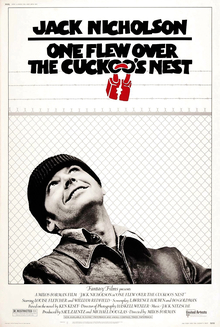
One Flew Over The Cuckoos Nest

When Your Prison Escape Plan Needs a Second Draft

Ever had one of those days where you try to dodge work by checking yourself into a mental hospital? No? Well, meet Randle Patrick McMurphy, a guy whose attempt to escape manual labor makes “quit your job and start a pottery business” look like a solid life choice.

McMurphy (played by Jack Nicholson, in a role that probably had method actors everywhere wondering if they should also get themselves committed) isn’t crazy – he’s just crazy like a fox who really didn’t think his plan through. After faking mental illness to dodge prison work duty, he finds himself in a psychiatric ward run by Nurse Ratched, a woman whose bedside manner makes Darth Vader look like a customer service trainer.

The ward is divided into two groups: the Acutes (potentially curable patients) and the Chronics (permanent residents who make the furniture look dynamic). Among the Acutes, we’ve got Billy Bibbit, whose stutter would give The King’s Speech’s Geoffrey Rush job security; Dale Harding, a man so deeply closeted he probably has winter coats in there; and Charlie Cheswick, whose emotional regulation makes a toddler at Toys “R” Us look zen. The Chronics include Chief Bromden, a Native American giant who’s perfected the art of playing deaf and mute – basically the world’s tallest mime.

McMurphy bursts into this environment like a food fight at a wine tasting. He immediately starts questioning everything: Why can’t they watch the World Series? Why does the ward’s music sound like elevator muzak composed by depressed snails? Why do their group therapy sessions feel like Twitter arguments in slow motion?

His battle with Nurse Ratched escalates from minor skirmishes over card games and TV privileges to full-scale warfare. It’s like watching a chess match where one player insists on using the pieces to act out scenes from WWE. McMurphy’s shocking discovery that many patients are there voluntarily leads to the greatest “wait, what?” moment since someone first explained cryptocurrency.

The plot thickens faster than institutional oatmeal when McMurphy organizes a ward party that makes your average college dorm shindig look like afternoon tea with the Queen. He smuggles in women and alcohol, and even gets Chief Bromden to break his silence – turns out the big guy was basically playing the world’s longest game of charades.

But because we can’t have nice things in this ward, everything goes sideways faster than a cafeteria jello cup. Billy Bibbit’s post-party encounter with Nurse Ratched proves that some people shouldn’t be allowed to weaponize guilt – it’s like watching your mom, your therapist, and your high school principal team up for an intervention, with tragic results.

The Verdict

What I Love:

  • Jack Nicholson’s performance, which makes other movie rebels look like hall monitors
  • Louise Fletcher turning passive-aggressive behavior into an Olympic sport
  • A supporting cast that could make group therapy actually worth attending
  • Direction so good it probably got Miloš Forman banned from hospital administration meetings
  • The most compelling argument against institutional healthcare since the invention of leeches

What Could’ve Been Better:

  • Might make you suspicious of every nurse offering medication
  • Will ruin your plans to fake mental illness to escape prison
  • Likely to make your next doctor’s visit more anxiety-inducing than it already was

This film swept the Academy Awards like Nurse Ratched sweeps away contraband cigarettes, winning all five major categories. It’s a masterpiece that will make you laugh, cry, and seriously reconsider any plans to avoid manual labor through institutional commitment.

Rating: 5 out of 5 suspiciously calm orderlies

P.S. – If you ever hear someone sweetly say “medication time,” run. Just run.

The Great Dictator

In what might be history’s most audacious case of “dress for the job you want, not the job you have,” Charlie Chaplin plays both a mild-mannered Jewish barber and his exact doppelganger, Adenoid Hynkel, the power-hungry dictator of Tomania (subtle, Charlie, real subtle). Our story begins in the trenches of World War I, where our unnamed barber heroically bumbles his way through a series of military mishaps, including accidentally piloting a plane upside down while carrying an important officer. Because apparently that’s how you survive war – with slapstick.

Fast forward to the barber waking up in 1939, after spending twenty years in the hospital with convenient plot-device amnesia. He returns to his barbershop in the Jewish ghetto, completely oblivious to the fact that his hometown has become the center stage for Hynkel’s anti-Semitic regime. Talk about missing a few newsletters during your hospital stay.

The ghetto sequences showcase some of Chaplin’s finest moments of resistance-through-comedy. Our barber befriends Hannah (Paulette Goddard), who’s made it her personal mission to bonk storm troopers with frying pans. He also gains the protection of Schultz, a high-ranking officer who recognizes him as the soldier who saved his life during the war (in that upside-down plane, no less – funny how these things come full circle).

Meanwhile, in a palace that looks like what would happen if you let a megalomaniac loose in IKEA, Dictator Hynkel is busy being a walking parody of Hitler. He practices speeches in mock German (which is really just gibberish peppered with occasional words like “wiener schnitzel” and “sauerkraut”), dances with an inflatable world globe in a scene that somehow manages to be both hilarious and terrifying, and throws temper tantrums that would make a toddler say “maybe dial it back a bit.”

The political satire kicks into high gear when Benzino Napaloni (Jack Oakie), the dictator of Bacteria, comes to visit. Their relationship is a masterclass in fragile masculinity, with both dictators trying to out-dictator each other. They compete over chair heights during a barbershop scene (yes, really), engage in a food fight at a formal dinner, and generally behave like schoolyard bullies who’ve been given countries to run. Their mustache-to-power ratio is off the charts.

Things take a turn when Schultz objects to Hynkel’s increasingly aggressive policies and ends up fleeing to the ghetto with a death sentence on his head. He and the barber organize a resistance movement, which goes about as well as you’d expect from a group led by an amnesiac barber and a defected officer with questionable planning skills. They end up in a concentration camp, but manage to escape wearing soldier uniforms (because apparently security protocols in Tomania were somewhat lax).

Through a series of coincidences that would make Charles Dickens say “that’s a bit much,” Hynkel goes duck hunting, falls into a lake, and gets arrested by his own troops who mistake him for the barber. Meanwhile, the barber, in stolen military gear, is mistaken for Hynkel just as the dictator is about to give a victory speech about invading Austria. Instead of doing the sensible thing and running for the hills, our barber-turned-accidental-dictator decides to give an impassioned speech about democracy, peace, and human dignity.

The film ends with Hannah listening to the speech on the radio in her new home in recently-invaded Austria. She’s inspired by the message of hope, though one might question the long-term viability of a resistance plan that involves accidentally replacing a dictator with his look-alike and hoping nobody notices the sudden personality change and complete reversal of all policies. But hey, in for a penny, in for a pound.

Chaplin’s film manages to be simultaneously slapstick comedy, pointed political satire, and earnest humanitarian plea. Released in 1940, when America was still officially neutral in World War II, the film was either an act of incredible courage or spectacular madness – or perhaps the special kind of genius that comes from being both. While some of the plot turns might require Olympic-level suspension of disbelief, the film’s core message about the absurdity of hatred and the power of human dignity remains as relevant as ever. Plus, where else are you going to see Hitler and Mussolini caricatures having a food fight?

(caption AI assisted)

I’d give this 4/5 stars. Mostly because it’s an audacious film and relevant to modern times. I can just imagine Trump and Putin having the chair size fight and it makes me giggle (which helps keep the night terrors away) Chaplin still has comedic chops especially with his physical comedy and although the plot contrivances are hard to believe they do land pretty well. After watching most of Chaplin’s silent movies during this project it was neat to see him speaking and he really does a great job. I’m a bit sad to not have any more of his films on my viewing schedule this year but I might loop back when this over and fill in the gaps.

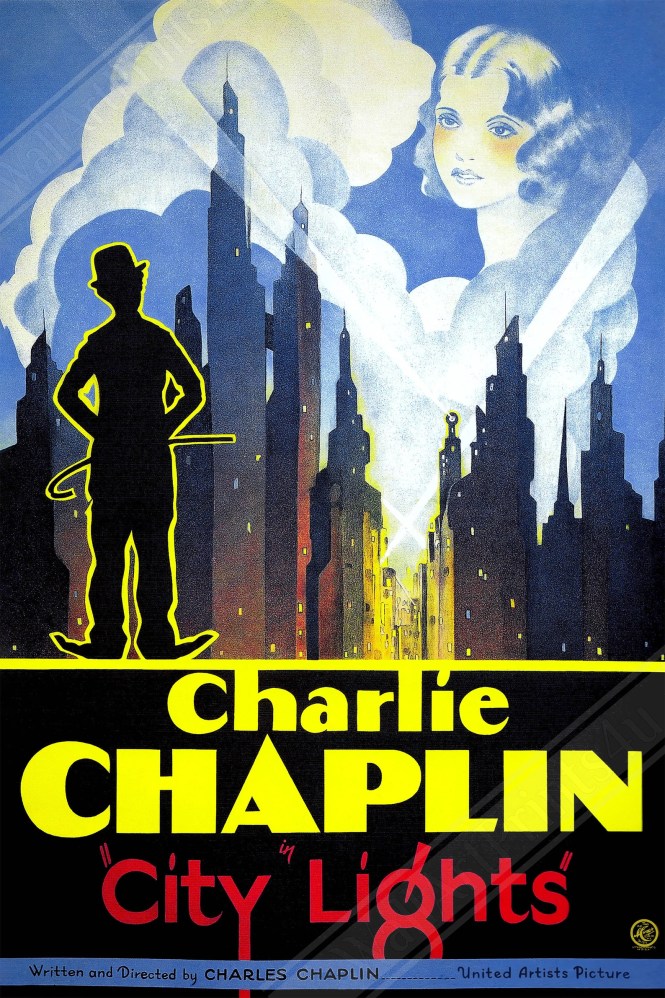
City Lights

Category: Silent Film, Comedy

Starring: Charlie Chaplin

Another Chaplin movie (a lot of his seem to make most ‘best movie’ lists and I can start to see why.  In this particular one he reprise the role of the tramp and the movie opens with him taking a nap under a tarp that is later revealed to be a statue that is having a big unveiling.  The usual slapstick shenanigans happen and he eventually escapes the authorities. He then meets a flower girl who is selling flowers and is instantly smitten.

As he’s leaving the flower girl hears a fancy car with a chauffeur and thinks it’s the tramp. Later that night the tramp is down by the water and he sees someone trying to kill themselves. He saves them from the attempt and it turns out the guy’s a millionaire and he takes the tramp back to his house to keep the party going. The guy’s a complete lush and when the tramp asks him for money to buy more flowers from the flower girl he peels off a few from a fat stack and sends him on the way telling him to take his car – a very nice Rolls Royce.

The thing is – the millionaire only really remembers the tramp when he’s hammered – once he’s sober he is a cruel and abrupt stereotype of a 1920’s tycoon.  It’s something that is repeated a few times with the millionaire who always seems to find the tramp when he’s sauced out of his mind.

Meanwhile the tramp keeps visiting his blind girl and one day she isn’t at her usual street corner. He eventually tracks her down and finds out that she is ill, so he keeps her company by reading her a newspaper. One of the articles is about a doctor who has a procedure to restore sight – the girl smiles and said it’d be wonderful because then she can see him. The tramp knowing he’s pretending to be rich and is aware of his looks isn’t enthused with this idea. However, as he’s leaving he finds an eviction notice and realizes her family is getting kicked out of the apartment.   Determined to help her he decides to get the money to pay her back rent.

The problem is he’s visited the blind girl too many times and the foreman fires him. One of his buddies ropes him into a fixed fight to make some cash but the crooked boxer takes off because the police are coming the his replacement is a giant of a man with murder in his eyes.  A comical drawn out boxing match happens which includes the tramp hitting the boxer with a shovel, the boxer punching the police, and general mayhem. However, the boxer eventually beats the tramp and he goes away without the money needed for the girl.

It’s at this time that the millionaire rolls up on the tramp, three sheets to the wind, and invites him to party (again). They have a good time and the tramp asks if he can give him the money for the girl. The rich guy says sure – and all seems to be solved, except that at that moment burglars break into the house and rob it – with the tramp making his getaway by running from the police (something he does quite frequently, to be honest)

Knowing that it’s a matter of time he runs to the girl and gives her the money – telling her that he’ll see her “in a while” shortly after the police find and arrest him. A while later he gets out of prison and goes to her street corner, only to find her gone.  One day as he’s walking down the street he looks in a store window and there she is! She runs a florist shop now and her sight has been restored! He nervously starts to approach but some newsboys who have taken a dislike to him start harassing him and she sees it through the window. She offers him a coin and a flower and when she touches his hand she realizes who he is and they share a smile.

4/5 – At this point the whole tramp gets the girl thing seems to have been done this is just another angle on it. The deranged millionaire was pretty funny and the slapstick bits are pretty consistent and humorous. Chaplin’s ability to express emotion without words is without peer and I can see why he dominated the silent film industry and his fame endures to this day.

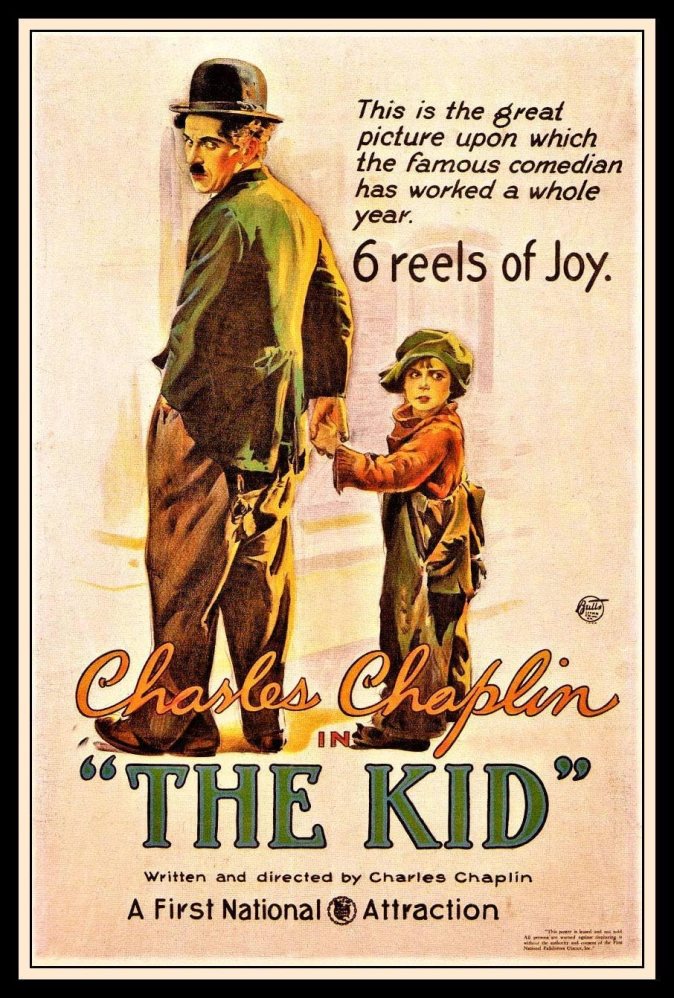
The Kid – 1921

Charlie Chaplin

Silent Movie / Comedy – 1921

3/5 stars

This one starts with an ingénue who has a baby but the father isn’t interested (doesn’t believe it’s his? Who knows with silent movies) so she is desperate to keep her career so she does the unthinkable and abandons the baby in a rich person’s car hoping he can have a better life (leaving a note asking for someone to care for this orphan child).However – the car is promptly stolen by two thugs who race off in the car only to pull over when the baby starts crying – one thug waves the gun at the baby and suggests (via body language) maybe we should you know.. Shoot it? The other thug who isn’t a complete sociopath decides to leave the baby in an alley (arguably an equally poor solution) where Chaplin’s tramp happens to live.

Chaplin stumbles across the baby and tries to leave it but his conscious won’t let him neither will the police officer who patrols the slums. He tries to put the baby in passing mother’s carriage but that backfires as she catches him in the act and Chaplin goes back into his hovel unsure what to do.

5 years pass and they’ve fallen into a  poverty riddled routine where the kids breaks a window with a rock and Chaplin walks around as a window repairman  and they scrape together enough to maybe buy some food (although seeing a coin operated gas meter was illuminating) – all during this time the mother becomes a famous wealthy actress who tries to atone for her guilt by running a charity for children where she unwittingly interacts with her own child – and she gives him a small toy to cheer him up.

The trouble began when a local bully stole the toy and the kid wasn’t taking that shit and threw down like a champion. They got into a proper brawl and the whole hood showed up for the show (not much else going on tbh) – the kid is whopping the bully’s ass but then the bully’s gigantic dad shows up and tells Chaplin if he kid loses he’s going to curb stomp him so Chaplin tries to throw the fight and pronounce the bully the winner but the kid has the heart of a lion and drops the bully with a tyson-esque combo (in reality he looked like Yoda fighting during the clone was) then Gigantor comes for Chaplin but he manages to avoid his punches for a while until he grabs a brick and starts going full mason on the bully’s dad’s forehead.. Eventually goliath falls and they escape back to their hovel.

Shortly afterward the kid gets sick and his mother (still unknowingly) arranges for a doctor to visit – where Chaplin explains that the kid isn’t his and shows the doctor the note. The doctor arranges for an orphanage to kidnap the kid forcefully which honestly is a traumatic scene to watch as a father which sets off a wacky rooftop chase scene where Chaplin rescues the kid and they hide out in a flophouse to figure out what to do. However, during this the mom met with the Dr. who showed her the note Chaplin had and she realizes that the kid is hers! What are the odds! She puts out a 1,000 dollar reward for his return

The owner of the flophouse sees the reward in the paper and grabs the kid to turn him in for the money and when Chaplin wakes up the kid is gone (again, nightmare fuel for dads) and he frantically searches for him before giving up and falling asleep at the door of his hovel which kicks off an LSD fueled fever dream where the people in his neighborhood are devils and angels and he’s flying around doing.. uhh.. I’m not sure. He’s awaken by the police and he thinks he’s going to jail but he’s actually brought to the mansion of the mother who then lets him in (presumably to reunite with the kid)

Fun fact: The actor who played the kid was uncle Fester in the Addams Family TV series!

Not Fun fact: This movie was written shortly after lost a son in childbirth – making is especially poignant.

Really not fun fact: The kid was conceived on a very young actress and Chaplin married her to avoid the scandal and was divorced shortly after – then he did it AGAIN with the girl who played the angel in THIS movie knocking her up at 16. Yikes.

Gold Rush [1925]

Charlie Chaplin

Silent Movie / Comedy

In a reprisal of Chaplin’s ‘tramp’ persona he heads off to the Alaskan territory with just his cane (and woefully underdressed) looking to capitalize on the gold rush.  He runs into a storm and takes shelter in what seems to be an abandoned cabin – but its currently being used by an escaped criminal who isn’t too happy with the new company. He chases Chaplin off in a comical wind/storm scene but then a prospector (Big Jim) who found gold seeks shelter from the storm in the cabin and overpowers the criminal. There’s an uneasy standoff where the three men begin to starve and they draw straws to see who goes out into the storm to get food. The criminal is sent off and promptly finds bounty hunters looking for him who have a nice sled full of supplies. He shoots them and steals their supplies and promptly vanishes from the movie (I’m not really sure why he even was in the plot except maybe as an antagonist for the staged cabin scenes)

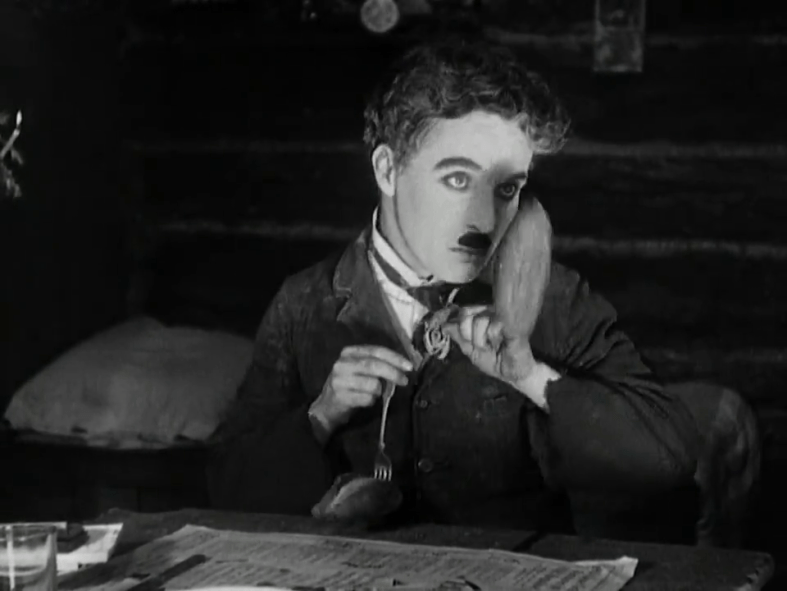
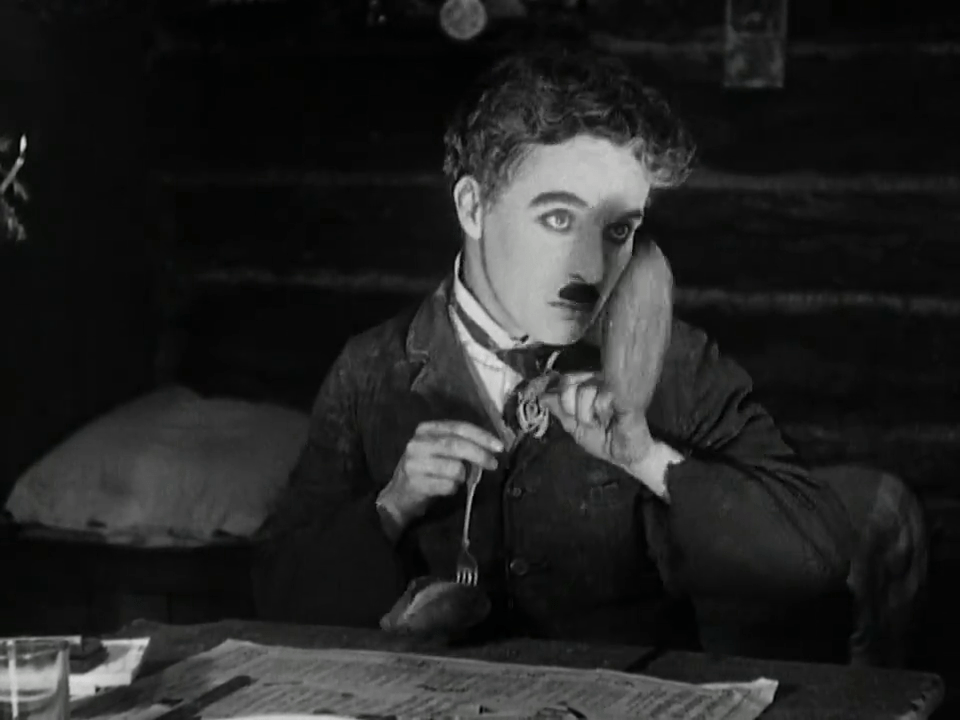
Cut back to the cabin and there’s the famous scene of Chaplin boiling his shoe to have something to eat (imagery featured frequently in images of hobos) and then Big Jim being delirious due to hunger and imagining Chaplin as a giant delicious chicken they have a quick chase and then big Jim comes to his senses and leaves to find his gold only to be assaulted by that criminal guy and left unconscious in the snow!

Cut to a different movie altogether for a while for a weird romance subplot where Chaplin meets a dancer who flirts with him to anger another guy and then agrees to go to dinner with Chaplin on NYE. On NYE Chaplin sets up his cabin all nice and then does the famous dancing roll bit (Oceana roll) then falls asleep waiting for her to arrive. She never does (quite a sad bit where he looks in the window and see her dancing with that handsome fella. He wanders off and then Georgia and her friends go to cause trouble for ‘the tramp’ but then see all the effort he want to for the party and she clearly feels guilty at her behavior. Later Chaplin goes into the party to confront them when big Jim rolls in (having lost his memory after the assault) and grabs Chaplin and says ‘we need to find the cabin! Then we can find my gold and I’ll share it with you!’ — so they head back to the cabin and get some rest before they head out but then a crazy storm blows in and blows the entire cabin to a cliff edge!

They wake up and a funny bit ensues where they walk back and forth and the cabin teeters on the edge but they think it might be a hangover but then when Chaplin opens the door he sees he’s dangling off a cliff and then they spend a few minutes figuring out how to escape but fate has smiled on them – the storm blew them right to big Jim’s mine! They’re rich!

Cut to them dressed fancily in furs and smoking cigars walking on a ship to sail back to America as millionaires – we see Chaplin’s girl also sailing out as it seems things didn’t work out with handsome man (she never really seemed that into him to begin with). Some various hijinks ensue where she shows she’s a somewhat good and remorseful person (offering to pay for his ticket when the crew thinks he’s a stowaway) and Chaplin goes in for the kiss and roll credits.

4/5 stars – The movie is iconic for a reason – so many tropes were born from this movie as well as call backs in many modern movies (the bread roll dance in Benny and Joon, countless eating your boots scenes.. Etc.) and for a silent movie it conveyed both comedy and pathos very effectively you forget it’s a silent movie and are drawn into the narrative completely.

(side note: apparently there’s a 1941 version re-cut by Chaplin that includes his own score and narrated interstitial panels. .might watch that if I have the time)

The General [1926]

Type: Silent Movie, Comedy

Starring: Buster Keaton

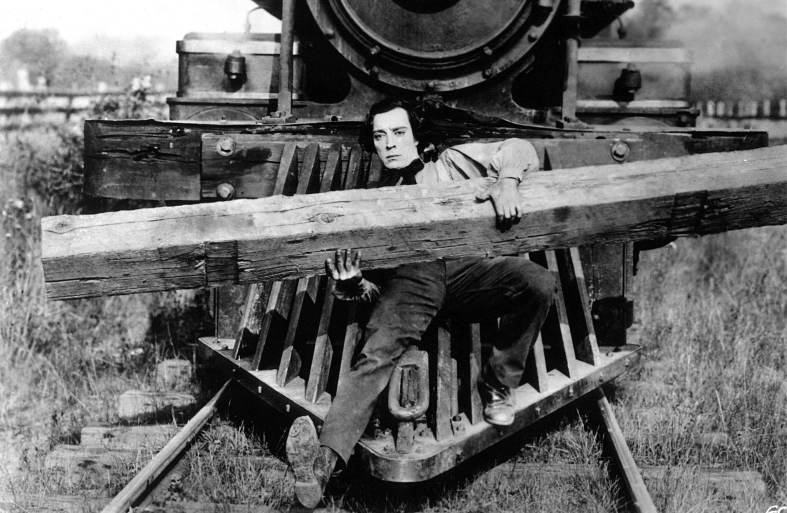
The origin of slapstick comedy in movies? This movie is 100 years old but the laughs are pretty timeless.  Keaton plays a train engineer who loves his train and Annabelle, a woman in his town. The movie is set at the outbreak of the civil war and when a general muster is called for the town Keaton tries to enlist (to impress his lady mostly) and he is deemed to important as a train engineer to fight on the front lines.

He tries several times to enlist but is rebuffed before he leaves rejected (the famous shot of Keaton sitting glumly on the train wheels as the train starts to move).  The union general sends some troops undercover to steal a train at the end of the line and then take it along the line destroying infrastructure on the way. They decide to steal Keaton’s train – and by happenstance his woman is on the train looking for something from her trunk.  He proceeds to chase the train using a variety of methods before commandeering a confederate train to chase them. He finally catches up with them and is hiding under a table when he hears plans for a union surprise raid and he sees that Anabelle is there! She’s been captured by the union and is held hostage.

He rescues her and they escape into the night.. When day breaks they see they are near a union train depot and lo and behold his train ‘The General’ is there! They sneak aboard and steal the train heading back to confederate lines being chased all the way. 

After setting a fire on a critical bridge they alert the confederate army who mount a counterattack on the union and drive them off and the Keaton gets the girl and a promotion to lieutenant

3/5

I really enjoyed the comedy elements of this movie – and Keaton did all of his own stunts, some of which were really straight dangerous! The plot existed to serve the comedy but was passable but the treatment of the actress was pretty poor (She was the inept comic relief who was dumb as a box of rocks) — yeah yeah I get it was the 1920s but it was still jarring to see.