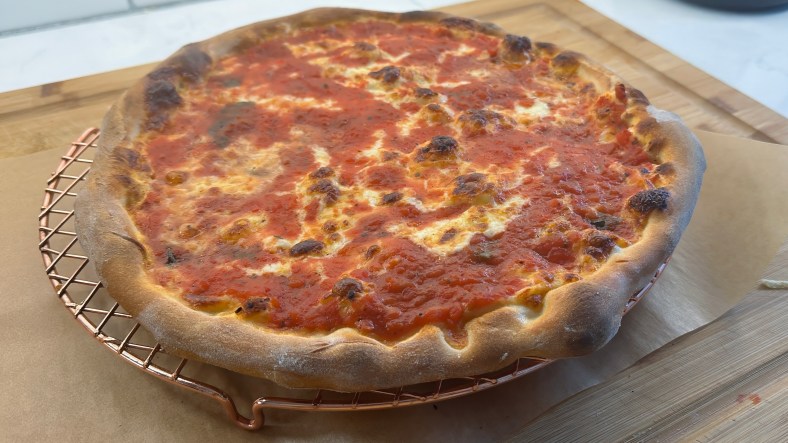
DOUGHS DOUGHS DOUGHS

Throughout this challenge I came across alternate ways of making pizza dough using interesting raitos, methodologies or ingredients. Since I usually just made a cheese pizza with each of them (a nice baseline that lets me judge solely on the crust) I don’t think they need their own post, but I’m going to touch on them here and provide some notes

Rye/Wheat Pizza dough (Nancy Silverton)
This pizza dough was getting a lot of hype online and I was curious what the addition of rye flour would do for a pizza dough. So I tracked down her recipe and gave it a shot. The methodology was simple – it used a sponge (or biga) to preferment and the folding technique. The rest of the steps were easy enough to follow. The resulting pizza was tasty and definitely had an earthier flavor than I was used to which was kinda of nice. I think the issue I has was the recipe I was using was adapted for home ovens, and I cooked them at 900 in my outdoor pizza oven so they dried out a bit. I think I’d like to give this a go again but use the high heat formulas

No knead cast iron pizza
No kneading? No complex formulas to create a delicious pan pizza? Sign me up -I’ve got a cast iron pan and some time so lets go! There’s a bunch of versions of this out there but the most referenced one is here . It really couldn’t be simpler: Mix the ingredients then cover and wait. That’s it. Once the dough has risen put it in the pans, then rise again until they’re puffy. Sauce, cheese and fire on a baking stone or steel. The resulting crust was open and airy and crispy from the oil used and the cheese at the edges got crispy. Overall this was a really good pizza, and super easy.

“72+” Pizza (extreme fermentation)

I’m usually a 24-48 hour pizza fermenting guy – 36 hours is usually the sweet spot where the yeast has put in the work and the flavor and rise is where it needs to be for an amazing pizza. I found a pizza formula for 72 hours and decided to make three dough balls and make them at 72, 96, and 120 hours. It obviously used very little yeast and relied on time to make it happen. The dough at 72 was super easy to open and felt a bit delicate so I was careful to top and bake quickly. The dough definitely had a nice flavor and cooked up crisp. The 96 was a bit more delicate and I had to use a a bit more bench flour to ensure I didn’t rip the dough when opening it and it cooked up a bit flat – I suspect the yeast was starting to give out. The 120 was a problem as it felt like it would tear if I looked at it funny – so I setup the pie on parchment paper and shaped it gently into a square shape as opening it didn’t seem possible. What came out of the oven wasn’t that great it didn’t have a great bite and was almost a flatbread. I suspect if I wanted to ferment that long I’d need to change the yeast ratios to account for it as the original formula was only for 72.

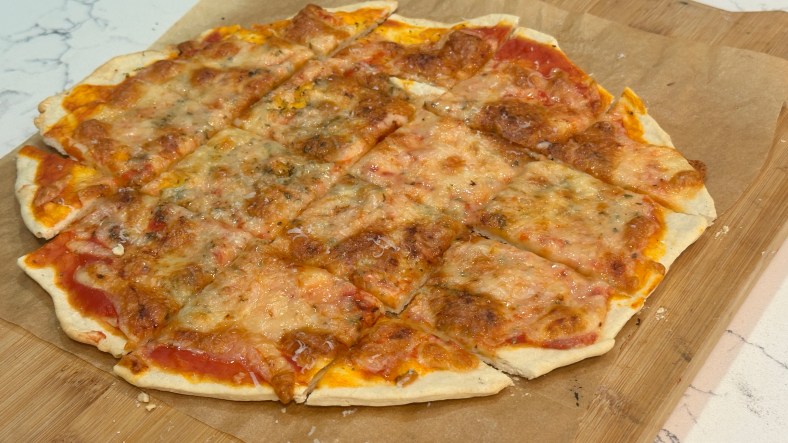
Thin Crust (Bar Pie)
Who doesn’t love a cracker thin crust? Crispy yet tender this bar pie style pizza is super easy to shape as you roll it out with a rolling pin (so much easier with an industrial roller, but all I have is the pin, so..) parbake it to ensure the sauce doesn’t make it soggy then top and throw back in the oven. Charred edges, crispy crust lots of ‘ronis and you’ve got a good Friday night. This goes really good with an ice cold beer which makes sense!

Sourdough Pizza
What to do with all this sourdough discard I was creating in making a sourdough starter? The very first thing that came to mind was making sourdough pizza of course. I did some research and found a few common methodologies and the one that made sense was to use the discard with some fresh yeast to refresh the rising ability a bit. It was also useful in that I could make it in the morning and have pizza at night since the starter delivered most of the flavor elements a long rise in the fridge would give it. The first attempt wasn’t that great, I think the starter was a bit weak so I fed that bad boy a bit more frequently and the next time the dough rose much better and the pizza had a great sourdough flavor note. I suspect I’ll be using this a lot as I go through my sourdough phase.

Tortilla Pizza / Naan Pizza
Is this cheating? Probably but I wanted pizza and didn’t have dough available. What I did have was a bunch of flour tortillas in the pantry. So I looked online and I found a viral video of tortilla pizzas and decided that sure this could work. Dear readers – it did not. If you aren’t a pizza person and just want a hit of sauce and cheese then sure, this could work for you. I suspect that one of the issues can be that I had ‘extra soft and fluffy’ tortillas because that’s what my kids like. If I used standard thin tortillas maybe it would have been a different experience?

Building on this, I also has some garlic naan leftover and said – well what if I throw sauce and cheese on this? The first try was a disaster as naan is designed to absorb liquid and that’s what it did turning into a soggy mess. Try #2 was me putting down a solid layer of cheese first then saucing it and that one was actually pretty good.

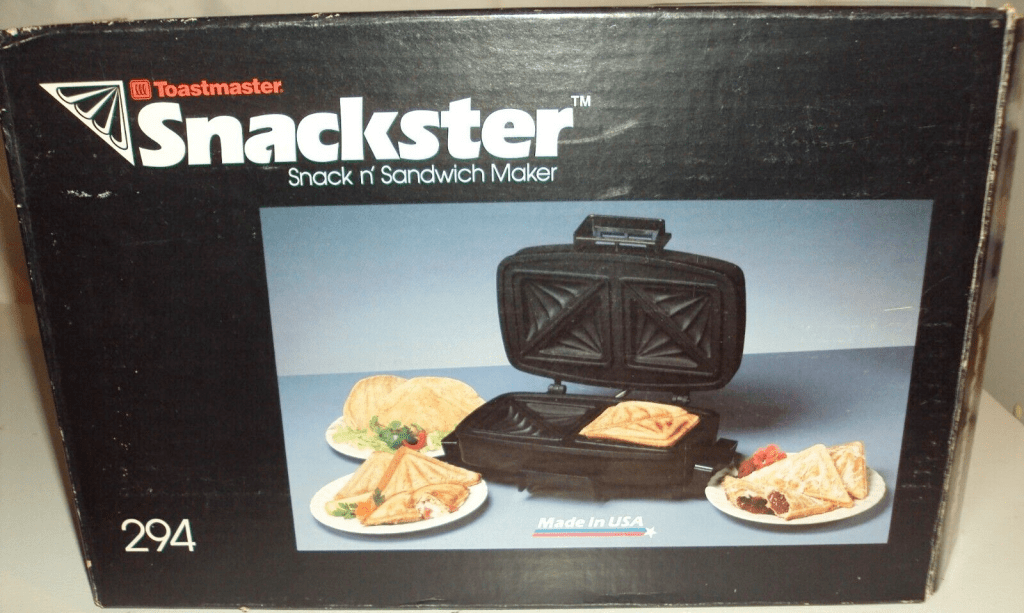
Bear with me here – I know these are pizza hacks. They are no substitute for a real dough that is made with love but if my research showed me anything its that a lot of people are doing this and who am I to judge their pizza happiness? One of my favorite memories as a kid is making hot pockets (back before they actually existed) by buttering two slices of bread and filling it with sauce and cheese and using that old school sandwich press. If doing these hacks makes people want to learn how to make their own pizza, isn’t that a good thing?
That’s what it all comes down to. Pizza is happiness – you make whatever pizza makes you happy. Except pineapple pizza. Stop it.
Goal Update: Visit 10+ Famous Pizza Places

I was at a work conference in Manhattan for a week and decided to seize this opportunity to squeeze in a few more famous pizza places into my year.

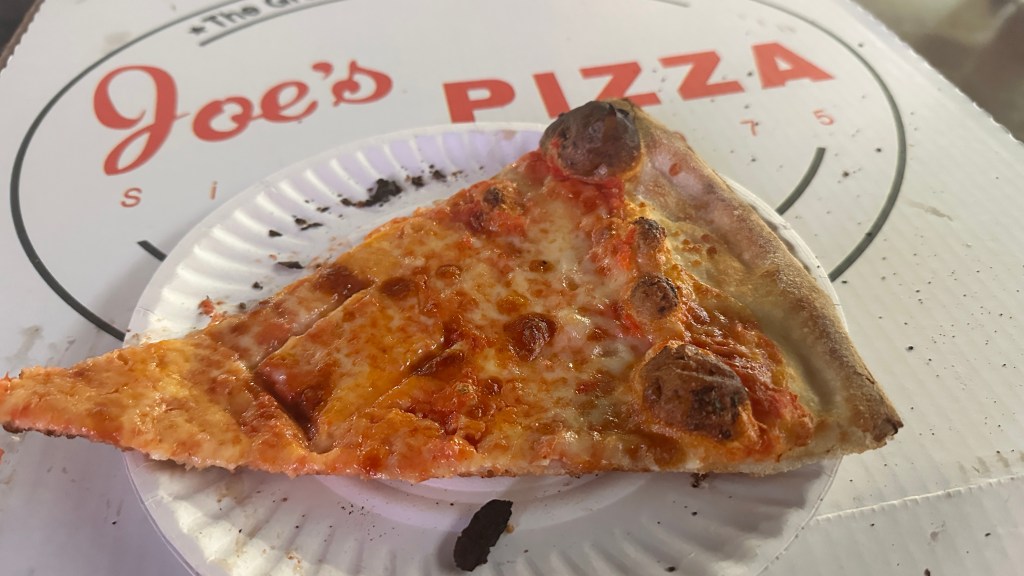
Joe’s Pizza on Broadway.
All the pizza people have a consensus that this is an exemplary NY slice and I was curious to give it a shot. The first thing you notice is the line – this was a random Tuesday in February and it stretched down the block. A quick peek inside showed that there were only a handful of tables and most people were sitting on the benches outside eating their pizza in the cold. I did some quick mental math and saw the line was going to be at least 45 minutes at the pace it was moving at so I did the logical thing and called in an order. I used the time to wander around and poke into some stores that were open and when I came back I walked in an grabbed my pie. However all the benches were taken and there were no seats available inside so I did the needful and ate with the box perched on the trash can outside on the sidewalk. The pizza was good – a perfect balance of sauce and cheese with a crispy crust with zero flop. I wasn’t blown away like some people were (perhaps because I’ve eaten a lot of NY style pizza over the years) but it was a really good slice that is a true representation of NY Style

Score 9.7

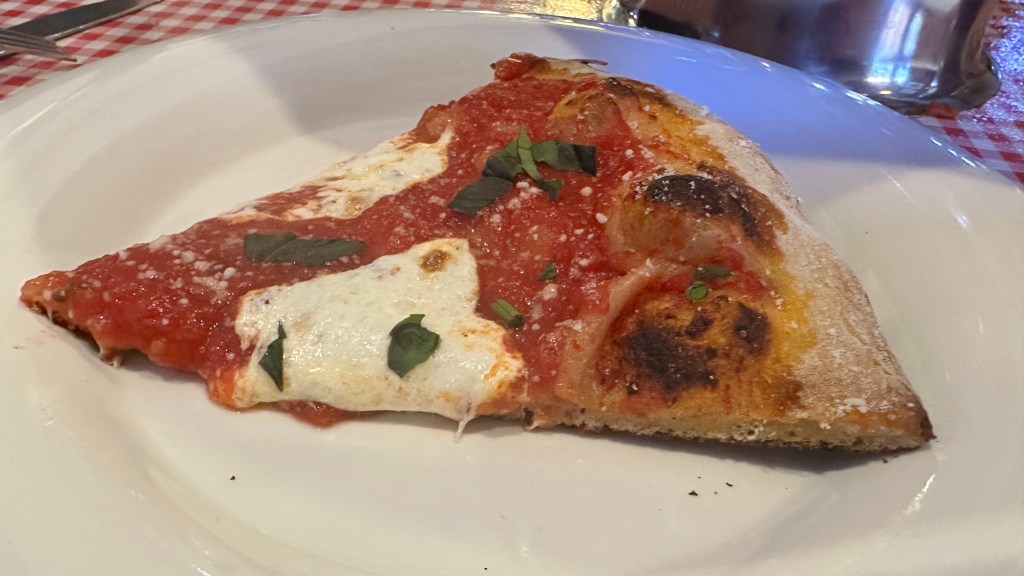
Lombardi’s – Little Italy
There are mixed reviews of this place – some state that they used to be great but when the owners changed it all went downhill. I decided that since it’s been there forever and is a landmark it still needed a visit. It’s a quaint place in the heart of little Italy and had the requisite red and white checkered tablecloths and pictures of celebrities who came to eat there. I ordered the margherita style pizza and a root beer (classic pairing) and he brought me a 8 ounce fountain root beer (no free refill signs are all over the place, mind you) so that’s not a great start. If you’re going to charge 4 bucks for a fountain soda make it at least 20 ounces. Then the pizza came out and it was tiny – I re-read the menu and the size of the pizza is mentioned there but 28 bucks for a 12 inch pizza? It also was dry and the sauce was too salty and the cheese was barely there. It’s obvious whoever owns it now is trading on the reputation of the original and is cost cutting wherever possible. If it was 10 bucks I’d have been more charitable – I’ve had NY dollar slices that had more flavor. The fact I was the only one there during prime lunch hour should have been my first clue.

Score 4.7

Rubirosa – Little Italy

This one snuck up on me – I had no idea this place was here but every reddit thread and pizza forum that talked about NYC pizza said this was the go to thin crust spot. It’s a small corner spot in little Italy and when I went they were pretty crowded – I got a spot at the bar and was waffling between the tie dye pizza and classic cheese when the bartender offered up that I could get half and half. I decided to give it a try so i could try both options. The pizza came out and it was huge and the crust was super thin and shattered when you bit into it. The cheese pizza was tasty but I felt like the sauce was a bit one note and the pesto glaze on the tye dye was good but it felt like there was something else in the pesto that gave it an off flavor. I still enjoyed the pizza for what it was – a good example of thin crust pizza. While I was there I noticed a lot of people were actually getting the pasta. If I wasn’t pressed for time and have eaten have a giant pizza I’d have tried some because it looked amazing. Next time I’m in the area I might need to stop in for some.

Toppings Topping Toppings!

In the beginning, and some weeks through this year I didn’t feel up for the research and effort new styles of pizza required so I went to my standard New York style pizza dough and just played with different toppings. [Shout out to Tony Gemignani’s method for a great dough] This was usually informed by whatever was fresh at the grocer, leftover cheese in the fridge or sometimes even what I had in the pantry. Instead of making a bunch of different posts – I decided to collate them all into one post since they all share the same base.

Three Cheese Pizza
This is a pretty standard pizza found in the NJ/NY area but I mixed it up by starting with a heavy layer of Parmesan, then dry mozzarella, then finishing with chunks of fresh mozzarella. I liked the clean milky taste of the fresh mozzarella as a counterpoint to the salty parmesan. A healthy dusting of Sicilian oregano and we have a winner!

Brooklyn Pie
What to do when it’s tomato season and you have an amazing fresh tomato at peak ripeness? Make a Brooklyn pie of course. The sauce base is just pureed pure plum tomatoes, large slices of fresh mozzarella (having an Italian Deli in town sure is helpful),s ome thin slices of said tomato and basil leaves from the garden

Prosciutto Pizza
I had some delicious prosciutto left over from something and decided to use it on a pizza. I knew one thing up front, you shouldn’t fire the pizza with the prosciutto on it so I went with a simple sauce of just pureed tomatoes and I wanted a light cheese so fresh mozzarella was the pick here. I fired it in the ooni and as soon as it came out I layered on the paper thin prosciutto and watched the fat start to melt into the pizza and knew this was going to be amazing. The trick it the meat has to be thin – none of this grocery store prepackaged stuff – go to an Italian deli and get it sliced super thin for best results.

Roasted Red Pepper Pizza
I had a bunch of jarred red peppers left over from a recipe and decided they needed to end up on a pizza. I knew that they had a flavor punch and were oily so some dry mozzarella was the go to here and I knew I wanted to ramp up the flavor a bit so I made a more robust sauce and added some red pepper flakes to it to counter the sweetness of the red peppers with a bit of heat. The only notes I had was to cut the red peppers into smaller slices, the texture of an entire red pepper was a bit much

Tex-Mex Pizza
Jersey Corn is some good corn – sweet and plentiful in the early fall and what else utilizes a lot of corn? Tex Mex cooking, that’s what. I tinkered with this a few times as the first try was pretty bland and I learned that the high heat of the pizza oven just isn’t enough to cook the corn so charring it on a grill before it goes on the pizza was the key there. I used pepper jack as the cheese and thin sliced red onions to provide a sweet element. Adding a bit of salsa at the end was universally panned as a bad option so if I make this again that salsa will remain in the pantry!

Meat Lovers Pizza
I don’t know why I waited to long to bust this bad boy out – I love pizza and I love meat so this marriage seemed to be destiny. I didn’t want to have a greasy mess to I limited it to sweet Italian sausage, meatballs, pepperoni, and crumbled bacon. Hmmm.. healthy. I cooked the bacon in the oven until crisp and added it at the end because otherwise it would have been a greasy mess. This was amazing – every bit was a meat enhanced flavor experience and if my cholesterol would allow it, I’d eat this all the time!

BBQ Chicken Pizza
Have a bunch of leftover BBQ chicken? Throw it on a pizza (I mean, that’s my first thought for most leftovers really). I knew I wanted to have that summer BBQ vibe for this pizza so I started thinking what can I grill to add some smoky flavor to this and settled on some corn and red onions. Grilling them up until they were slightly charred and adding them right at the end of the firing turned out to work great. The general feedback was the flavors were good but it was missing something – I’ll keep working on this until I figure it out. I suggested BBQ sauce and we tried a little bit on a slice and that’s.. not the answer.

Pineapple Pizza
Pineapple on pizza is nothing short of an insult to the very soul of Italian cuisine, a culinary abomination that defies centuries of tradition and the fundamental principles of balance, flavor, and respect for ingredients. Italian cooking is rooted in the idea that simplicity, seasonality, and harmony between flavors create perfection, and yet this tropical atrocity throws all of that out the window by introducing an aggressively sweet, watery, and acidic fruit onto a dish that was never meant to accommodate such an outlandish ingredient. The sheer audacity of pairing pineapple’s syrupy sugariness with the rich, savory depth of tomato sauce and mozzarella is an assault on the palate, a chaotic clash that drowns out the natural umami of the cheese and ruins the delicate interplay of flavors that make pizza an art form. Italians have spent centuries perfecting pizza, from the humble Neapolitan Margherita to the crisp Roman al taglio, all with an emphasis on balance and authenticity—yet somehow, this foreign corruption has spread like a virus, defiling menus worldwide. It is an offense not only to taste but to history, a mockery of the craftsmanship and passion that goes into every true Italian pizza. If there were any culinary justice in the world, pineapple on pizza would be banned outright, confined to the realm of misguided food experiments never to be spoken of again in the presence of serious pizza lovers.

But my wife loves it, so here we are. Happy wife and all that.

Sun dried tomato and artichoke with hot honey and basil oil

While brainstorming on what pizza to make that week I decided to raid the pantry and see what we’ve got. I found a bottle of sundried tomatoes, some artichoke hearts, some hot honey and a mostly empty bottle of basil oil. I looked at my pantry haul and shrugged ‘yeah. these should all go on a pizza together’ I opted for a simple tomato sauce as the oil from the sun dried tomatoes packs a ton of flavor and would overpower any delicate flavors I had on there. Some mozzarella mixed with provolone provided a nice salty background note the artichoke hearts got slightly charred in the oven which was a nice flavor. I added the. honey and oil at the end to preserve their delicate fresh flavors. The pizza was.. OK there was just too much going on. Too many flavors and textures competing. Sometimes that works but in this case it detracted from the finished product. It wasn’t bad though, so I did eat it but next time I’d go simpler.

SIX Cheese Pizza
We did three cheeses – lets go bigger! Four cheese? NO! FIVE CHEESE? HAHA Try SIX CHEESE! Is this because you had a bunch of leftover cheese in your fridge you wanted to use up? Yes. That’s exactly how this came about. I had some provolone, fontina, mozzarella, fresh mozzarella, ricotta and parmesan. I used a standard tomato base and ensured an even mix of the fontina, provolone, and mozzarella to ensure a good coverage. I started with a heavy dusting of parmesan, added the mixed cheeses then fired that bad boy in the oven. When I pulled it out I dropped dollops of ricotta across the pizza and dusted with oregano and basil. This lactose bomb was delicious and I ate almost the entire thing somehow all the cheeses worked in synergy and created a singularity of cheese. 6/5 Stars

Tre Sugo
I stole this idea from a pizza place near me – they made a standard pizza cheese first then striped three different sauces over the pizza – Tomato sauce, Pesto, and vodka sauce. I really liked that idea. They did it with a spiral pattern with one of those spinning sauce dispenser things but that seemed like too much work so I just striped the entire pizza in strips of different sauces so every bite you got a bit of each. It was really good – the only drawback was that the pesto was really strong and tended to overpower the other two sauces. I think if I make this again, I’ll make it a pesto cream sauce which I think would complement the other sauces better.

sfincione

If you think pizza means a thin, round, crisp-bottomed crust with neatly arranged toppings, sfincione (pronounced sfeen-cho-nay) is here to shake up your expectations. This is not your typical pizza—it’s thick, spongy, loaded with flavor, and dripping with history. The name itself comes from the Latin spongia, meaning sponge, which is fitting given its airy, focaccia-like texture. But while it shares some DNA with focaccia, sfincione is an entity all its own, thanks to its signature sauce and toppings that make it uniquely Sicilian.

Sfincione traces its roots back centuries, long before the modern pizza we know today took over the streets of Naples. Sicily, with its complex history of Greek, Arab, Norman, and Spanish influences, has always been a place of culinary fusion, and sfincione is no exception. Legend has it that this hearty, sauce-laden creation originated in Palermo, specifically in the kitchens of monasteries, where nuns baked it for religious feasts. It was a special treat, richer and more flavorful than everyday bread, but still simple and affordable enough for the common people. Unlike Neapolitan pizza, which became an icon of street food, sfincione was traditionally made at home, particularly around Christmastime, when families would gather to bake enormous trays of it to share.

What sets sfincione apart is its unapologetically bold sauce—a slow-cooked blend of tomatoes, onions, olive oil, and sometimes anchovies, creating a deeply savory and slightly sweet flavor. Unlike the fresh tomato-and-basil simplicity of Neapolitan pizza, sfincione’s sauce is more like a jammy, concentrated stew, meant to seep into the soft, porous dough. Speaking of the dough, it’s thicker and softer than most other pizza styles, but never heavy. It bakes up light and airy on the inside, with a crispy, olive oil-kissed crust on the bottom.

The toppings are just as distinctive. Instead of the classic mozzarella that dominates most pizzas, sfincione is typically topped with caciocavallo, a cheese that brings a sharp, tangy bite. If you’ve never had caciocavallo, imagine a firmer, more pungent cousin of provolone. Some versions also include grated pecorino for extra saltiness. Another key ingredient is the breadcrumb topping—yes, breadcrumbs on pizza! Sicilians have a knack for using breadcrumbs as a way to add texture and stretch ingredients further, and here they serve the dual purpose of soaking up all that rich sauce while adding a satisfying crunch.

Sfincione’s appearance might surprise those used to picture-perfect, symmetrical pizzas. It’s often baked in large, rectangular trays and cut into square slices, its surface an uneven, glorious mess of sauce, cheese, and crispy bits. Some versions are even more rustic, with no cheese at all, relying solely on the onions, anchovies, and breadcrumbs for flavor. This is especially true in Bagheria, a small town near Palermo, where locals fiercely defend their cheese-less, extra oniony version of sfincione as the “real” one.

Though sfincione remains a Sicilian specialty, it has made its way beyond the island. Sicilian immigrants carried their pizza traditions with them to the United States, where sfincione became the blueprint for what we now call Sicilian-style pizza—a thicker, rectangular pie that’s popular in pizzerias from New York to Detroit. But there’s a key difference: American Sicilian pizza usually has mozzarella and a more standard tomato sauce, whereas authentic sfincione stays true to its roots with its onion-laden, breadcrumb-topped goodness.

In Sicily, you don’t have to look far to find sfincione. Bakeries, street vendors, and old-school panifici (bread shops) sell it fresh from the oven, its scent wafting through the air, luring hungry passersby. It’s often sold in squares, wrapped in brown paper, and eaten on the go. In Palermo, you’ll even find sfincionari, street vendors who peddle their wares from three-wheeled carts, calling out “Scarsu di carni, ma chinu di sustanza!” which roughly translates to, “Low on meat, but full of substance!”—a proud nod to the pizza’s humble, meat-free but flavor-packed nature.

Sfincione is more than just a regional variation of pizza—it’s a slice of Sicilian history, a reflection of the island’s resourcefulness, and a testament to how a few simple ingredients can create something utterly delicious. Whether you’re lucky enough to try it in a bustling Sicilian market or decide to bake it at home, one thing is certain: sfincione is a pizza that tells a story, one crunchy, saucy, cheesy bite at a time.

Trenton Tomato Pie

f you think all pizza is just a variation of the same thing, Trenton Tomato Pie is here to prove you wrong. This New Jersey-born specialty isn’t just a pizza—it’s a philosophy. A distant cousin of the classic New York slice and the coal-fired legends of New Haven, Trenton Tomato Pie flips the script on what most people expect from a pizza by doing one simple, yet game-changing thing: the sauce goes on top.

Trenton Tomato Pie traces its roots back to the early 1900s, when Italian immigrants, particularly those from Naples, were bringing their pizza-making skills to the U.S. While New York and New Haven developed their own famous styles, Trenton (now officially called Hamilton Township, though locals still cling to the old name) was busy crafting something uniquely its own. The earliest and most legendary name in the game is Joe’s Tomato Pie, opened in 1910, but it was De Lorenzo’s Tomato Pies, established in 1936, that cemented the style’s reputation. These family-run pizzerias helped define what Trenton-style pizza was all about: a crisp, thin, yet sturdy crust, a restrained amount of cheese, and the signature move—ladling the tomato sauce over the cheese before baking.

Now, let’s talk about what makes Trenton Tomato Pie different from your average slice. The dough is stretched thin but remains firm enough to hold up under the weight of its toppings without going soggy. Unlike the airier Sicilian-style or the charred chew of a Neapolitan pie, this crust has just the right amount of crunch without being cracker-like. It’s baked in a deck oven—usually gas-fired, though some places use coal—resulting in an evenly cooked base with a golden brown, slightly blistered edge.

The cheese, typically low-moisture mozzarella, is applied sparingly, creating a more balanced bite where no single ingredient overwhelms the others. Then comes the defining feature: the tomato sauce. Unlike many pizzas where the sauce is buried beneath a blanket of cheese, Trenton Tomato Pie does it in reverse. The sauce is spooned over the cheese in dollops or a swirling pattern, allowing it to shine as the dominant flavor. This isn’t a basic, thin tomato sauce either—it’s chunky, vibrant, and slightly sweet, often made from hand-crushed San Marzano or Jersey tomatoes, simmered down just enough to concentrate the natural sweetness without losing that fresh, tangy punch.

Toppings on a Trenton Tomato Pie are kept relatively simple. Pepperoni, sausage, mushrooms, and anchovies are all common, but purists argue that the best way to experience this style is with just the essentials—dough, cheese, and sauce. That way, you can fully appreciate the interplay of textures and flavors without any distractions. One standout variation, though, is clam tomato pie, a nod to New Haven-style apizza, which adds briny, garlicky clams to the mix for a coastal twist.

Despite being overshadowed by its big-city neighbors, Trenton Tomato Pie has a fiercely loyal following. Institutions like De Lorenzo’s and Papa’s Tomato Pies (which claims to be the oldest continuously operating pizzeria in the U.S.) keep the tradition alive, serving up these old-school pies to both nostalgic locals and pizza pilgrims who’ve come to see what all the fuss is about.

In a world where pizza is often loaded with excessive toppings, heavy cheese, and thick layers of sauce, Trenton Tomato Pie stands as a testament to restraint and balance. It’s a pizza for those who appreciate the art of simplicity—where each ingredient gets its moment to shine. If you ever find yourself in New Jersey, seeking out an authentic Trenton Tomato Pie should be at the top of your food bucket list. One bite, and you’ll understand why this under-the-radar classic deserves a spot in the pantheon of America’s greatest pizzas.

New Haven Apizza

If you think you know pizza but haven’t tried New Haven apizza, prepare for a revelation. This Connecticut-born classic isn’t just a regional variation—it’s an institution. Locals (and pizza purists) will tell you it’s not just pizza; it’s apizza (pronounced ah-beetz, thanks to its Neapolitan dialect roots). And if you’re expecting something soft, foldable, and loaded with cheese, think again. New Haven-style apizza is a blistered, charred, chewy masterpiece that’s as much about texture as it is about flavor.

New Haven’s pizza legacy started with Italian immigrants in the early 20th century, particularly Frank Pepe, the man who put this style on the map. In 1925, Pepe opened Frank Pepe Pizzeria Napoletana, serving up coal-fired pies with his now-famous white clam pizza. Not long after, rival pizzerias like Sally’s Apizza and Modern Apizza emerged, each perfecting their own take on this iconic style. Unlike the more famous New York-style pizza, which leans on a balanced crust-to-topping ratio and a slight crispiness, New Haven apizza is all about the crust—thin, crisp on the bottom, airy inside, and charred to perfection in a coal-fired oven.

Let’s talk about that char. New Haven apizza is intentionally cooked at blistering hot temperatures (sometimes over 600°F), which gives it a signature blackened, crispy exterior. Don’t be alarmed by those dark spots—it’s not burnt; it’s perfectly charred, adding a smoky depth of flavor that’s completely unique. The dough itself is made with high-protein flour, fermented longer than usual to develop complex flavors, and stretched into an irregular, oblong shape—so don’t expect a perfectly round pie.

Then there’s the sauce-to-cheese ratio, which in New Haven is refreshingly sparse. A traditional “plain” apizza (tomato pie) features little more than a thin layer of tangy tomato sauce, oregano, garlic, and a drizzle of olive oil—no cheese unless you ask for it (mootz, short for mozzarella). That’s right, cheese is optional here. Order a plain pie without specifying “mootz,” and you’ll get a saucy, crispy, dairy-free experience that lets the ingredients shine in their purest form. If you do opt for mozzarella, it’s typically applied in moderation rather than covering the entire pizza.

Of course, we can’t talk about New Haven apizza without mentioning its most famous creation: the white clam pie. This local legend, first made at Frank Pepe’s, is an absolute must-try. Imagine a garlicky, olive oil-based pizza topped with freshly shucked littleneck clams, grated pecorino Romano, and a sprinkle of oregano—it’s briny, rich, and utterly addictive. No red sauce, no mozzarella, just pure seafood-meets-charred-dough magic. It might sound unusual, but one bite, and you’ll understand why people drive for hours just to get their hands on it.

Beyond clams, other classic New Haven toppings include hot cherry peppers, sausage, and fresh tomato (which is typically added post-bake for a bright, juicy contrast). But no matter what toppings you choose, the beauty of apizza lies in its balance—crispy, chewy crust, minimalist toppings, and that unmistakable coal-fired flavor.

Despite its deep roots in New Haven, apizza has started making waves beyond Connecticut. Devoted fans and former Yale students have helped spread the gospel of charred pies to other cities, with New Haven-style pizzerias popping up in places like New York, Boston, and even Los Angeles. But for the truest experience, nothing beats the original. Whether you’re biting into a classic tomato pie at Sally’s, indulging in a white clam pie at Pepe’s, or grabbing a crispy, cheesy slice at Modern, one thing is for sure—New Haven apizza is one of America’s greatest contributions to the pizza universe.

So, if you ever find yourself in the Elm City, do yourself a favor: order a large pie, embrace the char, and remember to call it apizza.

Goal Met: Make 50 Different Pizzas

This will be a cakewalk, I said to myself, I make pizza all the time how hard can it be to make 50 different pizzas? Let me tell you dear readers – it was very hard. The first few were easy as I busted out crowd favorites like Neapolitan, Pepperoni, and even a meat lovers. It was about 10 pizzas in when I started to wonder if just coming up with new toppings was a good way to accomplish this.

I did some research into topping combos and came up with a few that looked interesting but as part of my research I started seeing more regional pizzas pop up and it got me interested in how pizza can change as it travels across the world or even across the state. So I did a deep dive and became a pizzaologist. Tracking pizza as it went through all its different iterative changes.

These regional pizzas were still dough, sauce, and cheese but the way they went about it changed and I used my handy research assistant (ChatGPT) to do a deep dive into how Pizza was introduced to these regions and what the history of the style was (you can find these in the individual pizza posts) and it was some fascinating stuff.

Now there are some that argue for one style of pizza as being ‘real pizza’ and I get it. For me it’s a two way tie between a classic NY/NJ slice and true Neapolitan pizza. I get the appeal of Chicago deep dish and the buttery crust of a real good pan pizza and to be honest, I love them all. I’m not an elitist in that way (No, don’t take my NY Pizza card!) but I always come back to the classics when I’m in the mood for a good pizza that scratches that itch.

It was an educational journey and introduced a few new pies into my rotation (such as Apizza or pizza fritte) and there were a few that were just not great such as the steamed pizza. It’s like.. A bao bun with sauce and cheese. The texture was just not what I want from a pizza. The flavor was alright, but man I like steam buns and pizza but not this unholy fusion.

I’m glad I did this and I feel like I can talk about regional / international pizzas with a much more informed opinion having made and tried a lot of them.  The only drawback was I always felt like I needed to be making a new pizza even if I wanted a classic pie. Now that it’s over I expect classic margheritas are on tap for a few weeks to make things simple!

St. Louis Style Pizza

If you’ve never had St. Louis-style pizza, get ready for something totally unexpected. This Missouri-born creation defies every traditional pizza rule in the best way possible—starting with the fact that it’s cut into squares, not slices. That’s right, in St. Louis, pizza isn’t served in the familiar triangle shape but instead in a grid of bite-sized squares, thanks to what’s known as the “party cut” or “tavern cut.” But the unique slicing method is just the beginning of what sets this style apart.

First and foremost, the crust is unlike any other. Instead of a chewy, airy dough, St. Louis-style pizza has an ultra-thin, cracker-like crust that snaps rather than bends. There’s no yeast involved, which means the dough stays flat and crispy, giving each bite a satisfying crunch. This makes it one of the few pizzas that you definitely cannot fold—and honestly, you wouldn’t want to. The crisp texture is the backbone of the entire experience.

Then there’s the cheese—and this is where things get really St. Louis. Unlike most pizzas that use mozzarella, St. Louis-style pizza is topped with Provel cheese, a hyper-local blend of cheddar, Swiss, and provolone. Provel is an acquired taste—it’s ultra-melty, creamy, and has a slight smoky, buttery flavor. While some people love its gooey texture, others find it almost too processed. But for St. Louisans, Provel is non-negotiable. You’ll even find it in toasted ravioli, another local specialty. If you order a St. Louis-style pizza outside of Missouri, chances are they’ll swap in mozzarella, but if you want the real deal, it’s gotta be Provel.

As for the sauce, St. Louis keeps things sweet and tangy. Unlike the bright, acidic sauces of Neapolitan or New York-style pizza, St. Louis pizza sauce often has a touch of sugar, creating a slight sweetness that balances the saltiness of the Provel cheese. It’s usually spread in a thin layer, so the sauce never overwhelms the crispy crust.

And finally, we have the toppings. Since the crust is thin and crispy, St. Louis-style pizza can handle a lot of toppings without getting soggy. Popular choices include Italian sausage, pepperoni, mushrooms, onions, and green peppers, though some places get more creative. One classic St. Louis topping combo is bacon and onion, a salty-sweet mix that plays well with the Provel.

While the “who invented St. Louis pizza?” debate continues, one name always comes up: Imo’s Pizza. Founded in 1964 by Ed and Margie Imo, this family-owned business turned the local style into a full-blown institution. Today, Imo’s is to St. Louis what Domino’s is to the rest of America—a citywide staple with dozens of locations serving up thin, crispy, Provel-smothered pies.

Outside of Missouri, St. Louis-style pizza remains a bit of a cult favorite. Some people can’t get enough of the crispy crust and melty Provel, while others struggle to embrace its unconventional approach. But love it or hate it, St. Louis-style pizza is one of the most distinct and proudly regional pizzas in the U.S. It’s not trying to be New York, Neapolitan, or Chicago deep-dish—it’s doing its own thing, unapologetically.

So, if you ever find yourself in St. Louis, forget the debate over whether Provel is real cheese, embrace the party cut, and dive into a crispy, cheesy, square-shaped bite of Missouri’s finest. Just don’t ask for a slice.

Goal Met: Create Family Cookbook

I love cooking. Most of my skills in this area were honed when I worked as a line cook in various restaurants but they started watching people in my family cook.  My grandmother was your typical Italian Nonna, always at the stove making something delicious. My mom wasn’t what you’d call a great cook (she liked to overcook everything “just to be safe”) but she had a handful of go-to recipes that we all loved. There were other people who had signature dishes that they always brought out during the holidays.

Over time I started developing my own recipes and I was pretty haphazard about where I kept all my notes. Most of the ones I really liked made it into a small notebook that saw a lot of use (it’s currently held together at the binding my duct tape) but there were papers stuffed into folders, notes written into cookbooks with alternate ingredients / timings and in text files on my computer.

I decided to collect them all into one definitive source a ‘family cookbook’ that my kids could one day reference when they want to make the nostalgic meals that they remember from their childhood or have a recipe be passed down to another generation.

My recipes were easy – bit by bit I imported  them into OneNote and formatted them into a logical cookbook format (ingredients, methodology, cook time, etc.). My family’s  recipes were a bit harder as most of them were never written down. I narrowed them down to a few that I felt were important enough to include then dredged my memory to try to recall the ingredients and methods that were used. I had to get creative and try different approaches but I think I came as close as I possibly could.  I did have a copy of my grandmother’s recipe notebook which contained all her baking recipes. The only issue there was it was written completely in Italian. Luckily I was learning Italian this year as well so it was a win-win translating the ingredients and instruction into English!

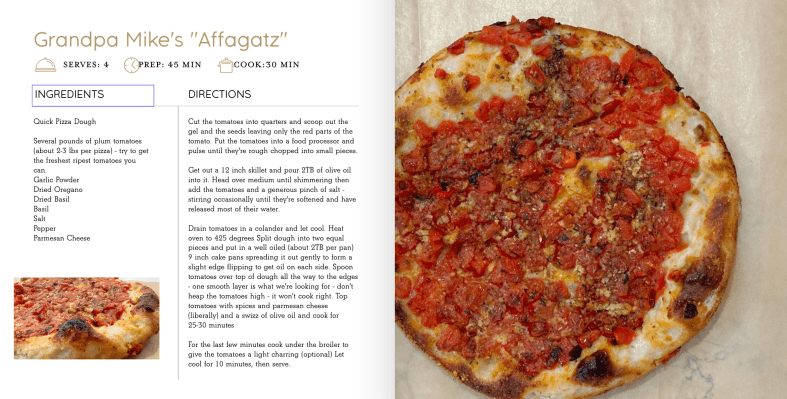
As I was developing these I took lots of pictures but there were some recipes where I either didn’t have a photo or the ones I did have weren’t very good. I absolutely was shameless in finding a stock photos that looked exactly like what I made only with better lighting. I wasn’t trying to publish this book so I didn’t concern myself with the ethics of that decision, I just know some of these stock photos were really good and representative of what I was putting out.

I tinkered with InDesign to see if I could make a standard cookbook but instead opted for a web service as their drag and drop methodology was much easier to work with and I could see in real time what the results would be.

All in all I was happy with how it turned out – going to wait until a sale comes around on the book publishing site before I get a physical copy – sometimes those coupons they send can be a real value!

Margherita Sbagliata

Margherita Sbagliata is a pizza that turns tradition on its head while still honoring the essence of what makes a classic Margherita so beloved. In Italian, “sbagliata” means “mistaken” or “wrong,” a word that suggests a happy accident or an intentional twist on the original. Much like the Negroni Sbagliato, where prosecco replaces gin for a lighter, sparkling take on the cocktail, Margherita Sbagliata takes the familiar ingredients of a traditional Pizza Margherita and rearranges them in a way that challenges expectations while delivering a completely satisfying experience.

At first glance, it might not even look like a Margherita pizza. The typical structure—red tomato sauce, white mozzarella, and green basil, meant to mirror the Italian flag—is flipped, reimagined, or even deconstructed depending on the pizzeria or chef making it. In some versions, the tomato is no longer the base but instead appears in chunks, roasted or semi-dried, scattered atop a white pizza, where a layer of fior di latte or burrata takes center stage. The result is a pizza that still tastes unmistakably like a Margherita but with a different balance of textures and flavors. Instead of a thin layer of tomato sauce seeping into the dough, the concentrated bursts of roasted or blistered cherry tomatoes add a more intense, almost jammy sweetness that contrasts beautifully with the creaminess of the cheese.

Another version of the Margherita Sbagliata plays with the cooking process, adding the tomato only after the pizza has baked, rather than spreading it onto the dough before it goes into the oven. This method, sometimes referred to as a reverse Margherita, allows the crust to develop a deeper char and crispness without absorbing moisture from the sauce, resulting in a more defined chew and crunch. When the pizza comes out of the oven, crushed or puréed tomatoes—sometimes raw, sometimes lightly cooked—are spooned over the bubbling cheese, creating a fresh and slightly unexpected contrast between the warm crust and the bright acidity of the tomato.

Some interpretations go even further, introducing ingredients like stracciatella, ricotta, or even smoked mozzarella to enhance the richness of the cheese element. Instead of the traditional basil leaf, some versions finish with a basil-infused oil or delicate microgreens, offering the herbal note in a more subtle, modern way. The flexibility of Margherita Sbagliata makes it an exciting canvas for chefs to experiment with while still keeping it firmly rooted in Italian tradition.

Despite the changes in presentation and technique, the fundamental appeal of this pizza remains the same as the original Margherita: a perfect harmony of dough, tomato, cheese, and basil. The “mistaken” part of its name is, in reality, anything but a mistake—it’s a rethinking of a classic that brings out different elements of its flavor profile, sometimes highlighting the brightness of the tomatoes, sometimes leaning into the creaminess of the cheese, sometimes emphasizing the crispness of the crust. It’s a variation that celebrates tradition while embracing the creativity that has always been a part of Italian cooking.

In Naples, where pizza is treated with near-religious devotion, you’re more likely to find the traditional Margherita reigning supreme, but in cities like Rome, Milan, and even international pizza hubs in New York or London, Margherita Sbagliata has carved out a niche as a modern, inventive alternative. Whether ordered in a trendy pizzeria or recreated at home with high-quality ingredients, it offers a fresh perspective on something familiar, proving that even a classic like the Margherita still has room for reinvention.