
Platoon

If you’ve ever wondered what the opposite of a feel-good war movie looks like, Oliver Stone’s “Platoon” is your answer. This isn’t your grandfather’s World War II glory story – this is Vietnam in all its mud-soaked, morally ambiguous, soul-crushing reality.

Our guide through this green inferno is Chris Taylor (Charlie Sheen, back when that name meant “serious actor”), a college dropout who volunteered for Vietnam out of a naive sense of patriotic duty. Remember those idealistic college essays you wrote about making the world a better place? Yeah, this is like that, except with more leeches, less sleep, and the constant threat of stepping on a land mine.

Taylor finds himself caught between two father figures: Sergeant Elias (Willem Dafoe), the compassionate warrior who hasn’t quite lost his humanity, and Sergeant Barnes (Tom Berenger, sporting a face full of scars and a soul full of darkness), who embodies the war’s dehumanizing effects. If Elias is the platoon’s conscience, Barnes is its survival instinct gone rabid.

The film doesn’t so much unfold as it descends – into madness, into moral corruption, into the heart of darkness (and yes, that Conrad reference is entirely intentional). We watch as Taylor’s idealism crumbles faster than a cookie in a monsoon. The platoon faces not just external enemies but internal ones: fear, paranoia, and the growing realization that maybe the real war isn’t between Americans and Vietnamese, but between different visions of what America should be.

Stone, drawing from his own Vietnam experiences, crafts scenes that feel less like Hollywood set pieces and more like fever dreams. The night ambushes, where muzzle flashes briefly illuminate terrified faces. The village raid that spirals into an atrocity. The cannabis-hazed moments in the “underworld” bunker where soldiers escape through rock music and chemical recreation. It all feels horrifyingly authentic.

The film’s most iconic moment – Elias running from the NVA with his arms raised (spoiler alert: it doesn’t end well) – becomes a sort of crucifixion image, the death of whatever moral high ground America thought it had in this conflict. When Samuel Barber’s Adagio for Strings swells over scenes of destruction, it feels less like a soundtrack and more like a requiem for lost innocence.

What Makes It Hit:

  • The raw authenticity that only comes from a director who’s actually been there
  • Willem Dafoe and Tom Berenger delivering career-defining performances as the angel and devil on Taylor’s shoulders
  • Cinematography that makes you feel the suffocating heat and paranoia of the jungle
  • A supporting cast (including a young Forest Whitaker and Johnny Depp) that brings the diverse reality of Vietnam-era America to life
  • The gradual build-up of tension that makes the explosive moments all the more impactful

What Makes It Miss:

  • Some of the symbolism (good sergeant vs. evil sergeant) can feel a bit heavy-handed
  • Charlie Sheen’s performance, while solid, occasionally feels overwhelmed by his more experienced co-stars
  • The voiceover narration sometimes states themes that the visual storytelling already conveys
  • The pacing in the middle section can drag for viewers expecting constant action

The Final Word:
“Platoon” isn’t just a war movie – it’s an exorcism of America’s Vietnam demons caught on film. It’s brutal, uncompromising, and absolutely essential viewing. While “Apocalypse Now” gave us Vietnam as surreal nightmare and “Full Metal Jacket” gave us Vietnam as dark satire, “Platoon” gives us Vietnam as it was: a meat grinder that took young men’s bodies and souls.

This isn’t a movie you enjoy – it’s a movie you survive, much like the war itself. It’s also one of the most important war films ever made, precisely because it strips away all the glory and pageantry to show war’s true face. When the credits roll, you’ll feel like you’ve been through something significant, even if you’re not quite sure you want to go through it again.

Rating: 5 out of 5 shattered illusions

P.S. Watch for the scene where King (Keith David) explains the reality of who’s fighting this war: “You got your white-bread, college boys like you out here, fighting this war, alongside your poor, black, Spanish, and redneck boys who’d be the first to die.” It’s a moment of clarity that cuts through all the fog of war.
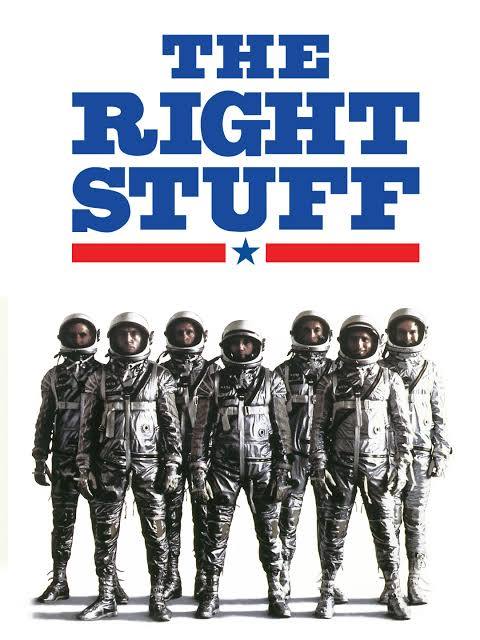
The Right Stuff

Ever wonder what happens when you take a bunch of cocky test pilots, stuff them into experimental aircraft, and tell them to push the limits of human possibility? Well, “The Right Stuff” has your answer, and spoiler alert: it involves a lot of sonic booms and even more swagger.

Based on Tom Wolfe’s bestselling book, this epic chronicles the birth of America’s space program, starting with the sound barrier-breaking exploits of test pilots at Edwards Air Force Base and culminating in the Mercury space program. At its heart is Chuck Yeager (Sam Shepard), the quintessential test pilot who treats breaking the sound barrier like it’s just another day at the office (which, for him, it kind of was).

Enter the Mercury Seven astronauts, led by John Glenn (Ed Harris, sporting a smile that could power a spacecraft) and Gordon Cooper (Dennis Quaid, whose cocky grin should have its own credit). These guys go from being hotshot pilots to America’s first astronauts, though the transition isn’t exactly smooth. Think of it as going from being cowboys of the sky to being spam in a can, as some of them put it.

The film brilliantly captures the absurdity of early spaceflight preparation. Want to be an astronaut? Great! Just let us stick every possible medical instrument into every possible orifice, spin you around until you’re ready to redecorate the centrifuge, and then parade you in front of the press like circus animals. All while your wives (including a stellar Pamela Reed as Trudy Cooper) maintain perfect hair and picture-perfect smiles for the cameras.

Director Philip Kaufman weaves together multiple storylines with the skill of a master storyteller. We bounce between Yeager’s continuing adventures pushing the envelope at Edwards, the Mercury astronauts’ training and missions, and the political circus surrounding the space race. The film manages to be both intimately personal and grandly historical, showing us both the men behind the headlines and the massive governmental machine that turned them into American icons.

What really sets “The Right Stuff” apart is its sense of humor about the whole enterprise. Yes, these men were heroes, but they were also gloriously human. The film captures their competitiveness, their fears, their family struggles, and their occasional bouts of what Tom Wolfe called “maintaining the zipper-down reputation.” It’s three hours and thirteen minutes of American history that never feels like a history lesson.

The Review Stuff:

What Works:

  • The cast is phenomenal across the board, with Sam Shepard’s laconic Yeager and Ed Harris’s earnest Glenn being particular standouts
  • The visual effects, despite being pre-CGI, are still impressive and give a visceral sense of what early test flights and space missions felt like
  • The script balances humor, drama, and historical accuracy with remarkable skill
  • Caleb Deschanel’s cinematography makes both the desert and space look equally magnificent
  • Bill Conti’s score soars as high as the aircraft it accompanies

What Doesn’t:

  • At over three hours, the film can feel a bit long-winded in places
  • Some of the supporting characters get lost in the shuffle
  • The political context of the space race with the Soviets feels somewhat underdeveloped
  • A few of the effects sequences haven’t aged as well as others

The Verdict:
“The Right Stuff” is that rare historical epic that manages to be both informative and entertaining, reverential and irreverent. It’s a testament to both human achievement and human folly, showing us heroes who were all too human and humans who became heroes. While it might be a bit too long for some viewers, it’s a journey worth taking, especially for anyone interested in aviation, space exploration, or just damn good filmmaking.

Rating: 4.5 out of 5 sonic booms

P.S. Keep an eye out for the running gag about the mysterious test pilot deaths being explained away as “crashes into the side of a mountain.” It’s both darkly funny and historically accurate – the government’s go-to explanation for classified mishaps during the Cold War era.

Amadeus

Amadeus: When God’s Favorite Composer Was His Least Favorite Human

Meet Antonio Salieri, a man who had the misfortune of being a pretty good composer in the same era as a certifiable genius. It’s like being a decent amateur juggler who has to follow someone juggling chainsaws while riding a unicycle. Blindfolded.

The film opens with elderly Salieri (F. Murray Abraham) attempting suicide while screaming apologies to Mozart for murdering him. This leads to him being committed to an asylum, where he tells his story to a young priest who probably wasn’t expecting his day to include a feature-length confession about musical jealousy and divine betrayal.

Through Salieri’s incredibly biased narration, we meet Wolfgang Amadeus Mozart (Tom Hulce), whose laugh sounds like a hyena that just discovered nitrous oxide. Mozart arrives in Vienna as the most talented brat in musical history – a genius composer who also happens to be a giggling, cursing, drinking manchild with a thing for potty humor. Imagine if you combined Einstein’s brain with a frat boy’s personality, then gave him a wig.

Salieri, who has dedicated his life to God and music (in that order), can’t handle the fact that the Almighty has chosen to give his divine gift to this “obscene child.” It’s like watching someone who spent decades practicing their craft get upstaged by a natural talent who doesn’t even bother to warm up. Mozart composes masterpieces the way most people doodle – without effort and often while doing something else entirely.

The film follows Mozart’s career in Vienna, where he manages to offend pretty much everyone who could help his career. He’s commissioned to write an opera, and decides the perfect subject would be a comedy about life in a harem, because nothing says “court approval” like sexual innuendo in Turkish costumes. Meanwhile, Salieri plots Mozart’s downfall while simultaneously being the only person who truly appreciates the genius he’s trying to destroy.

Mozart’s life starts to unravel faster than a cheap wig. His father dies (appearing later as a terrifying figure in a mask to commission the Requiem), his wife Constanze (Elizabeth Berridge) leaves him, and he’s reduced to teaching piano lessons to “squealing children” for money. Salieri, seeing his chance, disguises himself as Mozart’s dead father and commissions a Requiem Mass, planning to steal it and reveal it as his own composition at Mozart’s funeral – because nothing says “mentally stable” like planning to premiere your stolen masterpiece over your rival’s dead body.

The film builds to Mozart racing against time and his own deteriorating health to complete the Requiem, while Salieri pretends to help him while actually helping him die faster. It all culminates in one of cinema’s greatest sequences, as Mozart dictates his Requiem from his deathbed to Salieri, who writes it down while probably thinking “I could have written this… okay, no I couldn’t.”

The Verdict

What I Love:

  • F. Murray Abraham making musical jealousy into high art
  • Tom Hulce’s laugh, which should have gotten its own Oscar nomination
  • The most beautiful soundtrack in film history (thanks, Wolfgang)
  • Costume design that makes modern fashion weeks look understated
  • Miloš Forman’s direction making classical music sexy before it was cool

What Could’ve Been Better:

  • Might make you feel bad about quitting those piano lessons
  • Will definitely affect your ability to listen to “Eine Kleine Nachtmusik” without giggling
  • Could make you question every gift you thought God gave you

“Amadeus” is less about historical accuracy and more about the agony of being second-best in a field you’ve dedicated your life to. It’s like a sports movie where the antagonist is the narrator, God is the referee, and Mozart is that guy who shows up without training and breaks all the records.

Rating: 5 out of 5 powdered wigs

P.S. – After watching this, you might want to listen to Mozart’s Requiem. Just don’t commission one yourself.

Taxi Driver

Ever had insomnia so bad you decided to become a taxi driver and slowly descend into violent psychosis? Meet Travis Bickle (Robert De Niro), a Vietnam vet whose idea of a self-improvement program makes Fight Club look like a mindfulness retreat.

Travis takes a job driving a taxi on New York’s night shift, which in 1976 was about as relaxing as being a rodeo clown with vertigo. He cruises through a Times Square that makes modern-day Times Square look like Disneyland, carrying passengers that would make an Uber driver’s one-star reviews seem quaint. His journal entries reveal a man who sees the city as a cesspool that needs cleaning, though his idea of urban renewal involves significantly more ammunition than most city planners would recommend.

Our sleep-deprived protagonist becomes fixated on two women: Betsy (Cybill Shepherd), a campaign worker for presidential candidate Charles Palantine, and Iris (Jodie Foster), a 12-year-old prostitute. Because nothing says “I’m totally stable” like taking your first date to a Swedish porn film, Travis manages to spectacularly bomb his chances with Betsy faster than you can say “poor choice of venue.” Pro tip: X-rated movies are generally not considered first-date material, unless you’re dating a film critic with very specific interests.

Meanwhile, Travis’s mental state deteriorates faster than a sandwich left in a hot cab. He starts working out, buying illegal guns from sketchy salesmen (played by Steven Prince, who probably didn’t have to act much), and practicing quick-draws in front of his mirror while delivering the now-iconic “You talkin’ to me?” monologue – which, by the way, is the worst self-help affirmation ever.

His apartment turns into what would happen if an army surplus store had a baby with a pharmacy’s worth of uppers. He straps a gun to his arm using a homemade sliding mechanism that would make Q Branch jealous, shaves his hair into a mohawk that would give any barber PTSD, and generally transforms himself into a one-man army whose recruiting officer really should have checked references.

The plot accelerates when Travis fixates on “saving” Iris from her pimp, Sport (Harvey Keitel, rocking a wardrobe that makes most disco outfits look understated). He also decides that presidential candidate Palantine needs to be assassinated, because nothing says “I’m helping” like attempting to shoot a politician. When that plan fails – turns out Secret Service agents don’t appreciate mohawked guys reaching for their pockets – Travis redirects his violent salvation complex toward Sport and Iris’s other exploiters.

The finale explodes into one of cinema’s most notorious bloodbaths, as Travis storms the brothel in a scene that makes The Shining look like a real estate walkthrough. He eliminates Sport, the hotel manager, and Iris’s client in a sequence that’s both horrifying and weirdly balletic, if your idea of ballet involves multiple gunshot wounds. Travis himself is shot several times but keeps going, demonstrating that crazy beats bullets every time.

The film’s coda is a masterpiece of irony: Travis survives and is hailed as a hero by the media for saving Iris. We see him back at work, now famous among his fellow cabbies, even getting a fare from Betsy who seems impressed by his newfound notoriety. But that final look in his rearview mirror suggests that New York’s most unstable cabbie hasn’t exactly found inner peace.

The Verdict

What I Love:

  • De Niro’s performance, which makes other method actors look like they’re doing dinner theater
  • The grimy portrayal of 1970s New York that makes modern tourists seem adorably naive
  • Bernard Herrmann’s last and possibly greatest score, which sounds like jazz having a nervous breakdown
  • Paul Schrader’s script that reads like Dostoevsky after three days without sleep
  • Michael Chapman’s cinematography that makes you want to take a shower, but in a good way

What Could’ve Been Better:

  • Might make you reconsider using ride-share services
  • Will definitely make you suspicious of anyone who owns multiple guns and hair clippers
  • Could affect tourism to New York (though modern Times Square has done that anyway)

“Taxi Driver” is a masterpiece that manages to be both a character study and a slap in the face to anyone who thinks mental health services are adequately funded. It’s like watching a train wreck if the train were consciousness itself, and the track were society’s failed support systems.

Rating: 5 out of 5 possibly imagined cab fares

P.S. – After watching this, you might want to take the bus for a while.